
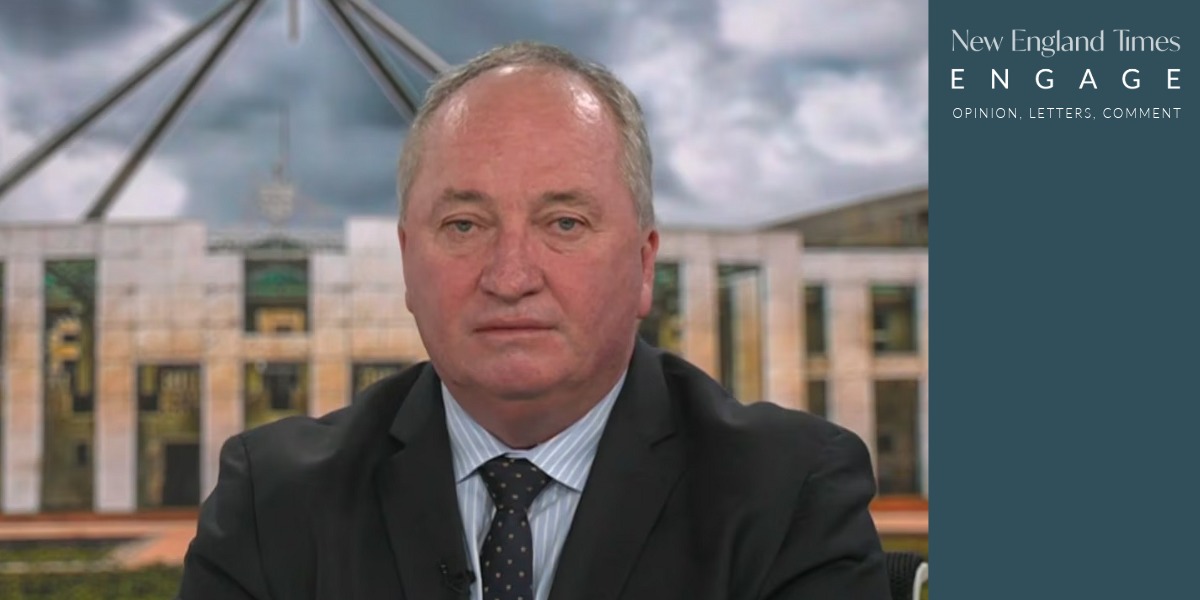
There are moments in politics when a single comment tells you everything you need to know about a person’s character.
This week, Barnaby Joyce failed the schoolyard bully test spectacularly.
His remark that he “never knew there were that many people with walking sticks” in relation to the NDIS was not merely clumsy. It was ignorant, mean-spirited and profoundly revealing. It exposed a breathtaking misunderstanding of disability and the daily realities faced by millions of Australians.
The tragedy is that Joyce appears to believe disability should be visible. If he cannot see it, he seems unwilling to understand it.
The cruel irony is that Joyce’s comments perfectly illustrate the problem people living with disability face every day. Because their disability is not always visible, they are constantly confronted by people who assume they are exaggerating, exploiting the system or somehow less deserving of support. In a few careless words, Joyce became the embodiment of the prejudice he should have been condemning.
Disability is not defined by a wheelchair, a walking stick or any other stereotype. Autism, intellectual disability, psychosocial disability, neurological conditions, acquired brain injuries and chronic illnesses are often invisible to the casual observer. The challenges are real whether Barnaby Joyce can see them or not.
What is truly offensive is the implication behind his comments: that Australians living with disability should somehow have to prove themselves worthy of support. That they should justify their existence to politicians and taxpayers before receiving the assistance they need to live with dignity.
More troubling still was the implication lurking beneath Joyce’s remarks. When politicians express surprise at the number of people receiving disability support because they do not fit a visible stereotype, they inevitably invite suspicion about whether those people are genuinely entitled to assistance. Australians living with disability should not have to defend themselves against that kind of insinuation.
That is not the Australia most of us believe in.
The NDIS was created because Australians recognised a simple truth: disability should not condemn someone to exclusion, isolation or a life of limited opportunity. It reflects the belief that people living with disability deserve dignity, independence and the chance to participate fully in society. That principle should not be controversial. Yet Joyce’s comments suggest some politicians still do not understand it.
The NDIS is not charity – nor is it a handout.
It is one of the most significant social reforms in modern Australian history and reflects a simple belief that Australians living with disability deserve the same opportunities, dignity and independence as everyone else.
What makes Joyce’s comments particularly ugly is that they were directed at Australians who spend their lives battling barriers most politicians will never have to face. Not powerful corporations. Not vested interests. Not those with the means to look after themselves.
No. They were directed at people living with disability.
Families already carry enormous emotional, physical and financial burdens. Parents spend decades advocating for their children. Carers sacrifice careers, income and often their own health. Many lie awake at night wondering what will happen to their loved ones when they are no longer there to provide support.
Those realities are invisible. The exhaustion is invisible. The fear is invisible. The sacrifice is invisible. But they are no less real.
Joyce’s comments betray a mindset that sees Australians living with disability not as people with hopes, aspirations and potential, but as a cost to be counted and a burden to be justified. That is not fiscal responsibility. It is a failure of empathy.
It reflects a worldview that measures people by what they cost rather than what they contribute.
Most Australians instinctively understand something that Joyce appears not to: a person’s worth cannot be measured by the cost of supporting them.
A strong society is not judged by how it treats the wealthy, the powerful or the fortunate. It is judged by how it treats those who need support. It is judged by whether everyone gets a fair go.
That is why Australians should be appalled by Joyce’s comments.
People living with disability do not need lectures from politicians who do not understand their lives.
They do not need to justify their worth. They do not need to “look taxpayers in the eye.”
They are taxpayers. They are workers. They are students. They are parents, neighbours, friends and family members.
They are Australians.
And they deserve respect, dignity and support, not the ignorance and cruelty that Barnaby Joyce put on display this week.
His comments were not merely offensive. They were a reminder of the prejudice and misunderstanding that Australians living with disability confront every day.
When Barnaby Joyce looked at Australians living with disability, he thought he was judging them.
In reality, Australians were judging him.
And in that moment, Barnaby Joyce reduced himself from a former Deputy Prime Minister to little more than a schoolyard bully punching down on some of the most vulnerable Australians.
They saw a politician looking at Australians living with disability and asking what they cost rather than recognising what they are worth.
That is why his comments were not merely offensive.
They were shameful and unworthy of a former Deputy Prime Minister.

Denise McHugh is an experienced educator in Tamworth. She is Chair of the NSW ALP Education and Skills Committee and Deputy President of the Independent Education Union (IEU).
All opinion and comment on New England Times Engage is the opinion of the writer and not New England Times.
Got something on your mind? Go on then, engage. Submit your opinion piece, letter to the editor, or Quick Word now.
Leave a comment