
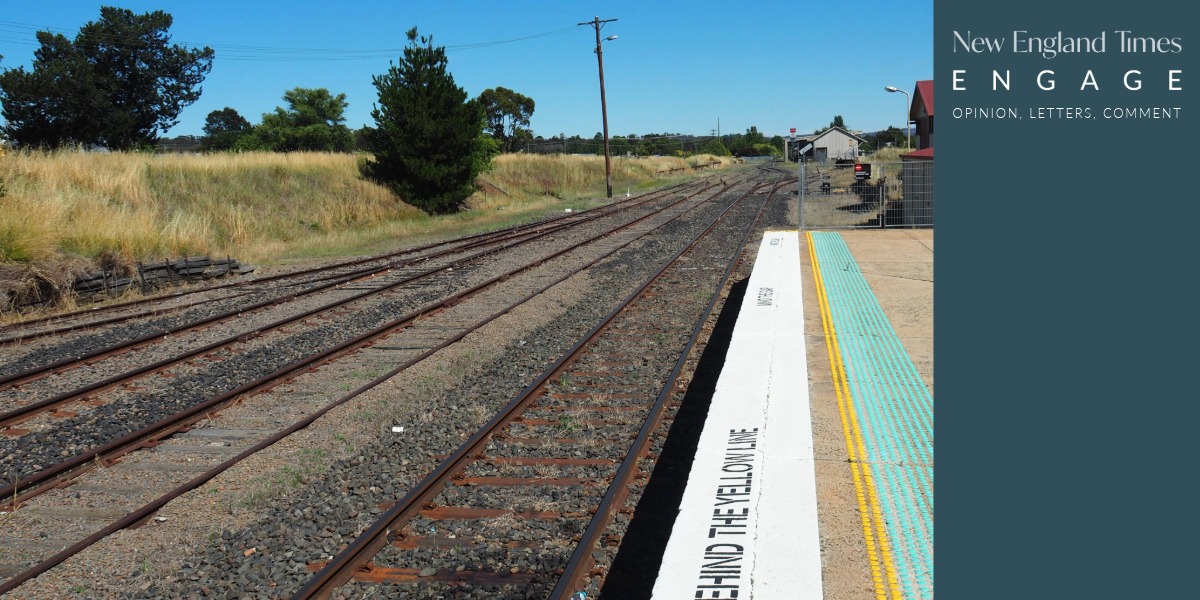
In 2024, a petition carrying more than 10,000 signatures was presented to the NSW Parliament calling for the reinstatement of passenger train services to the New England North region. During that parliamentary debate, the then State Member for New England, Adam Marshall, stated clearly: “No line has ever been drawn through the Great Northern Railway line.”
The Great Northern Line may currently be disused, but it has never been officially closed — a step that would require an Act of Parliament. That distinction matters.
For many in the region, the railway has never been abandoned in spirit. When services were withdrawn, communities did not quietly wave goodbye. They gathered on the platform at Armidale station in large numbers and protested the loss of their trains. Since that day, residents across New England have continued to advocate for the return of rail services. The trains may have stopped running, but community support for the line has not.
In recent years, some have spoken confidently — and repeatedly — that “the trains will not be back.” Yet during the 2024 parliamentary debate, there was no definitive statement from the government declaring the line permanently closed. Instead, the position expressed was that rail use had not been ruled out and that any reinstatement would require a proper business case supported by evidence.
That process of gathering evidence is now underway. Strategic transport documents, integrated regional transport planning, freight reform discussions and submissions to current inquiries are all contributing to the broader assessment of rail’s future, and how it will serve both state and country. The corridor remains a state asset, and any decision regarding its future rests with state decision-makers.
The Great Northern Line has previously been discussed as a potential complement to both Inland Rail and the coastal corridor for freight diversification. It is geographically unique in its capabilities to connect both Queensland and NSW together through a major federal transport route, this greatly adds to its potential to be redeveloped for future considerations. Whether or not that option proceeds, no formal “death sentence” has been handed down. No final ruling has been made against the possibility of trains returning.
At the same time, proposals to convert the corridor into a rail trail must also pass through extensive processes. Environmental studies, biosecurity management, community consultation, regulatory approvals, lease negotiations and funding applications are all required under the NSW Rail Trail Framework. Significant public funding would be needed, at a time when government budgets are tight and competing infrastructure priorities are many.
Rail trails elsewhere show that these projects can take years — even decades — to complete in full. They are not automatic outcomes simply because a rail line is currently unused. They require state approval and substantial investment.
There is also a third possibility: that neither trains nor trails proceed in the near term.
Ultimately, the decision rests with the NSW Government. The rail corridor is a state-owned asset, and its future use — whether for transport, recreation, freight diversification or continued preservation — will be determined at that level.
For now, speculation serves little purpose. No final decision has been made. The debate continues, evidence is being assembled, and policy processes are still unfolding.
The gavel has not fallen on the Great Northern Line. Until it does, the future of the corridor remains open.
All opinion and comment on New England Times Engage is the opinion of the writer and not New England Times.
Got something on your mind? Go on then, engage. Submit your opinion piece, letter to the editor, or Quick Word now.
Great summary Tanya. There are at the moment plans to reactivate line for heritage rail to Guyra and beyond and the local Heritage Rail group are going through the necessary requirements. Inclusive tourism. New England Railway Inc
It should be fully opened to QLD for freight and passengers, should never been closed.
The New England rail corridor reactivation is an excellent opportunity to achieve many objectives.
* Flood resistant alternative to the coastal route both rail and road.
* Connects Qld to all capitals and states using existing rail corridors. Backbone train connection.
* Provides future express train from Brisbane to Melbourne. 840km already upgraded from Melbourne to Narromine for inland rail.
* Saves 250kl of truck diesel daily attracting fed gov decarbonisation money. About ten return freight train trips daily.
* Boost local economies with train tourists, backpacker travellers, medical and student movements.
* Alternitive to the outer inland rail route at half the cost saving about a billion dollars. Outer IR route requires 400 km of new rail corridor. New England route is all existing corridor.
Average grade 1 in 40 average curve too sharp average speed too slow cost of rebuilding a total waste of money
What freight is going to go out if New England by rail. There’s no rail connection to the nearest port and distribution centre, Brisbane and none to the abbatoirs? The Pacific Highway was closed to flooding for a couple of days in the worst ever floods. They just used the New England.
You would have a great imagination to come up with such contrived arguments . The government has repeatedly told you it’s not going to take money from other far more pressing transport needs just to provide a train for a couple of small towns served by a perfectly good bid service that few locals use.
This is not about freight or even passenger rail. It’s just more noise to try and stop the community and tourists enjoying a rail trail that would destroy nothing except your lobby hobby.
Government has zero interest in rail pax outside Newcastle, Sydney and the Gong. Tracks that aren’t used for coal or steel get zero upgrades. I think you are tilting at windmills up there.
Check the rail maps with gradients and curves for this part of the line and you will see why the government shut the line .
It has one section that is 5km long with a 1 in 50 gradient (very steep for freight trains ). Lots of tight curves keep the trains very slow .
Oh I so wish for a modern alignment railway system rather than the old slow meandering steam age railway alignment was .
Getting trucks off our highways and workers out of cars requires much more than snail train .
Geoff Bensley Sydney to Newcastle has 1 in 40 grades, as has Sydney to Melbourne. The main west to Lithgow has 1 in 33 grades. The North Coast meanders around hills and rivers and has very few high speed sections. The old main north is looking pretty good in comparison. All are still a far more fuel efficient alternative than the thousands of trucks currently carrying much of the east coast freight and all of the freight in the New England region, regardless of how good the roads are.
Doug Erskine yes and the steep grades plus meandering alignments are why freight stays on our roads !
As our highways keep getting better with straighter alignments and lower gradients our railways stay on the same 1800s alignments .
We don’t need high speed rail but we do need modern alignment for speeds up to 160kmh .
Sydney Central Station to Casino Station takes more than 11hr 40m by train . By car is 8hr 30m with a stop .
Freight by rail in NSW on the Brisbane to Sydney route is less than 5% whereas Brisbane to Cairns is around 85%.
Good old slow train network in NSW running on steam age alignments is giving the trucking industry a huge win and is keeping workers in cars .
Too many slow train advocates with romantic steam age memories .
There are three realistic futures for the old rail corridor:
1. Passenger/freight trains return.
2. It becomes a rail trail.
3. Nothing happens and it stays dormant and rots.
Electrified rail would likely produce the biggest long-term benefit if it actually happened — better transport resilience, stronger regional connectivity, and potential economic uplift.
The problem is probability. Across NSW, reinstating long-closed regional passenger lines is rare. Without funded business cases or capital allocation, the chance in the next 15–20 years appears low and doesn’t improve further out.
A rail trail is far cheaper and politically easier. It delivers moderate benefits — tourism, recreation, low carbon transport, local amenity — and is therefore much more likely to occur.
Doing nothing preserves the corridor but produces no tangible benefit and gradually increases costs later on.
When you combine size of benefit with likelihood (the basic idea of “expected value”), the rail trail currently comes out ahead — not because it is better in principle, but because it is far more probable.
Rail becomes the rational bet if:
A. Its probability rises substantially (e.g., there serious funding commitment from feds/state in the near term), or
B. You believe a rail trail would cause long-term structural harm to the region.
There’s no reason to believe that either of these are true.
At some point a decision has to be made, we cannot keep defaulting to “option C” in the hope of a “better future”: In the cold
light of day, the rail trail is the best compromise.
As far as transporting freight to Queensland is concerned, it would be like going back to the old days when it was necessary to change over to the Qld trains at the Border as there is no standard gauge track from Wallangarra to Brisbane. Sure, a lot of freight is now carried in containers but it certainly wouldn’t be a quick job.
I would imagine there are too many valid reasons why the line will never be opened for rail traffic.
Should we use steam, diesel or electricity?
The government will decide when the line will be reopened for rail those that huff and puff that it won’t need help, besides this proposal that running a bike track through Guyra will revitalise the whole area in so much that the return from it that Guyra will be likened to Queenstown NZ due cyclists in their thousands that just can’t get enough of the place. Along with farmers selling cream teas over the back fence to passing cyclists will be such a boost to their pastoral interests it will be likened to another wool boom.
If fact these cyclists will be so cashed up the odd 50-60 million it will cost it will pay for itself in no time, but hang on to your hats once the word gets out it will need extending to Tenterfield to make room for the amount of bed and breakfasts being planned along the way. There is a catch though for as our towns are running out of water make sure to bring plenty.