
Most of the conversation around AI and marketing is missing the point.
It’s focused on the technology, not on what’s actually changing.
For years, businesses have been able to rely on content that sounds right. It’s been well written, keyword friendly, and consistent. But not necessarily useful.
Now that people are asking better questions, and increasingly getting direct answers, that kind of content is starting to fall away. Not because it’s bad, but because it doesn’t actually help anyone.
We finally got used to SEO. Now the rules are shifting again.
For years, businesses were told to focus on keywords, publish regularly, and structure their websites properly. That still matters. But it’s no longer the whole picture.
Search behaviour has changed.
People aren’t just typing in keywords like “hydraulic services Armidale”. They’re asking full questions. Can I run an auger without a tractor? What’s the best setup for fencing on uneven ground? Do I actually need this?
And increasingly, they’re not just getting links. They’re getting answers.
Which means the game has shifted from ranking pages to being the answer.
A regional New England business created a case study around a very specific question: can you run an auger without a tractor?
Instead of producing a generic service page, they showed the problem, explained the custom solution, and demonstrated how it works in practice. Now, when people search that question, the content doesn’t just sit on a website.It shows up as part of the answer.
Not because it’s technically clever, but because it’s clear, specific, and based on real work.
Here’s what that looks like in practice.
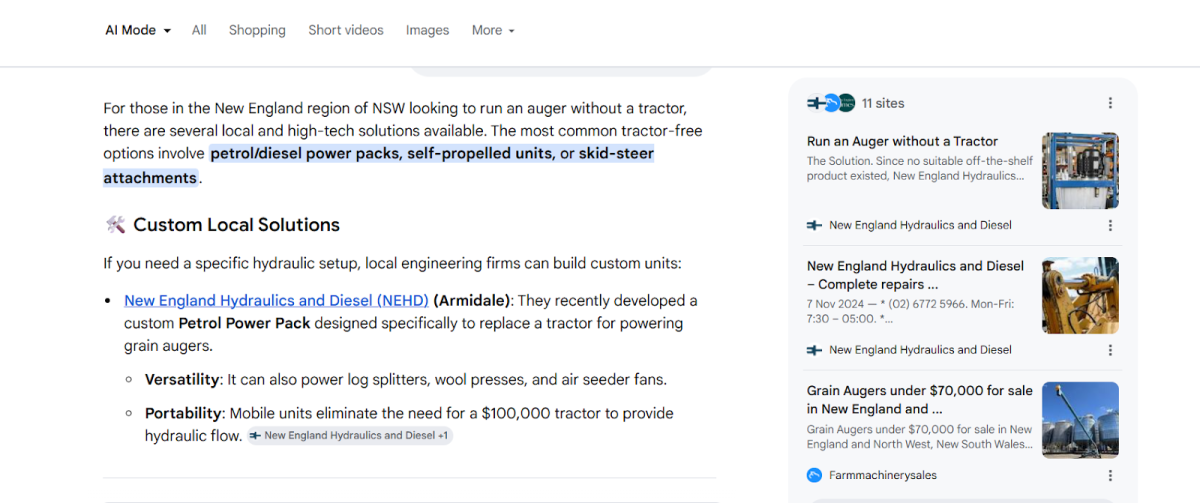
Even with a less specific search for an auger in New England NSW will prioritise the detailed, contextual content in the site suggestions next to the AI summary.
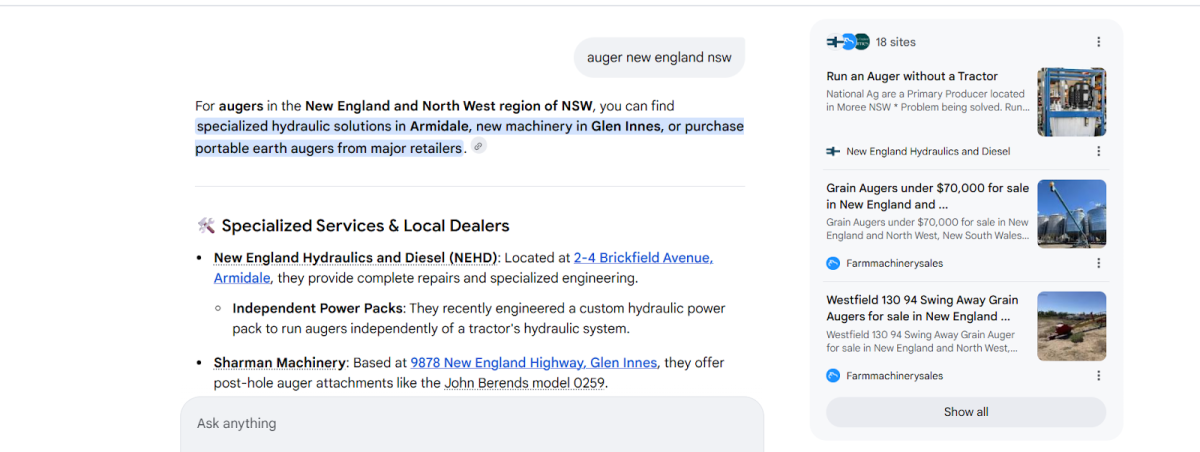
That’s the difference. Not more content. Not better design. Clearer thinking.
A similar pattern shows up in completely different industries.
A physio clinic wanted to position themselves as the go-to for over 50s, The obvious approach would have been to update the website, talk about their experience, and highlight services they offer.
Instead, they focused on the questions their clients were actually asking. Why does this pain keep coming back? Is this just age, or something I can fix? What can I safely keep doing?
They created content that answered those questions directly. It wasn’t overly polished or technical. Not overly polished. It was simply clear.
Over time, that content started doing the heavy lifting. It built trust before someone even made contact, it was shared on socials, and it showed up in search.
The platform wasn’t the deciding factor. The question was.
Each platform still rewards something slightly different. Facebook tends to reward consistency, engagement, and frequency. SEO has traditionally rewarded structure, keywords, authority over time.
What’s happening now with AI search is about your content being picked up and used in a really powerful way, presenting your information as the answer to the question.
Like the auger example, the case study becomes part of the answer, not just another search result.
Your content isn’t just shown to people. It’s picked up and used to answer their questions.
For a long time, marketing has been about visibility. Getting in front of people, staying top of mind, and showing up often enough to be remembered. That still has a place.
But now content is increasingly being selected based on whether it helps someone do something or understand something. Not how polished it sounds. Not how often you post. Whether it’s actually useful.
This is where a lot of businesses get caught.
They’re producing content that sounds right. “We offer quality service.” “We pride ourselves on reliability.” “We deliver tailored solutions.”
It reads well. It just doesn’t help anyone make a decision.
A more useful way to think about it is to change the question.
Instead of asking what should we post, ask what do our customers need help understanding.
That shift sounds small, but it changes everything. You move from general statements to specific explanations, from broad claims to real examples, and from sounding right to being useful.
Long-form content is back
This is also where long-form content starts to make more sense.
Not because it’s longer, but because it gives you space to actually explain something properly. To show how it works, and to show that it works.
A short post might last a few days. A well-written case study or article can keep working for months, even years. It can show up in search, be used to answer questions, support sales conversations, and be broken down into smaller pieces over time.
It isn’t just content. It’s an asset. It keeps working because it actually explains something properly.
Generic marketing says post more, do SEO, and stay consistent. What’s emerging now is different. Answer the right questions properly, show real examples, and make it easy for people to understand and act.
That’s the shift. Not more content. Better, clearer answers.
Most businesses don’t have a content problem. They have a clarity problem.
And the ones who solve that won’t need more marketing.
They’ll need less of it, because it will actually work.

Ingrid Rothe is a brand strategist and founder of Vivid Thinking, working with regional businesses to bring clarity to their marketing. She focuses on getting the thinking right first, so everything that follows works harder and lasts longer.
Marketing Clarity is Ingrid’s regular column.
Got something on your mind? Go on then, engage. Submit your opinion piece, letter to the editor, or Quick Word now.