

In our latest Engage Poll, the Big Shifting Issues Survey, the question of whether New England should become its own state has created some unexpected chatter.
Although some were genuinely unaware New England Statehood was ever a thing… the real surprise isn’t that people support the idea of a New England state, or that this might be something to consider. The surprise is that anyone thought the idea had gone away.
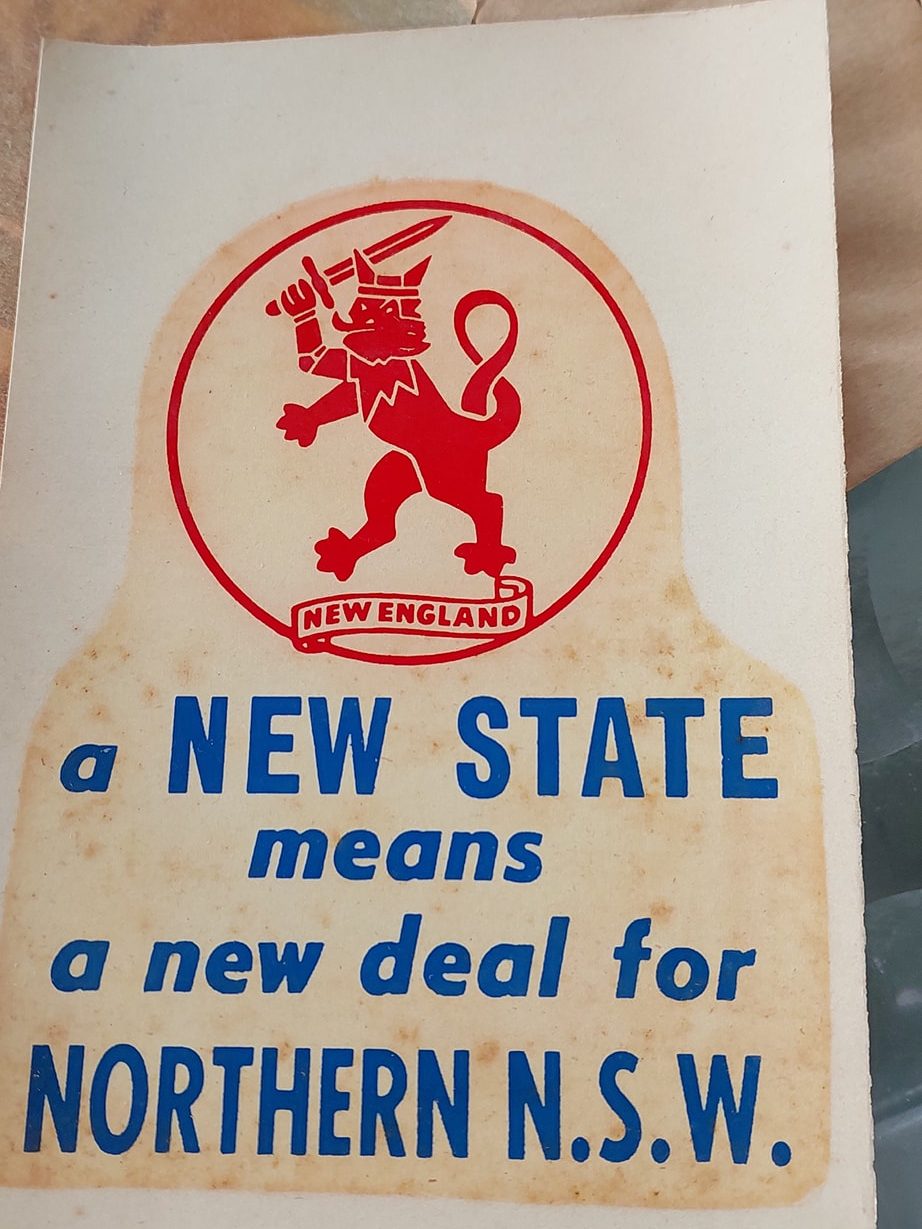
There’s still a Facebook group, albeit no real leadership in the movement, and significant organisation would be required to really fire things up. (And preferably a new flag… the original one above was so very… English.) But for something supposedly consigned to history, this issue does tend to resurface whenever the gap between what regional communities need and what they get becomes painful.
And right now, that gap is overwhelmingly impossible to ignore.
This issue was not selected for this survey because any personal favour, it was selected because we were seeing it mentioned in the social media and other chatter we monitor, not least of which was a recent post by Barnaby Joyce in relation to the NSW gun law reform last December, where he called for the issue to be revisited.
(Yes I know. This makes two things I agree with Barnaby on – the other being decentralisation of government functions. Must put a stop to that, it’ll ruin his reputation.)
This is not really a debate about identity or nostalgia. It is about failure. Systemic, repeated failure from a state government geared towards Newcastle, Sydney, Wollongong, that routinely consigns the rest of the state to a mere annoyance that should just shut up and be a nice quarry for the real people in the city.
Call it neglect. Call it political reality. But do not pretend it is working.
The real issue is simple: Northern NSW is governed by a system that does not even understand it let alone care about it. When a political staffer in Sydney can assert that services in Newcastle are “regional” and servicing the New England hundreds of kilometres away, you are not dealing with a misunderstanding. You are dealing with a worldview so detached from reality that it cannot be corrected with polite emails.
At some point, the question stops being “how do we fix this?” and becomes “why are we still part of it?”
Why do we keep fighting Sydney? Why don’t we just cut them off?
This is a proud region that produces energy, food, and renewable power at a scale that props up the broader state economy. We can keep the gas and coal from Narrabri and Gunnedah, renewable power generation across the tablelands and slopes, and enormous agricultural output feeding national and export markets, and some of the worlds best tourist spots, all for ourselves.
At the moment, the value is generated here, but the decision-making stays elsewhere.
That’s just broken.
A separate state would not magically fix everything, but it would change the priorities and the decisions. Revenue raised here could be spent here. Infrastructure priorities would be set by people who use it. Health, transport and education planning would reflect regional realities. We might even give ourselves some decent public transport.
The historical evidence is instructive. The 1967 referendum did not fail because New England rejected statehood. Across New England and the Northern Rivers, support was strong. In Armidale, Tenterfield, Lismore and Clarence, the “yes” vote was decisive.
What killed it was Newcastle.
By forcing a fundamentally different region into the same proposed state, the movement created a built-in opposition bloc large enough to defeat it. The further north you went, the stronger the support. The further into the Hunter, the stronger the resistance.
That was not coincidence. It was a strategic error. Possibly a deliberate strategy of our southern overlords to make sure it failed.
Other federations do not insist new states must be built around major cities with large ports. The United States and Canada are full of smaller, regional jurisdictions that function perfectly well. The argument that Newcastle must be in the new state must was a political compromise, and a fatal one.
Fix that mistake, and the equation changes.
Although there is another truth likely to make some in Sydney (and Canberra) squirm: if the Hunter were allowed to keep its coal industry, rather than being sacrificed on the altar of national energy transition, the voting dynamics might look very different. The Hunter may vote ‘yes’ should the question be put again.
Critics will point to cost. Establishing a new state is expensive.
But delaying it does not make it cheaper. It makes it harder.
Every year entrenches the imbalance further. Every funding model and policy setting assumes the structure will remain. If there is a moment to reconsider it, it is when the cracks are visible. Now would be good.
The case for a New England state today is practical and urgent. Roads connecting inland communities to the coast have deteriorated to the point they are frequently unusable. Investment decisions are made hundreds of kilometres away by people who will never use the infrastructure has ensured that we never get the infrastructure we need. Our communities are starved of everything from health services to police, because Sydney does not give a flying proverbial about us.
There may also be more appetite for change than one may assume. In Canberra, breaking up the concentration of power in New South Wales is not unthinkable.
Even in Sydney, there would be those who would quietly welcome shedding regions that are politically difficult and expensive to service. Lismore and its floods, for example, are pesky things to deal with in Macquarie Street; they don’t see the beautiful communities that have been let down by repeated government failures, and keep picking themselves up over and over again, they just see cost.
New England and the North Coast are not marginal outposts. It is a dynamic and vibrant part of the world with abundant industry, resources, institutions, and a strong sense of itself. We have inspiring enterprises, exporters, natural assets, thought leaders, great people, and communities that have demonstrated resilience time and again.
What we do not have is control.
We don’t need Sydney. We do need to recognise that the current arrangement is not delivering and that incremental fixes have not solved the problem. And it’s getting worse, not better, possibly beyond the point of no return.
We need to be honest that the radical option is starting to look like the right option.
End rant.

Dr RK (Kath) Crosby is the CEO of research and strategy company KORE CSR, former strategist for the Australian Democrats, and holds a PhD in political behaviour. She is also a well known migraine and health advocate, and the Publisher of New England Times and North Coast Times.
Got something on your mind? Go on then, engage. Submit your opinion piece, letter to the editor, or Quick Word now.