
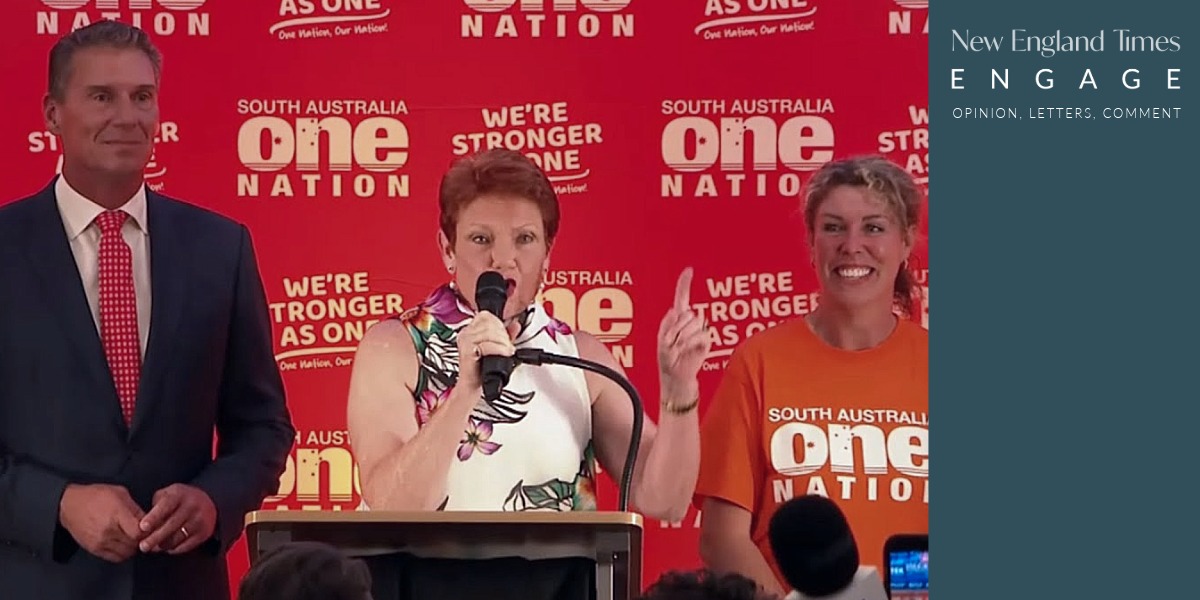
The South Australian election result has already been seized on as evidence of a One Nation surge. That is only half the story — and not the most important half.
Labor didn’t just win — it delivered the largest victory in the state’s history. Even with a small dip in its primary vote, support across the broader progressive vote actually grew, with the Greens recording a significant increase.
At the same time, One Nation’s lift — including the possibility of picking up a small number of seats — looks less like a breakthrough and more like a symptom. Much of that vote came out of a collapsing Liberal base, particularly in areas where the Coalition once held firm.
In traditionally Liberal, higher-education electorates, voters shifted toward Labor. In more economically strained outer areas, frustration flowed toward One Nation. This is not a unified movement — it is a right-wing vote splitting under pressure.
That matters.
Because while the headlines focus on protest votes, the underlying result points to something more consequential: Labor’s base remains solid, and instability on the right is pushing moderate voters toward the centre rather than away from it.
The past few weeks have also been a reminder of how quickly global instability can reach Australian households. Rising fuel prices and supply fears have followed escalating tensions in the Middle East, while the unpredictability of international politics — with Trump running riot — has again injected uncertainty into the global economy.
Events like these create anxiety. They raise real concerns about the cost of living, energy security and whether governments are prepared for shocks that originate far beyond Australia’s borders.
That is the environment in which protest politics grows.
When people feel the system is not working — when wages are stretched, services are under pressure and the future looks uncertain — frustration looks for somewhere to go. In Australia, that outlet has often been Pauline Hanson and One Nation.
But the South Australian result is a reminder of something important: being noticed is not the same as being trusted.
The Coalition’s ongoing dysfunction — particularly the instability within the Nationals — has only deepened that dissatisfaction, leaving many voters questioning whether the opposition is capable of presenting a coherent alternative government.
When major parties are consumed by internal division, space opens up.
But space alone is not a mandate.
At a federal level, the contrast remains clear. Whatever criticisms are made of the government, Labor at present appears comparatively united and stable. In uncertain times, that matters more than political noise.
Many Australians, myself included, will simply never vote for One Nation. The party’s long record of inflammatory rhetoric, political stunts and overtly racist statements places it outside the bounds of acceptable politics for a significant share of the electorate.
That judgement is not based on rhetoric alone. It is also grounded in the party’s record. For all the talk about standing up for ordinary Australians, One Nation’s voting history has too often run in the opposite direction — opposing measures aimed at lifting wages, strengthening worker protections and investing in the public services those same communities rely on.
Yet frustration still creates the conditions in which it can grow.
One Nation presents itself as the vehicle for that anger — the party that will “shake up the system” and say what others will not.
It is a message that cuts through.
But saying the words is the easy part.
Pauline Hanson herself has said she has laid “landmines” in the political system — which tells you everything you need to know. This is not a project focused on solutions. It is a strategy built on disruption.
Governing is the hard part — and that is where it falls apart.
The challenges facing regional Australia are real: cost of living pressures, access to health services, workforce shortages, infrastructure gaps and the long-term sustainability of rural industries.
Those frustrations deserve serious attention.
But the question voters should always ask is simple: what actually changes if protest politics succeeds?
One Nation has been part of Australia’s political landscape for decades. It has proven highly effective at generating headlines and amplifying grievance.
What it has not demonstrated is a consistent ability to turn that into outcomes.
That is the pattern of protest parties everywhere. They thrive on dissatisfaction with the system but rarely show they can work within it to deliver change.
The South Australian result is not an endorsement of solutions. It is an expression of frustration — and a warning sign for a divided conservative side of politics.
Frustration, left unaddressed, will keep finding outlets.
But voting out of anger is not the same as voting for answers.
Regional Australia’s challenges are complex. They require serious policy, steady leadership and a willingness to do the hard, often unglamorous work of governing.
Shouting at the system might feel satisfying. Fixing it requires something else entirely.
Discontent may create the conditions in which One Nation gains attention. But if voters are looking for real answers — rather than protest slogans — it is unlikely to provide them.

Denise McHugh is an experienced educator in Tamworth. She is Chair of the NSW ALP Education and Skills Committee and Deputy President of the Independent Education Union (IEU).
All opinion and comment on New England Times Engage is the opinion of the writer and not New England Times.
Got something on your mind? Go on then, engage. Submit your opinion piece, letter to the editor, or Quick Word now.
“The challenges facing regional Australia are real: cost of living pressures, access to health services, workforce shortages, infrastructure gaps and the long-term sustainability of rural industries.” … “Regional Australia’s challenges are complex. They require serious policy, steady leadership and a willingness to do the hard, often unglamorous work of governing.”
I agree with what is written BUT I wish the above was where the focus was, instead of Ms Hanson.
We get it, One Nation will never form Government. How many times do we need to read and hear this. Let’s get over the fact that One Nation voters think differently, let them.
So let’s get on with hounding our State and Federal Governments into tackling the issues. Let’s stop getting sucked into the distraction and fuelling more division. Let’s focus on what help we need out here in the regions. That brings us all together as voters … more focus on the issues and less focus on tribal acrimony. Ms Hanson and Mr Joyce want tribal fighting; their whole politics is based on this. So, let’s change it up. It would probably shock the pants of us all to find out we share common ground about how we improve everyone’s lives.
In the middle of an energy crisis, why on earth should we waste our personal energy on One Nation, especially when this opinion and other similar ones keep telling us One Nation are going nowhere …
Good point Annabel and I will take it on the chin. I agree that we need more discussion about what is happening rather than political argy bargy. Everything is contextual and this piece was written before the SA election, and all the talk was on a One Nation resurgence.
But to your point. I actually agree with the broad point you make: regional Australia does not need more political argy bargy. It needs delivery.
Cost of living is biting. Health access is patchy. Housing is tight. Workforce shortages are hollowing out services. And right now, on top of all of that, people are understandably worried about fuel, energy and whether this country is actually prepared for a proper supply shock.
So yes — let’s talk about policy. But if we are going to do that honestly, then we also need to stop pretending that One Nation is somehow part of the answer, which many people do and why I write about them.
Because this is the thing about protest parties: they are very good at identifying anger, but much less useful when it comes to the hard, boring, deeply unsexy work of actually governing. And governing is exactly what is required right now.
Take the current fuel and energy crisis. It requires governments to do the practical work of securing supply, cushioning the shock, and making sure the country does not get caught flat-footed.
And that is exactly what the Albanese Government has been doing.
It has moved on fuel excise relief to ease immediate pain at the bowser. It has put in place a national fuel security response. It has worked to secure additional imports and stabilise supply. It has brought more transparency to stock levels. And importantly, it has now rolled out a $1 billion interest-free loan scheme for businesses hit hardest by the fuel crisis — including transport, freight, fertiliser and other critical supply chain businesses. That is not symbolism. That is direct economic support aimed at keeping essential parts of the economy moving when global conditions go sideways.
That matters — especially in the regions.
Because fuel insecurity does not just mean expensive petrol. It means freight pressure, higher food costs, pressure on farmers, higher transport costs, pressure on local business, and real risk to the industries regional communities rely on.
And while all of that is happening, Labor is also doing the longer-term work that should have been taken seriously years ago: trying to make Australia less vulnerable in the first place.
That means building a more resilient energy system, strengthening supply chains, backing domestic capability, improving transmission, and finally accepting that “just hope the market sorts it out” is not an energy policy.
At the same time, there has also been real movement on the broader pressures.
At the federal level, Labor has delivered energy bill rebates, cheaper childcare, cheaper medicines, bulk billing incentives, urgent care clinics, Fee-Free TAFE, housing investment, and support for regional roads and infrastructure.
At the NSW level, the Minns Government has put money into regional health worker incentives, public preschools, teacher attraction, TAFE, hospital staffing, and regional infrastructure that communities actually use.
At the same time the wheels of government continue to roll with no fuss. That is no small feat.
Is it enough? No. Is it perfect? Also no. But it is real.
And that is where One Nation comes unstuck.
Because if they want to present themselves as the voice of “forgotten Australians”, then they should also be judged on whether they support the kinds of policies that would actually take pressure off those Australians.
Too often, they do not.
One Nation loves to pose as the party of “ordinary Australians,” but when it comes to actual votes, the record is far less heroic: they opposed Labor’s Housing Australia Future Fund, which was designed to fund social and affordable housing, including for women, children and veterans in acute need, and they also opposed Help to Buy, a shared-equity scheme aimed at helping low and middle-income Australians into home ownership. They have also attacked or opposed broader cost-of-living measures like expanded childcare support, despite the obvious fact that cheaper childcare is one of the biggest practical things government can do to help working families stay afloat.
Beyond housing and childcare, they have also opposed or attacked measures like cheaper medicines, 60-day dispensing for people with chronic illness, expanded Medicare bulk-billing investment, and elements of paid parental leave and women’s economic security reforms. They have also positioned themselves against parts of Labor’s broader skills, housing and energy transition agenda.
That’s the pattern with One Nation — endless speeches about pressure on “ordinary people,” then a voting record that lands on the side of blocking the very measures that might actually relieve it.
So yes — I agree that the conversation should be less about political argy bargy and more about who is delivering.
But ignoring One Nation and not calling them out on their record gets nowhere either. If a party wants to claim it speaks for ordinary Australians, then it should be judged on whether it backs the policies that would actually make ordinary Australians’ lives easier. And too often, One Nation does not.
I also just read in the New England Times that the Albanese Government will fast-track $6.15 billion in concessional finance to support Australian businesses facing ongoing global disruptions, with a focus on strengthening supply chains and boosting domestic production.