
I’m not generally a big fan of gender theory, all those masculinities and femininities has never been my preferred way of seeing the world. But I’m enough of a social scientist to be able to see your heuristics and raise you a normative construct, and admit there are times when a critical gender lens isn’t just useful, it’s necessary.
Like for example, when considering the Draft Armidale City Centre Vitality Plan.
You don’t even have to read the plan. Just flip through it. Here’s a couple of pages to make it easier.
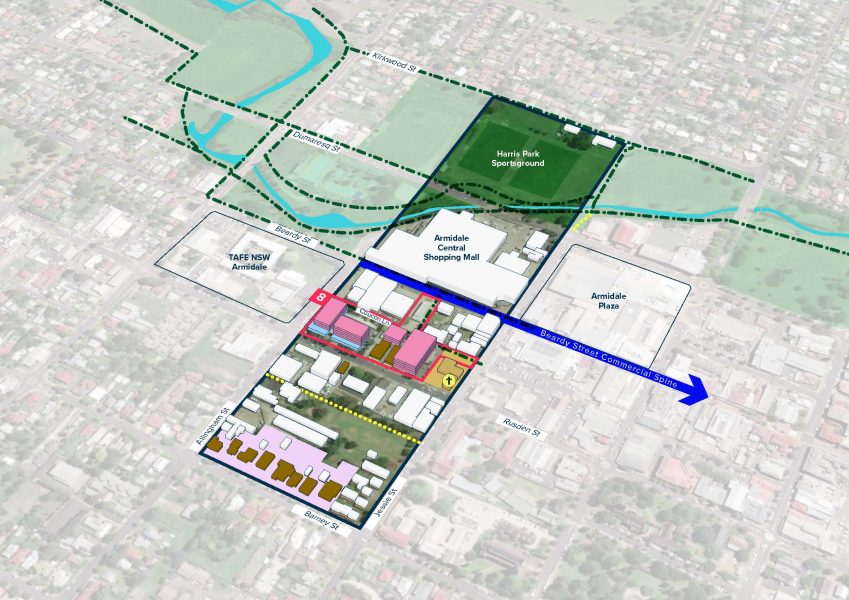
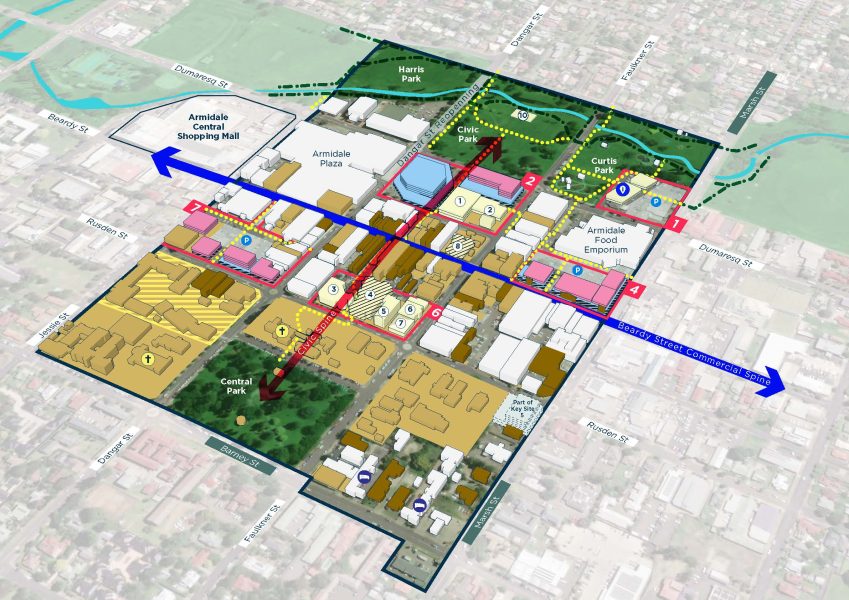
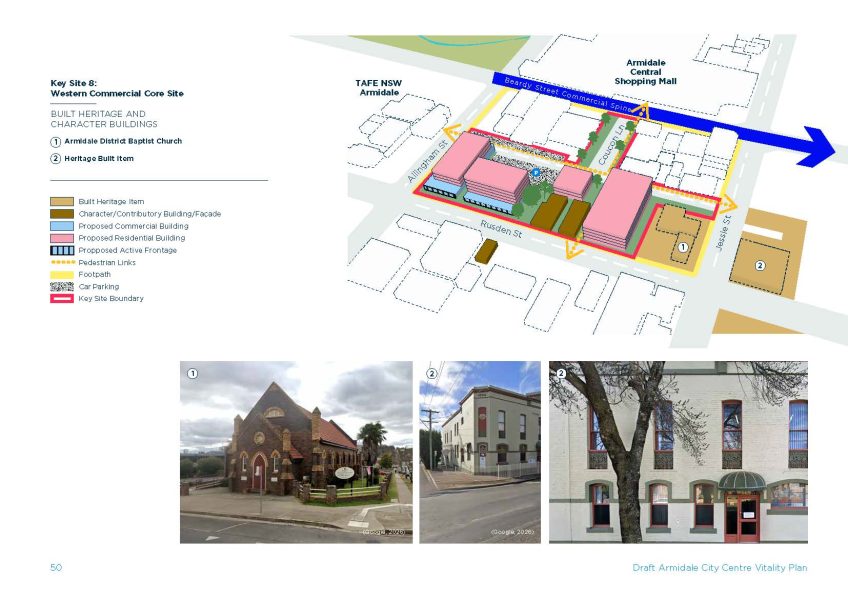
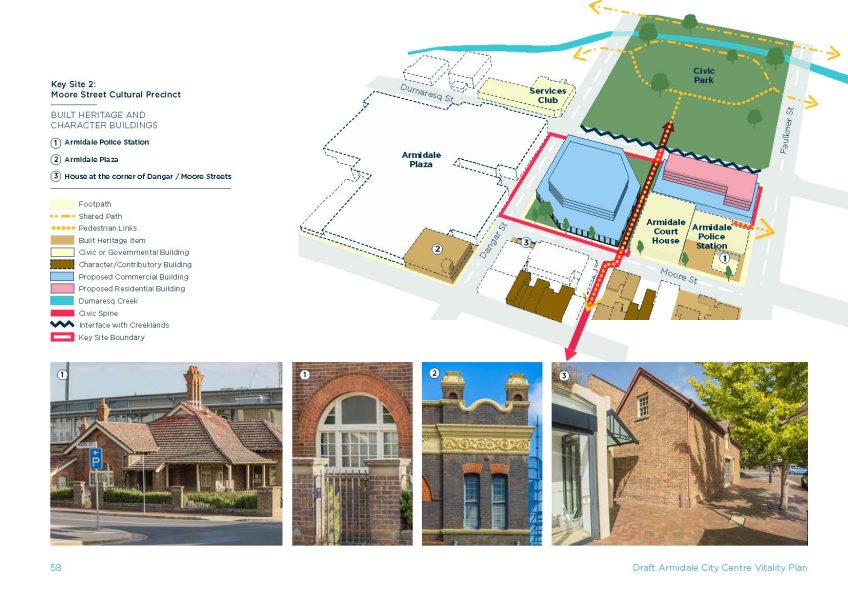
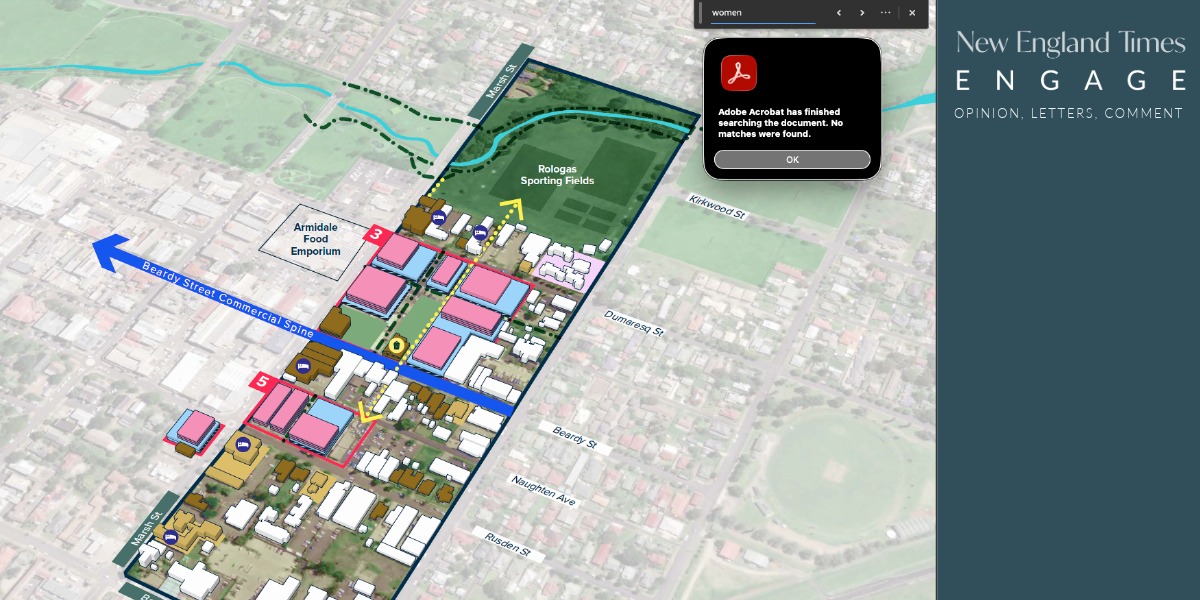
Almost all the plan maps are covered in enormous arrows, like giant male symbols thrusting their way the city.
Once you notice them, you can’t unsee them.
Now, I concede that most people won’t open a relatively dry government document and see all those arrows as gay bar toilet door graffiti-like inferences of the male form, violating our city from every angle without the bother of a little romance. And perhaps, between Lyne MP Alison Penfold’s attempts to redefine gender and the Deputy Mayor Todd Redwood allegedly running around telling people I’m a man hater (huh?), I have been over-thinking issues of sex, gender and symbolism of late.
But, taking the plan as a whole, it’s hard to miss the intentional redesign of our city heart from one that is innately feminine: inclusive, safe, connected, a place of gathering and sharing – to the masculine: fast, moving, unsafe, selfish.
It is, sadly, not an aberration. Much of the activity that has been foisted upon us by Council in recent years has had a dominating male flair to it. From big flashy things in the sky to massive (also pretty phallic) Christmas trees, there also hasn’t been a great deal of ensuring active and enthusiastic consent.
It is no wonder the community is feeling violated and trust of Armidale Regional Council is at an all time low.
Council is, to state the obvious, very male dominated. The organisation has a male majority in both its elected chamber, 6-3, and its executive leadership, 5-2 with one of the two female executives only acting in the role. The hegemonic masculinities and other artefacts of gendered power biases, both within and of Armidale Regional Council, are, like the masculine symbols all over this plan, hard to unsee once you’ve seen them.
To be clear, I do not assert for one moment that there was an intentional application of maleness all over the Draft Plan document. Nor do I believe it would have occurred to any of the men on Council that all of those phallic arrows would have affected their consideration of the plan, as symbols do at an unconscious level, like subliminal porn juicing them up to thrust forward with impatience.
However, one cannot deny the reality of it, once you’ve seen it.
And, regardless of the symbolism, at least one of them should have clocked that the supposed vision for the city, that goes into some detail about the nightlife and the various shovel-ready projects, makes no real mention of women.
Or children. Or the elderly. Or the disabled.
Or public transport. Or playgrounds. Or public toilets.
Or quiet spaces. Or sensory rooms. Or designing out crime.
There isn’t really much in this plan other than pubs, sport, parking to go to the pubs and sport, and things being stumbling distance from pubs and sport. And a new cultural centre, presumably with a licensed bar.
Seven licensed venues are referred to by name in the plan (eight if you count the now closed Imperial). The plan also refers warmly to a growing cluster of pubs, cafes, and dining venues on Marsh Street as an asset to build upon.
This in a city with a well-documented and difficult relationship with alcohol and its consequences.
The plan also calls for more laneways, and proposes a new green space between two pubs, as though it were an intentional design feature to create more places where women can feel unsafe after dark.
In a city that already has a significant problem with sexual assault. Not unconnected to the aforementioned difficult relationship with alcohol.
Researchers have long observed that women and children disproportionately use public space for activities that generate no economic output whatsoever. Sitting. Talking. Supervising children. Waiting. Caring. Meeting friends. Spending time.
The plan borders on misogynistic with its violent destruction of most of those female and child friendly spaces that encourage connection and togetherness, such as the Mall. It does away with most safe and welcoming places to rest and gather or for children to play in favour of through streets and productivity. (The playground at Curtis Park is on the map, so I guess it survives, but it looks like it will be in the shadow of a two story building that will render it useless of a winter morning.)
The mall, whatever its limitations, is the most gender-equitable space in the city. The plan’s historical analysis argues (without any basis in my opinion) that the mall was a planning mistake that caused retail decline. It does not engage with the possibility that the mall may have been considerably more successful as a social space than as a retail one, dismissing all the sitting and gathering like it doesn’t exist or doesn’t have value.
Those activities rarely appear in planning documents because they don’t produce measurable productivity.
Yet they are precisely what makes a city feel alive.
Even the plan acknowledges that markets, festivals and events alone cannot create a thriving city centre. Yet almost all of its activation strategy revolves around programmed experiences rather than asking the more fundamental question: what would make people want to spend an ordinary Tuesday afternoon in the middle of Armidale?
The answer probably isn’t another traffic lane.
Or another cultural centre.
A good cafe that stayed open past 2pm would be on my list.
Other very deliberate design choices of the past, such as closing Dangar Street so that people could freely and safely make their way from the car park to the shops, are also derided as mistakes that must be undone, rather than taking a moment to understand who the current form benefits, and what value they may still hold.
Even the one that is not like the others, the relocation of the library from its current location two blocks down the road, is framed in male, economic reasons, and blind to social purpose. As the plan states “Libraries are proven drivers of incidental activity, supporting surrounding cafés, retail and services”. Not about what people do in the library, nothing about gathering and connectivity, education, or an information hub. There is a very solid argument to be made for the benefits of a city centre library with a safe pedestrian connection to the mall, but they don’t make it.
What strikes me most isn’t simply that this is an overtly masculine plan. It’s that it is being imposed with all the subtlety of a drunk bloke at closing time who mistakes the firm but polite ‘no thanks’ for consent because she didn’t say ‘f*ck off loser’.
The community wasn’t asked what kind of city it wanted before the plan was drawn. The very businesses that were erased by the plan, like the bowling club, weren’t even warned it was coming. It was presented as a finished product with a condescending patriarchal flair and we were informed the little people could now have their say.
That’s not consultation. That’s asking whether we enjoyed it after the fact.
If this was a consent conversation with a teenager, you’d be carefully explaining that ‘no means no’.
And when it comes to reopening the Mall, and numerous other rehashed ideas in this plan, Armidale has already said no. Multiple times.
It was predominantly women who came together to petition and protest and save the mall in 2017, and I have no doubt they will again.
But they shouldn’t have to.
The real irony of all of this is that Armidale is a city of women. 52.6% of Armidale residents at the last Census were female. That makes Armidale one of the top 20 female cities in the country, and unique in that it is both female and young. Most of the other female heavy towns are retirement centres like Bowral, which is 54% female, but has an average age of 55 as opposed to Armidale’s 36.
This has long been a city where women have come to build new lives. Students. Academics. Single mothers. Professionals. Women seeking education, opportunity, safety, and community in a progressive regional centre.
Precisely because of built structures like the mall that created space for gathering and connection, the strong (albeit slightly underground) web of social groups and activity, and the University offering fantastic services and opportunities to reinvent oneself that are otherwise hard to find, Armidale has long been a magnet for women looking for a fresh start in a strong community where they could afford to live.
The Draft Plan says its purpose is to “redesign what the city centre is for”.
Well, before you can redefine anything about this city, you first need to understand what this city is.
That this city is not about boys, toys, and beers.
This is a city of women, culture, education, opportunity, and community.
Let’s design that city.
End rant.

Dr RK (Kath) Crosby is the CEO of research and strategy company KORE CSR, former strategist for the Australian Democrats, and holds a PhD in political behaviour. She is also a well known migraine and health advocate, and the Publisher of New England Times and North Coast Times.
All opinion and comment on New England Times Engage is the opinion of the writer and not New England Times.
Got something on your mind? Go on then, engage. Submit your opinion piece, letter to the editor, or Quick Word now.
Generally speaking, I like your rants. Always to the point of the matter with a lovely socialist bent.
And, realistically this rant is no exception!
But…
To decifer a draft city plan whilst looking through a gender based lens?
Humorous, yes.
A novelty, perhaps?
Germane Greer would be supportive but sadly hers would be a solo opinion.
Focus rather on what Chairman Sam wants. Then conclusions become more obvious