
There are some sentences that manage to explain an enormous problem in remarkably few words. Nepal’s Foreign Minister Shisir Khanal produced one of them this week:
“Whatever melts in the Himalayas rises in the sea.”
It is difficult to think of a better description of the interconnected world in which we now live — or of the extraordinary folly of continuing to treat climate change as somebody else’s problem.
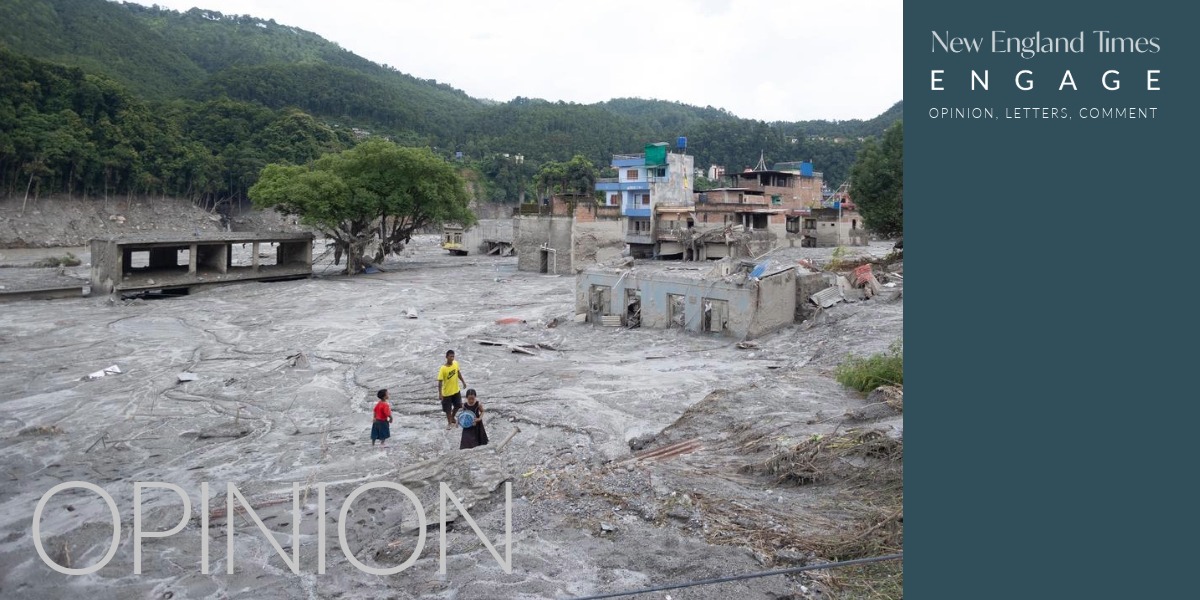
Recently, catastrophic flooding tore through parts of Nepal after an avalanche of snow and ice in the Himalayan region sent a wall of water down the Bhote Koshi River. Lives were lost, communities devastated and infrastructure destroyed.
Nepal’s Prime Minister Balendra Shah did not dance around what had happened. “This incident indicates that the risks we face in the Himalayan region are increasing alongside climate change,” he said. Khanal was equally direct, pointing out the cruel injustice at the heart of the climate crisis: Nepal is suffering some of its consequences despite contributing less than 0.01 per cent of the carbon pollution driving global warming.
When Anthony Albanese was asked whether the world shared collective responsibility for the tragedy because of its failure to adequately tackle climate change, he was more cautious. “There will be time to examine the science and what has occurred here,” he said, quite reasonably preferring at that moment to focus on the victims and their families.
I understand the instinct. Nobody wants human tragedy immediately turned into a political football. But there is something troubling about the suggestion that we need to wait to “examine the science”.
The science has been examined. Again and again and again.
We have known for decades that the planet is warming. We know why it is warming. We know that glaciers are retreating, oceans are heating and sea levels are rising. We know a warmer atmosphere can hold more moisture and intensify rainfall. We know extreme heat is becoming more dangerous. We know the risks increase as temperatures rise.
Nepal’s glaciers have reportedly lost almost a third of their volume in the past 30 years. Across the Hindu Kush Himalaya, glaciers are now losing ice at roughly twice their historical rate since the beginning of this century. And this isn’t simply a problem for a few remote Himalayan villages.
The vast stores of snow and ice across this region are sometimes described as the world’s “third pole”. The river systems they feed sustain enormous populations across Asia, supporting agriculture, drinking water and electricity generation. For the moment, accelerated melting can mean too much water — floods, landslides and catastrophic releases from glacial lakes. Eventually comes the opposite problem: too little.
Researchers warn that the region could reach “peak water” around the middle of this century. After that, diminishing glaciers mean diminishing water supplies, with potentially profound consequences for food production, migration, economies and political stability.
Think about that for a moment. We already live in a world struggling with war, displaced populations, food insecurity and political instability. Now imagine major river systems supporting hundreds of millions of people becoming increasingly unreliable.
And yet somehow climate change is once again being pushed down the political priority list. Perhaps we have heard the warnings so often that we have become numb to them. Black Summer was supposed to be our wake-up call. The floods were supposed to be our wake-up call. Record temperatures were supposed to be our wake-up call. The bleaching of the Great Barrier Reef was supposed to be our wake-up call. Now Nepal.
Apparently every climate wake-up call comes equipped with a snooze button.
Meanwhile, western Europe has endured repeated heatwaves. Wildfires are becoming more destructive in many parts of the world. Polar ice continues to retreat. Oceans are warming. Pacific nations continue to warn that rising seas threaten their very existence.
And what are some of the most powerful people on Earth doing while all this unfolds? Donald Trump has spent years attacking climate action and encouraging a retreat from international cooperation. Vladimir Putin’s invasion of Ukraine has caused immense human suffering while destabilising global energy markets. Benjamin Netanyahu’s prosecution of war in the Middle East has contributed to another enormous humanitarian and geopolitical crisis.
Whatever our views on the complex histories behind those conflicts, there is something almost surreal about watching supposedly sophisticated human beings devote such extraordinary resources, ingenuity and political energy to destroying one another while a much greater threat quietly gathers strength around all of us.
Trillions can be found for weapons. Entire economies can be reorganised for war. Governments can suddenly act with astonishing speed when they decide national security is at stake. But ask humanity to cooperate to protect the climate system upon which every nation depends and suddenly everything is too difficult, too expensive or politically inconvenient.
Imagine what even a fraction of the money, technology and human ingenuity devoted to warfare could achieve if directed towards renewable energy, energy storage, climate-resilient infrastructure, scientific research and helping vulnerable nations adapt to a changing climate. We keep fighting each other when the great common battle of this century is staring us in the face.
Climate change does not recognise borders. It doesn’t care whether you are American, Chinese, Russian, Israeli, Palestinian, Australian or Nepali. It doesn’t distinguish between Labor and Liberal, left and right, conservative and progressive. The atmosphere doesn’t care who won the argument on Sky News. It doesn’t care what Donald Trump posts. It doesn’t care whether One Nation believes net zero is a conspiracy, whether Barnaby Joyce dismisses wind farms as “swindle factories”, whether the Coalition decides climate policy is electorally inconvenient or whether a business leader has replaced “net zero” with the more fashionable “energy pragmatism”.
And it doesn’t particularly care what I think either.
Physics is wonderfully democratic like that.
Of course there are legitimate arguments about how we respond. The transition to cleaner energy is difficult. Communities hosting renewable projects and transmission lines deserve genuine consultation. Energy reliability matters. Electricity prices matter. Jobs matter. People already struggling with the cost of living cannot simply be lectured about carbon emissions by people who will never have to choose between paying an electricity bill and buying groceries.
Those debates are real and they should be had. We can argue about nuclear power, renewables, gas, transmission lines, carbon prices, environmental approvals and how quickly the transition can reasonably occur. What we cannot sensibly continue arguing about is whether there is a problem.
We are perfectly entitled to debate how we respond to climate change. We are not entitled to negotiate with the laws of physics.
Australia has a particular responsibility here. We are a wealthy country, a significant energy exporter and a nation with extraordinary renewable resources. We also live in the Pacific, alongside countries whose leaders have been telling us for years that climate change is not an abstract environmental issue for them. It is an existential one.
There is also a bitter irony in watching climate action become another casualty of the populist politics sweeping parts of the world. Climate change should be the ultimate argument for international cooperation. Instead, we are entering an era increasingly defined by nationalism, protectionism, authoritarianism and conflict.
Build walls. Find enemies. Blame foreigners. Distrust scientists. Attack institutions. Promise that the uncomfortable problem isn’t really a problem at all. It is much easier politics than telling people that solving an enormous global problem requires investment, compromise, patience and cooperation.
But there is one rather significant flaw in that strategy.
The climate doesn’t vote.
A government can lose an election and disappear. A climate target can be abandoned. An international agreement can be torn up. A politician can declare net zero dead and receive thunderous applause from supporters. None of that removes a single molecule of carbon dioxide from the atmosphere.
Which brings us back to Nepal.
There is a temptation when disaster strikes somewhere far away to watch the pictures, feel sympathy for a few minutes and move on. But Nepal is not somebody else’s warning. The water rushing through a Himalayan valley, the fires burning through Europe, the bleaching coral on the Great Barrier Reef and the rising seas threatening our Pacific neighbours are not separate stories. They are different chapters of the same one.
“Whatever melts in the Himalayas rises in the sea.”
Perhaps we should write that sentence above the entrance to every parliament in the world. Because the real wake-up call from Nepal is not that climate change might be coming. It is already here.
And while some of the world’s leaders remain preoccupied with territory, power, grievance and wars that leave cities destroyed and families grieving, the one threat that ultimately respects no army, no border and no ideology continues to grow.
Human beings have always been remarkably good at finding reasons to fight one another. The great test of this century may be whether we are finally clever enough to recognise when we have a common enemy.
The alarm is ringing. How many more times are we going to hit snooze?

Denise McHugh is an experienced educator in Tamworth. She is Chair of the NSW ALP Education and Skills Committee and Deputy President of the Independent Education Union (IEU).
All opinion and comment on New England Times Engage is the opinion of the writer and not New England Times.
Got something on your mind? Go on then, engage. Submit your opinion piece, letter to the editor, or Quick Word now.