
The people of New England once expected their federal representative to command respect through judgement, preparation and substance. Today, too often, headlines have replaced homework.
There was a time when the title Member for New England carried genuine weight. It was a position that commanded respect, not because everyone agreed with its holder, but because the office was occupied by people who understood the responsibility that came with it.
You did not have to agree with Ian Sinclair’s politics to recognise the quality of the parliamentarian. He was articulate, knowledgeable, formidable and respected across the political divide. He understood government, mastered policy and commanded genuine authority in Canberra.
Nor did you have to support Tony Windsor to acknowledge his intelligence, independence and deep understanding of the region he represented. Windsor demonstrated that a Member for New England could influence national policy while remaining firmly grounded in the practical needs of local communities.
Neither Ian Sinclair nor Tony Windsor would have agreed with each other on everything. Nor would I have agreed with either of them on every issue. But that isn’t the point. Respect is earned not through political agreement, but through competence, diligence and integrity. They understood that the office of Member for New England was something to be honoured, not merely occupied.
They came from different political traditions, but they shared something that transcended politics. They respected the office they held. They understood that representing New England demanded preparation, judgement, credibility and substance. Whether you agreed with them or not, they elevated the office.
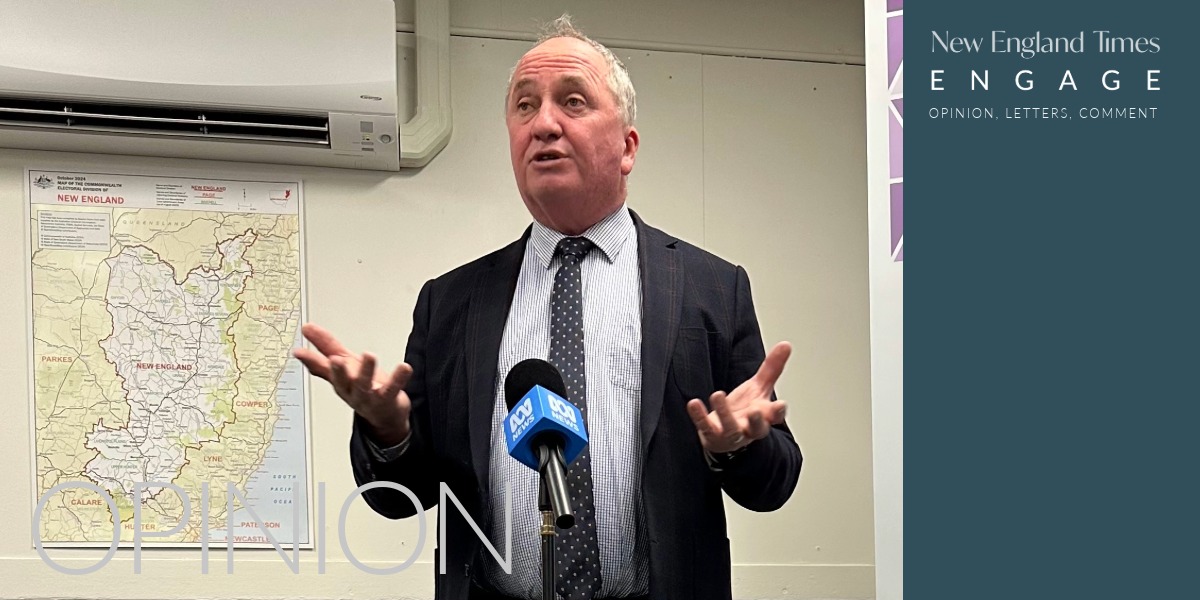
Today, New England is represented by Barnaby Joyce.
Whatever his supporters may admire about his style, it is difficult to imagine a more dramatic decline in the standard of representation expected from this great electorate. We have gone from representatives who commanded gravitas to Bumbling Barnaby—forever chasing the next headline, inflaming the next controversy and offering the next half-baked claim before apparently undertaking the most elementary fact-checking.
His recent claims about the New England Highway provide a particularly telling example.
As reported by the New England Times, Joyce claimed the highway would be closed six days a week to transport components for the Winterbourne Wind Farm. He then escalated the claim, saying traffic would be diverted onto unsuitable dirt roads and warning that “someone’s gonna get killed.”
It was dramatic. It was alarming. And it spread rapidly across social media.
The available evidence told a very different story. The transport proposal involved 16 brief overnight traffic pauses each week, averaging around five minutes, between 1am and 5am. There was no proposal to close the highway six days a week, and no plan for widespread diversions onto dirt roads. The correspondence being circulated was part of an ongoing discussion about managing oversized vehicle movements safely and with minimal disruption.
This was not an obscure national issue on which Joyce could claim to have been poorly briefed. It concerned the major highway running through the electorate he represents. Before making such serious claims, surely the first step should have been to check the facts with Transport for NSW, the project proponent or both. That is what constituents should expect from their federal representative.
That is the fundamental problem.
This is not simply a disagreement over renewable energy policy. People are entitled to support or oppose wind farms. Communities have every right to demand proper consultation, fair compensation, environmental protections and sensible planning. But there is an important distinction between legitimate political debate and presenting exaggerated or unsupported claims as though they are established facts.
Only days earlier, following the major Telstra outage, Joyce publicly suggested China could have been responsible. His evidence? He later acknowledged that the idea had simply occurred to him while he was on an earlier phone call.
Not after receiving a national security briefing. Not after consulting telecommunications experts. Not after advice from intelligence agencies. Just a thought.
Subsequent investigations found no evidence of foreign interference, instead identifying a software fault as the cause of the outage.
Nor was his recent Sunrise appearance any more reassuring. Asked repeatedly by Allegra Spender to explain Pauline Hanson’s use of the term “monoculture”, Joyce never provided a clear definition. Instead, he wandered into immigration, coal, agriculture and a range of unrelated topics, leaving viewers no clearer about the very slogan he was defending. What did become clear is that he is just as much in the dark as the rest of us.
Just as revealing as his inability to answer the question was the way he conducted himself throughout the interview. Time and again, he interrupted whenever Spender attempted to ask a follow-up question or complete a sentence. Yet moments later he complained, “Let me speak.”
It was an extraordinary contradiction. He repeatedly talked over others, then protested that he wasn’t being allowed to talk himself. And when he finally had the floor, viewers were often left wondering whether the original question had been answered at all.
Good representation is about more than holding strong opinions. It is also about listening, engaging respectfully and having the discipline to answer legitimate questions directly. Australians expect robust debate from their elected representatives. They should also expect basic courtesy.
Nor is this an isolated incident. Joyce has repeatedly made claims about renewable energy that have been challenged or contradicted by independent experts and fact-checkers. Assertions about government payments to renewable generators, the impacts of wind farms and other aspects of the energy transition have, on multiple occasions, been found to be inaccurate, misleading or stripped of important context.
Healthy democracies depend on robust debate. They do not benefit when speculation is elevated to the status of evidence.
Barnaby Joyce’s defenders often say he “speaks his mind”. Perhaps he does. But speaking your mind is only admirable when your mind is anchored to facts.
Being colourful is not a substitute for being competent. Being loud is not leadership, and being constantly quoted is not the same as being respected. Public office demands something more than the ability to dominate a news cycle.
Meanwhile, New England faces genuine challenges: reliable health services, housing affordability, telecommunications that actually work, road and rail infrastructure, agriculture adapting to a changing climate, regional universities, skills shortages and economic diversification. These are serious issues requiring serious representation.
They require a representative who reads the documents, checks the evidence, understands the policy and commands enough respect in Canberra to deliver results. Instead, too often, we have a representative who seems to treat every issue as another opportunity for a dramatic media appearance or viral Facebook clip.
The issue is no longer whether Barnaby Joyce occasionally says something controversial. Every politician does. The issue is that controversy has increasingly become a substitute for substance. Whether it is making dramatic claims about the New England Highway that do not withstand scrutiny, speculating about foreign interference in the Telstra outage without evidence, defending political slogans he cannot explain, or preferring interruption to reasoned debate, the pattern is remarkably consistent.
That is perhaps the greatest disappointment.
The comparison with Ian Sinclair and Tony Windsor has nothing to do with political ideology. I would never have voted for Ian Sinclair, and Tony Windsor and I would not have agreed on everything either. But I respected both men because they respected the office they held. They did the work, mastered the detail and understood that credibility is earned through preparation, not performance.
I don’t expect to agree with every vote my local member casts. I don’t expect them to win every political battle. But I do expect them to know their brief, to check their facts, to treat others with respect and to understand that the office they hold is bigger than the individual who occupies it. That was once the standard in New England. It should be again.
The people of New England deserve representation that is respected because it is informed. They deserve a Member whose words carry weight because they are grounded in evidence rather than speculation. Above all, they deserve someone who understands that the role is about serving the electorate, not starring in the next media controversy.
From Ian Sinclair to Tony Windsor… to Bumbling Barnaby.
From gravitas to gimmicks.
That is not simply the story of Barnaby Joyce.
It is the story of what happens when performance replaces preparation, when outrage replaces judgement and when headlines become more important than hard work.
The people of New England deserve better.
Regional Australia doesn’t need another performer. It deserves a representative worthy of the office.

Denise McHugh is an experienced educator in Tamworth. She is Chair of the NSW ALP Education and Skills Committee and Deputy President of the Independent Education Union (IEU).
All opinion and comment on New England Times Engage is the opinion of the writer and not New England Times.
Got something on your mind? Go on then, engage. Submit your opinion piece, letter to the editor, or Quick Word now.
Well said Denise, captures most of my thoughts, but you did omit his low moral standards, contempt for science and environmental protection, and his alcoholic behaviour.
We badly need a good leader to stand at the next election to restore the dignity of the position, who would address inequality, sustainability, and the serious threat of climate change.