
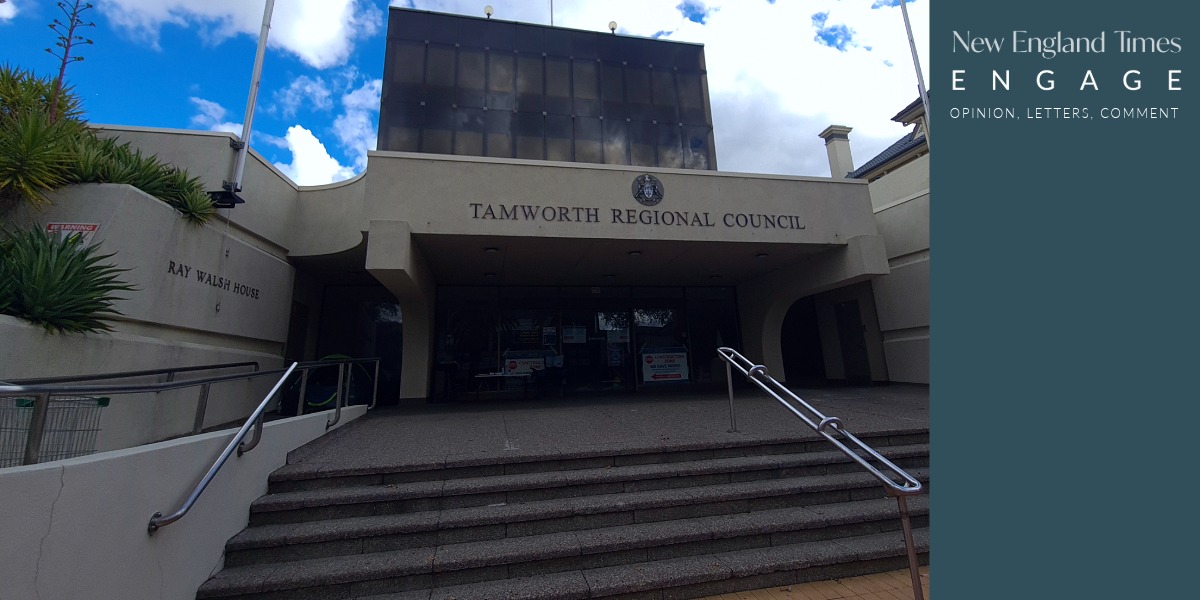
On 30 June, Tamworth Regional Councillors will make a decision that future councils may not be able to easily reverse.
The decision before them is not simply whether Ray Walsh House should be repaired. Nor is it simply a question of asbestos.
The question is whether all available options have been properly examined, independently assessed and transparently compared before a significant community-owned asset is sold.
Over recent months, the community has been presented with a narrative that Ray Walsh House is too expensive to retain. Many residents accepted that proposition at face value. Others began asking questions.
Those questions have not gone away.
One of the most significant developments has been the emergence of differing remediation estimates. Community members have obtained professional advice suggesting costs substantially lower than figures previously discussed publicly.
That does not automatically mean one figure is right and another is wrong. However, it does raise an important question: if estimates vary significantly, what confidence should councillors have that they are making a decision based on the best available information?
The issue becomes even more important when the proposed alternative is considered.
If Ray Walsh House is sold, Council will move into leased accommodation. Based on figures publicly discussed, the lease arrangement is expected to cost more than $1.5 million per year, indexed over time. Analysis undertaken by community members suggests the total cost over ten years could exceed $17 million.
Reasonable people may disagree about whether that represents good value. However, before disposing of a major public asset, residents are entitled to ask whether the long-term cost of leasing has been fully compared against retaining and renewing a building Council already owns.
This is where many members of the community are struggling to find clear answers.
What options were considered before the recommendation to dispose of Ray Walsh House was reached?
Were alternative remediation strategies examined?
Were staged refurbishment options assessed?
Were other capital projects considered for deferral, redesign or cancellation before recommending the sale of a council-owned building?
Has the community been provided with a transparent comparison of all viable options?
These are not unreasonable questions.
Nor are they questions that should be dismissed as opposition to progress.
Large organisations regularly review projects, reassess priorities and test assumptions before making major financial commitments. Local government should be no different.
The significance of this decision extends beyond the building itself.
Ray Walsh House has served as the administrative centre of local government in Tamworth for decades. Once sold, it is unlikely to ever return to public ownership. Future councils will inherit the consequences of whatever decision is made this month.
That is why many residents are less concerned about the eventual outcome than they are about the process used to reach it.
If councillors ultimately determine that disposal is the best option after considering comprehensive and independently verified information, that is their role.
But if questions remain unanswered, if key assumptions have not been tested, or if alternative options have not been properly evaluated, then there is a strong argument that more work should be done before an irreversible decision is made.
Community consultation is not simply about informing people what has already been decided. It is about ensuring decisions are made with the benefit of scrutiny, transparency and public confidence.
Whatever position people take on the future of Ray Walsh House, most would agree on one thing.
Before a significant community asset is sold, councillors and residents deserve clear answers to some very important questions.

Robyn Lang is the Secretary of the Tamworth Regional Residents and Ratepayers Association Inc.
(TRRRA). She is actively involved in community advocacy and local issues across the Tamworth region, with a focus on community participation, clearer access to information, and helping local voices be heard on issues affecting the region.
All opinion and comment on New England Times Engage is the opinion of the writer and not New England Times.
Got something on your mind? Go on then, engage. Submit your opinion piece, letter to the editor, or Quick Word now.
Do any of the councillors have any background in economics?
I certainly do not have these qualifications, but it would appear to me that some of them do not either.
There is certainly a big can of worms here.
Cost to repair needs a more careful approach than has already been exersised. And alternative methods considered.
What is the cost to rent over cost to repair amortised over the ten year period claimed?
What happens in ten years time as regards rental costs?
Are the existing council owned and occupied premises able to be rented out immediately upon being vacated our will they remain vacant and fall into disrepair, or will they also be sold in a fire sale.
The propsed greenfield site for the new council office is not so greenfield. Perfectly good buildings already exist on the proposed site.
No geotechnical investigations have been carried out to determine if the proposed site is suitable for a multi storied type of construction.
There is a posibility that this lack of insight could escalate costs by $50M before they even get started.
Other councils operate efficiently with staff working from home, yet our council is unable to manage it’s workforce effectively in separate offices. This is unbelievable.
I vote not to sell RWH
If it is to be sold then it should be by public auction with a reserve price of $50M.
My husband and I would truly like to have an honest report on what would be required to refurbish the Ray Walsh House to “It’s” former glory where it has served our community well. A transparent report on the costs, and if I could be done on a staged manner, and without another abnormal rate rise would be the ideal situation. Extra money could be saved by delaying some of the extravagant expenditures like the aquatic centre. (really unneeded at this stage in our option)