
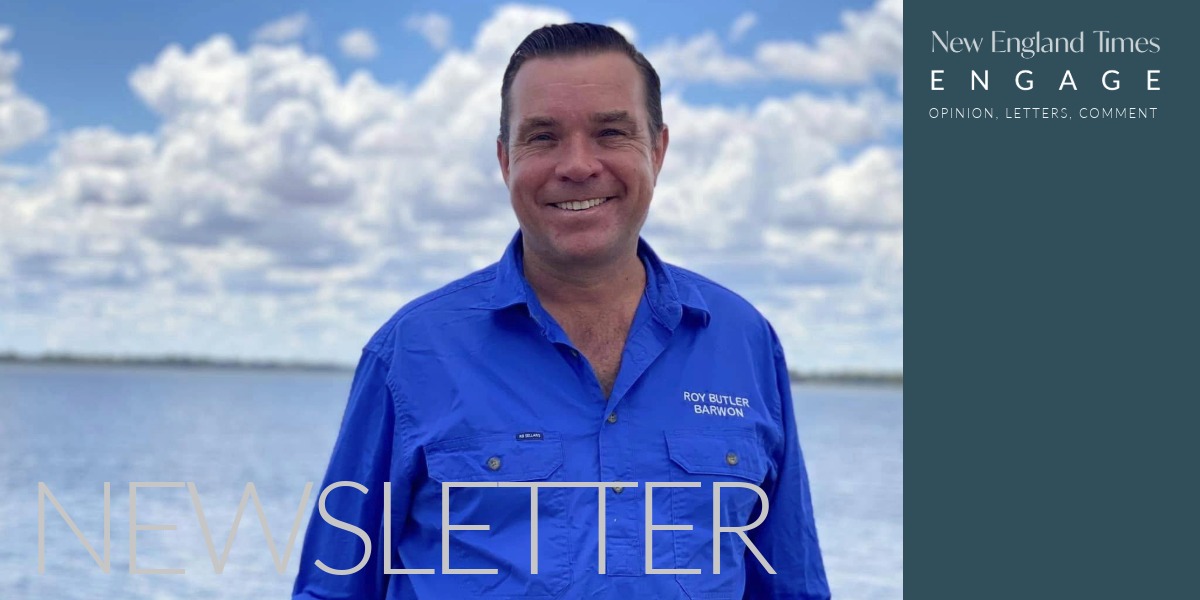
Roy’s Roundup 3 August 2026
G’day folks,
Last week I was in India, observing and learning about some of their industries, government services and infrastructure, and discussing opportunities for trade, exchange of expertise and cooperation between India and Barwon.
This week I am back in Parliament for the sole sitting week of August, after which I will be busy with committee work and in between I will be heading out around Barwon.
Given that there is only one week in August for government business, and that an election is not far off, it should be jam-packed.
Attorney General in Barwon
A couple of weeks ago the Attorney General, Michael Daley, paid a visit to Barwon. The main point of his visit was to meet with a range of stakeholders from both non-government organisations and local government to talk about youth crime in the region and youth diversionary programs, and to tour the decommissioned prison, Yetta Dhinnakkal, a facility that could be used for residential diversionary programs.
He arrived in Cobar and met with members of the council and council staff, including General Manager Peter Vlatko, where we heard about some of the problems with youth crime in Cobar.
We then moved on to Bourke where the Attorney General met with Uncle Phil Sullivan and Alister Ferguson from the Bourke Tribal Council, who talked about the youth diversionary programs developed under the banner of Maranguka, a community-driven, place-based model for investment in social justice. Mr. Daley also spoke to Bourke Council and Superintendent Gerard Lawson, who were all strongly supportive of the proposal.
From there we went to Yetta Dhinnakkal, where the Attorney General was hosted by Dave Kirby, the General Manager of Brewarrina Council, and with some members of Walgett Council. I want to thank Fran Carter and her husband Lance who prepared a delicious feast for us.
The next morning, we took a tour of the facility, and the Attorney General was impressed by what he saw.
We then headed on to the Warren Youth Centre & Community Hub, where we met with Kelly Sinclair and her team who are doing some great work with youth in Warren, as well as meeting with members of Warren Council and Police Superintendent Tim Chinn. We had a discussion on youth crime and youth programs in Warren and discussed the possibility of Warren partnering with the councils supporting the Yetta Dhinnakkal proposal.
There is still a lot of work to be done, and the government is not making any promises, but they are giving serious consideration to the project. I will continue to advocate for it and keep you updated on any developments.
Any visit by a cabinet member to Barwon is always welcome. It is vitally important that the government gets as much information, on the ground and in discussion with community members, to make more informed decisions about such projects.
Water Storage in Cobar
There is some good news on water for Cobar.
Recently I visited the brand-new five megalitre water storage facility that has been completed above the town, which is a big win that will improve local drinking water security.
Anything we can do to shore up water quality and security is a good investment. However, this is just one piece of the puzzle. There are much larger, vital water infrastructure projects right across Barwon that still desperately need funding.
One pressing project is the pipeline from Nyngan to Cobar, which is past its useful life span and in need of immediate replacement. This pipeline is essential for supplying water to homes, businesses and industries in Cobar.
I will continue to push for the state and federal governments to fund this vital project. A decision needs to be made sooner rather than later, the longer the delay the more the project will cost.
Travel to India
As mentioned, I was in India last week, after being invited to participate in an “Australia–India bilateral trade, investment and industry discovery mission”.
Over eight days, I travelled to various parts of the country to see operations of a range of industries and services, and to look at some of their infrastructure.
The main objectives of the visit were to:
- Strengthen bilateral engagement between New South Wales and Indian State Governments.
- Explore trade, investment and industry opportunities relevant to regional New South Wales.
- Facilitate government-to-government, industry-to-industry and business-to-business relationships.
- Promote advanced manufacturing, technology and supply-chain partnerships.
- Identify potential joint ventures and market-entry opportunities.
- Support innovation, research and technology-commercialisation partnerships.
- Encourage reciprocal government, industry and investment delegations.
- Develop skills, vocational-education and workforce-capability partnerships.
- Establish an ongoing engagement framework through the Australia–India Industry and Advanced Manufacturing Bridge.
The six-day tour took us to Bangalore, Indore, Mumbai and Coimbatore. It was a demanding schedule, but it was a great opportunity to develop good relationships for future commerce.
Our hosts were extremely hospitable, and I want to thank them for their time and their hospitality.
Air Services need funding to be renewed
In remote areas like Bourke, Brewarrina, Cobar, Lightning Ridge and Walgett, air services are vital. The distances that separate many outback towns means that air travel is a much more practical way of getting around. For the last few years, the Far Northwest Joint Organisation has been successful in getting subsidies for an air service to get to these remote towns.
While Cobar’s air service has become viable, driven mostly by the fly-in fly-out workforce for Cobar’s mining industry rather than commercial passengers, the funding for the other towns needs to be renewed.
The state government needs to step up to make sure these towns continue to be served by aircraft. I have been advocating for that funding and will continue the conversation during this sitting week.
Feral Pig Eradication pilot program in Walgett
Collaboration between our hard-working farmers and Local Land Services (LLS) is always welcome, but the recent talk of fines needs to be parked immediately. Threatening landholders sends a terrible signal of bureaucratic command and control, completely undermining the respectful cooperation our regional communities deserve.
I have organised an urgent meeting between the Minister for Agriculture, Tara Moriarty, and key farmer representatives to completely reset what should be a good program.
Let’s be clear: farmers need to design this program, not city-bound bureaucrats. Collaboration is the absolute key to successful pest management, not control and financial penalties.
For too long, LLS has frustrated and blocked landholder access to Category D firearms for authorised control campaigns, and this excess of red tape needs to stop right now. Furthermore, if anyone should face fines, it is the government agencies acting as public land managers; they must be firmly within the scope of penalties if they fail to control pests on their own dirt.
I look forward to working closely with our stakeholder groups and Minister Moriarty to establish a respectful, farmer-driven approach to wild pig control. Farmers are not the problem here—they are the solution.
Important notices:
- Clubgrants Category 3 Infrastructure Funding: Applications are now open for funding between $50,000 and $300,000 to upgrade sports centres, playgrounds, community hubs, and recreational spaces. Applications close on 17 August 2026. You can apply via the NSW Responsible Gambling Grants Portal at https://www.nsw.gov.au/grants-and-funding/responsible-gambling-grants
- Male Suicide Awareness: I am proud to announce I will be hosting and sponsoring the #2500toomany event in the Sydney Domain on 22 October 2026, alongside Glen Fisher and the team from The Leg Up Project. We will be asking all politicians at Parliament House to tie a ribbon in the Domain in respect of the male suicide tragedy in Australia.
- Round 2 of the ACEREZ Community Grants Program Opens 10 August
Community organisations across the Central-West are encouraged to apply for funding to support projects that enhance:
- Public amenity
- Health and wellbeing
- Agriculture
- Education
- Sport and recreation
- Aboriginal and Torres Strait Islander communities
Free grant writing assistance is available again this year.
Learn more: www.acerez.com.au/community
cwo.community@acerez-acjv.com.au
Phone 1800 298 379 (24/7)
Civics: How Political Parties are Formed
The recent emergence of alternatives to our two-party political system has shown the power of our robust democracy. When political parties are seen to have failed to deliver what the electorate wants or perhaps has drifted too far from what is seen as their traditional voter base, the electorate has the option of voting for other parties, or independents, or even starting their own party.
Any registered voter can start a party by writing a constitution, signing up 750 eligible, fee-paying members who are on the electoral roll (1,500 at federal level), or have at least one sitting member, then applying in writing to the Australian Electoral Commission. The application should outline the party structure and list those who hold official positions within the party. A fee of $500 is then paid.
The party constitution must outline the ideas, objectives and rules that govern the running of the party. Those rules can be vitally important when imposing party discipline and making sure that the members adhere to the electoral laws concerning financial disclosure, authorisation of the party’s official communications and restrictions on donations. Parties need to keep accurate accounting records.
The party’s name must be registered, must not be the same as another registered party (if it is similar you may need to seek consent of the other party), and must not be “obscene, frivolous or vexatious”. The party also needs to have registered logo and abbreviation that are not the same as or like another registered party.
However, registering a party takes time and it takes 12 months for a party to receive all the entitlements registration brings. It is now too late for parties to register for the 2027 election and receive the benefits including being allowed to put their authorised abbreviation beside the name of their candidate on the ballot and having a higher cap on donations (than a party that is on the register of parties).
A party needs to have $2000 in its coffers, drawn from fees and not from donations, to pay the application fee for an election. If the party gets more than 4 percent of the primary vote at an election it will be eligible for funding from the electoral commission. Although new parties often struggle to reach this threshold because they are competing against the resources, membership, legitimacy and reach of established parties.
Although any registered voter can, in theory, register a party if they get enough paying members, or sign up a sitting member of parliament, the hard part is to keep voters interested in the continued existence of the party and to keep the membership growing to the point where it gains a certain amount of momentum at elections. Most new parties are only successful in gaining upper house seats in NSW Parliament, or federal parliament, but even a foothold there can give a new party a lot of leverage.
Often new parties form around a single issue or a specific theme, but many try to capture voters dissatisfied with major parties, some have even taken the members of dying parties to form a new party. Many parties have come and gone, even some that were around for a decade or more vanished once they became irrelevant to the electorate or collapsed due to internal problems.
Facts:
There have been some important minor parties that have held the balance of power at times when dissatisfaction with the major parties was on the rise. One of them was the Democratic Labor Party, which formed from members who split from the Labor Party in 1955. The party often held the balance of power and was partly responsible for keeping Labor out of office until 1972. The party dissolved in 1978.
Another was the Democrats, registered in 1977, its leader was Don Chipp, a former Liberal Party cabinet minister who decided that Australian politics needed a centrist party to “keep the bastards honest.” The Democrats were mainly an upper house party winning seats in the federal Senate and in the NSW upper house. But their influence declined, and they were de-registered in 2019 when their membership fell, and their leadership struggled. They have recently attempted a comeback.
There have been some strangely named minor parties officially registered with the AEC, including the Bullet Train for Australia Party, which campaigned for a fast train, but only lasted from 2012 (when it started out as the Bullet Train for Canberra party) until 2017.
The UK has had some particularly eccentric parties register for elections, including the Monster Raving Looney Party, formed in 1983 by musician David “Screaming Lord” Sutch. It was intended as a satirical party but remains a registered political party.
Roy Butler is the state MP for Barwon. This is his regular newsletter.
All opinion and comment on New England Times Engage is the opinion of the writer and not New England Times.
Got something on your mind? Go on then, engage. Submit your opinion piece, letter to the editor, or Quick Word now.