
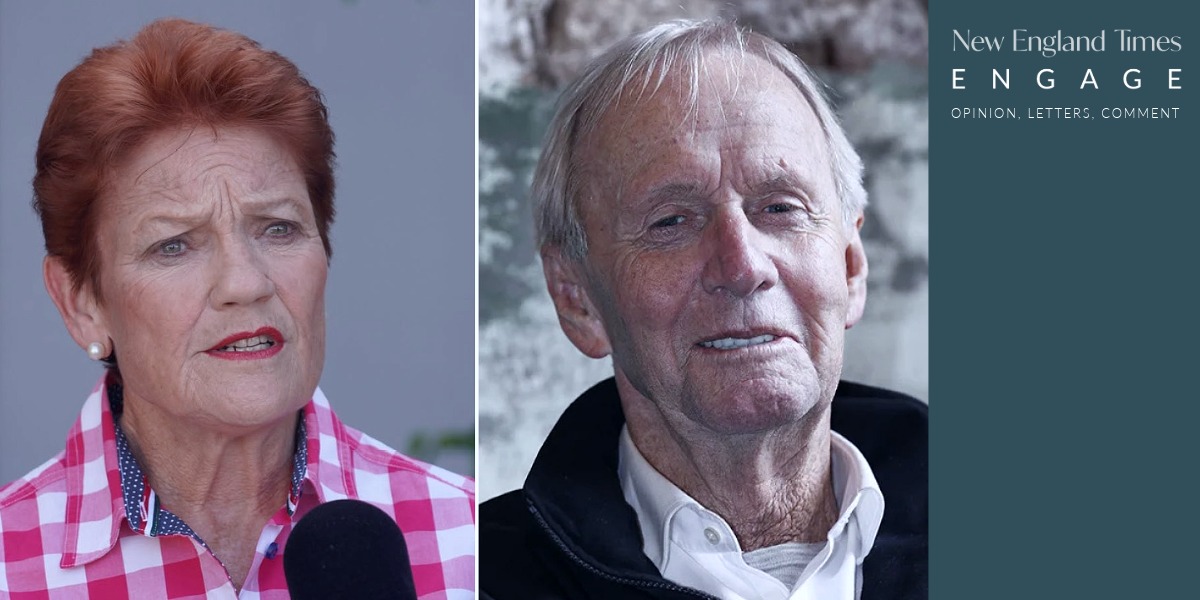
Last week, speaking at a Swan Chamber of Commerce function in Perth, Pauline Hanson declared she has no intention of retiring until she is, in her words, “comfortable to hand on to the next one to carry on my legacy, what I’ve started.” Ironically, the person expected to carry that legacy forward is her own daughter.
Legacy. It’s a powerful word.
Because it raises a question every long-serving politician should be prepared to answer.
What exactly is Pauline Hanson’s legacy?
Not the headlines. Not the controversies. Not the outrage. Not the number of television appearances or newspaper front pages.
What lasting reform has she delivered that has genuinely made Australia a better place?
Pauline Hanson has now spent almost thirty years in Australian politics.
Thirty years is a long time in public life. It’s long enough to build institutions, reform policy, improve people’s lives and leave a lasting mark on the nation.
Former Liberal Senator Amanda Vanstone recently asked much the same question, expressing it in considerably more colourful terms. What made her comments particularly noteworthy was that they came not from a Labor critic, but from a respected Liberal who has spent decades in Australian politics herself. Her central point was unmistakable: despite Pauline Hanson’s longevity in Parliament, it is remarkably difficult to point to any enduring achievement or significant policy legacy. That is a question worth reflecting on.
This debate has become even more relevant following Hanson’s recent National Press Club speech. Once again, Australians were treated to the familiar catalogue of grievances: migrants, multiculturalism, Welcome to Country, climate action, the ABC, the public service, Indigenous organisations, women, workers and just about anyone else who didn’t fit her increasingly narrow vision of Australia.
The speech generated headlines, but it also generated a backlash. Recent polling suggests One Nation’s support has softened following the speech and Hanson’s “monocultural Australia” comments, with dissatisfaction in her leadership increasing.
RedBridge Director Kos Samaras perhaps summed up the political fallout best when he observed: “Turns out telling women and workers to get stuffed is bad politics.”
Perhaps Australians are beginning to tire of the politics of permanent outrage. After nearly three decades, they are entitled to ask not simply who Pauline Hanson opposes, but what she has actually built.
Perhaps the most revealing response came from someone Hanson herself chose to invoke as representing the Australia she wanted to return to.
That person was none other than Paul Hogan – ‘Hoges’!
Hanson held Hogan up as a symbol of the Australia she believes we’ve lost.
He rejected the idea that Australia had ever been the monocultural country Hanson imagines, reminding Australians that, apart from First Nations peoples, this nation has always been shaped by migration. He also dismissed Hanson’s rhetoric in typically Australian fashion by calling her “a pelican”.
Then there was Norman Gunston.
Hanson also invoked Norman Gunston as part of her nostalgic vision of Australia. There was just one problem. Norman Gunston isn’t real. He’s a fictional satirical character created by Garry McDonald to parody Australian culture and politics.
In many ways, that perfectly sums up Hanson’s speech. It wasn’t built around the Australia that actually exists—or has ever existed. It was built around an imagined Australia. A nostalgic version of the past that conveniently overlooks our history, ignores our diversity and forgets that immigration has been central to Australia’s story for generations.
But even if we put the speech aside, the bigger question remains.
After almost three decades in Parliament, what has Pauline Hanson actually built?
Politics ultimately isn’t judged by the enemies you make. It’s judged by the country you leave behind.
History remembers leaders who leave something behind. It is one of the simplest tests of political success. Long after the speeches are forgotten and the election posters have faded, what remains?
Whether you agreed with them or not, Australians can readily identify the legacies of our Prime Ministers. Gough Whitlam expanded access to higher education and laid the foundations for universal health care. Bob Hawke and Paul Keating transformed the economy and introduced compulsory superannuation. John Howard will always be associated with gun law reform and the GST. Kevin Rudd is remembered for the National Apology to the Stolen Generations, one of the defining moments of modern Australian history. Julia Gillard delivered the National Disability Insurance Scheme, while Malcolm Turnbull oversaw the legalisation of same-sex marriage.
Notice I haven’t mentioned every Prime Minister. That’s because not every leader leaves a defining legacy. But those who do are remembered for building something that outlasts their time in office.
What, then, is Pauline Hanson’s equivalent?
If the answer is simply division, grievance and perpetual outrage, then that is a legacy Australians should think very carefully about inheriting.
After thirty years, Australians can certainly point to plenty of controversy.
They can point to repeated attacks on migrants, Muslims, Aboriginal Australians, climate science, multiculturalism and, more recently, transgender Australians.
They can point to endless outrage, division and a seemingly permanent search for someone else to blame.
But enduring nation-building reform?
That’s much harder to identify.
Remaining in Parliament for thirty years is an achievement.
Leaving Australia better than you found it is a legacy.
They’re not the same thing.
History rarely remembers the people who shouted the loudest.
It remembers the people who built something that lasted.
Perhaps that’s the real lesson from the past three decades. Politics is not measured by the number of headlines you generate or the number of people you offend. It is measured by whether Australians are better off because you were there.
On that measure, the answer speaks for itself.

Denise McHugh is an experienced educator in Tamworth. She is Chair of the NSW ALP Education and Skills Committee and Deputy President of the Independent Education Union (IEU).
All opinion and comment on New England Times Engage is the opinion of the writer and not New England Times.
Got something on your mind? Go on then, engage. Submit your opinion piece, letter to the editor, or Quick Word now.