
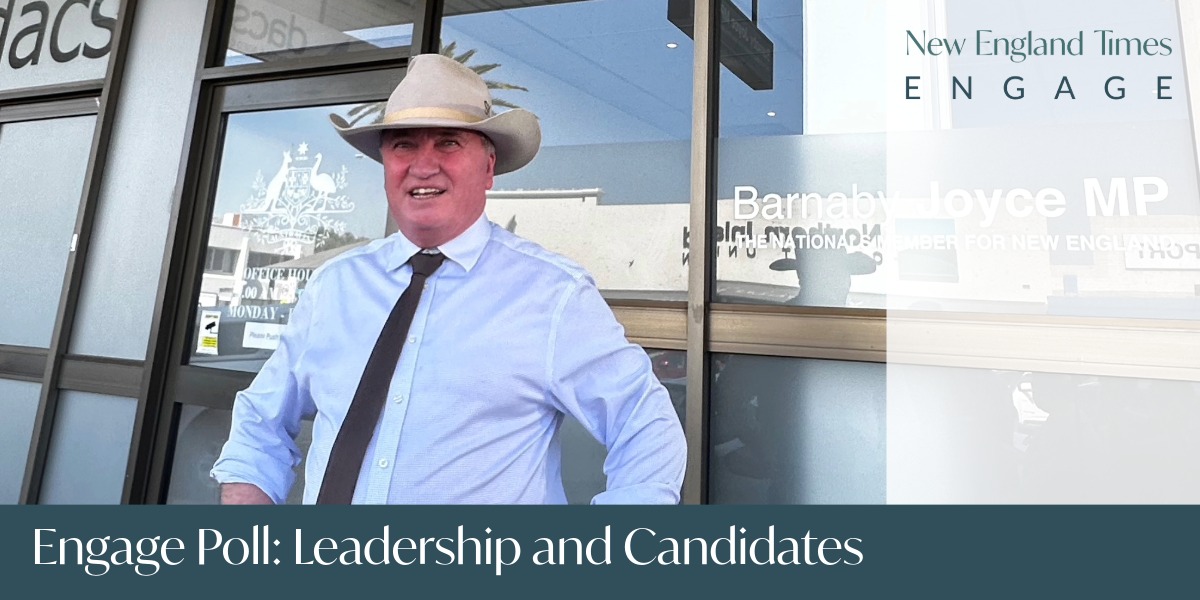
Below are the responses to Engage Poll number 11 on Leadership and Candidates.
Engage Poll 11 Subject: Leadership and Candidates Collection Dates October 26-31, 2025; (Control Nov 12-14, 2025) Format Online Sources KORE Panel, River (Facebook push, Bluesky, X, LinkedIn organic), New England Times Email, Snowball Total sample 780 (Control 50) Weighting Raking method: age, gender, postcode Effective sample after weighting and cleaning 751 (673 New England) Confidence/Margin of error 95% / 3%
A number of these questions were also asked in the lead up to the Federal Election earlier this year, see results here for comparison.
Technical note: due to the immediate emotional response to the news of Barnaby Joyce’s intention to not stand again at the next election and the various rumours about his plans, a control sample of an additional 50 members of the KORE Panel were polled two weeks after the initial frame to assist with assessing any bias in the original responses. They are not included in the statistics below, but their responses did not differ markedly from the primary sample, confirming the validity of the below results.
Barnaby Joyce resignation
Read our analysis on New England Times
The results for these questions have been limited to New England voters (n=673, C 95%, MOE 3.5%).
In your opinion, has Barnaby Joyce been a good member for New England?
The part that many in the city don’t understand is that regardless of whether you like him or his politics, Joyce is an effective local member. If you go to him with an issue, the vast majority of the time he’ll at least write a letter. You invite him to something, he usually turns up. And as a result, the proportion of New England voters that think he has been a good member for New England is higher than his primary vote.
Would you like to see Barnaby Joyce change parties, as has been speculated?
Much of the hyperbole and gossip was about whether Barnaby Joyce was intending to depart the National Party and join One Nation. While he has never said anything to indicate this was his plan, that was what was being reported by city media, and thus many people believed. In the New England, however, there is not very much support for such a move, or starting his own party, or going independent. 45% of respondents said they didn’t know or didn’t care, and lots of comments that they just wanted him to quit.
Given he has announced he will not contest the next election, do you think Barnaby Joyce should stay in his seat until the next election?
One of the more immediate responses in the social chatter was people demanding that Joyce resigns immediately and trigger a by-election. Noisy though those people may be, there is no support for a by-election, with the majority wanting him to serve out his term.
Would you like Barnaby Joyce to change his mind and run again at the next election?
There is a very clear sense that Joyce’s political career has run its course in the New England – but for those thinking he’ll have a third act by returning to the Senate are going to need to find those votes somewhere else, with only 10% of respondents supporting a Senate run. Even amongst those who voted for him earlier this year, a third don’t think he should change his mind, and less than half want him to stand for New England again.
Candidate Attributes
This section asked a number of questions about who people would like to vote for.
Describe your ideal candidate – who would you like to vote for to represent you?
The most common desired qualities in an ideal candidate were someone who will honestly listen, understand, and work hard to represent local people and concerns. Agriculture, renewables, and health were the most referenced policy positions, while farmer, a woman, and ‘someone like Tony Windsor’ were common also common descriptors.
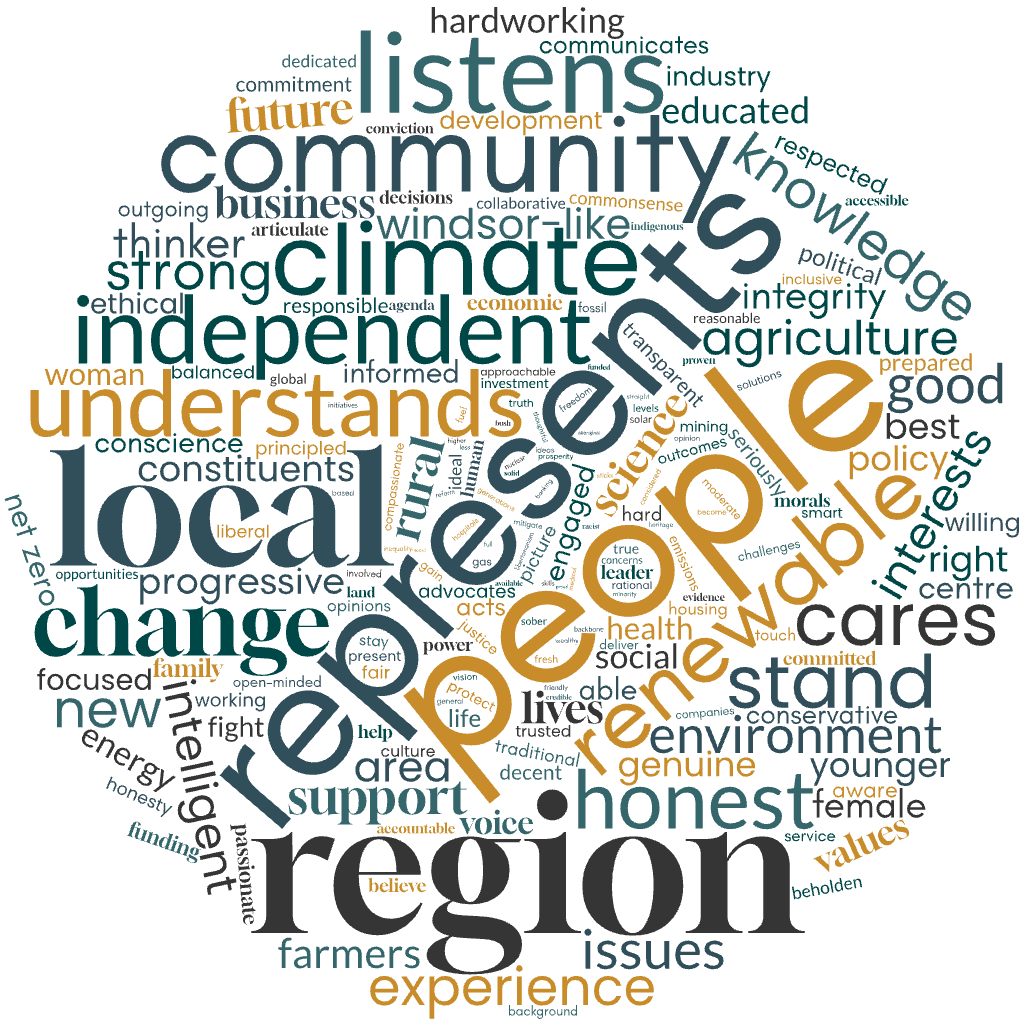
Word cloud of responses to open text questions on ideal candidate, New England Times Engage Poll 11.
Can you name anyone that you would really like to see run as a candidate in a future election?
Around half of the respondents were able to name someone they would like to vote for, but very few names people who were not already politicians. This test is not particularly indicative at this point in the cycle, but serves as a good baseline for testing who has momentum and is increasing their supporter base gong forward.
Adam Marshall, the recently retired state member for Northern Tablelands, was the most commonly named person that people said they would like to vote for, with more than a quarter of responses. The other two in the top ten who are not currently an elected politician of some kind are Heidi Hallam (staffer to Barnaby Joyce and new chair of the Tamworth branch of the Nationals, ran for Tamworth Regional Council last year as Heidi Williamson prior to getting married recently), and former NFF President Fiona Simson.
Gender preference
A number of respondents in our pre-election poll on similar issues nominated that they would really like to see a woman in the job, so we added this question directly. The vast majority of voters do not care about gender, which is normal, but the 10 point difference in male versus female in those who do care would give most political operatives pause in choosing the next candidate.
Which of the following is important to you in deciding if you would consider voting for a candidate?
A smaller list of factors than our pre-election poll delivered similar results, with issue position and living in the electorate being the most important factors, and more than half of respondents consistently saying that party affiliation is not important.
Is there any personal attribute or other factor that a candidate must have for you to vote for them? What’s your dealbreaker?
Another open text question, but this one yield a lot more about the negative side of what people want or will not tolerate – and honesty emerges much more clearly as the number one thing New Englanders want from a politician.
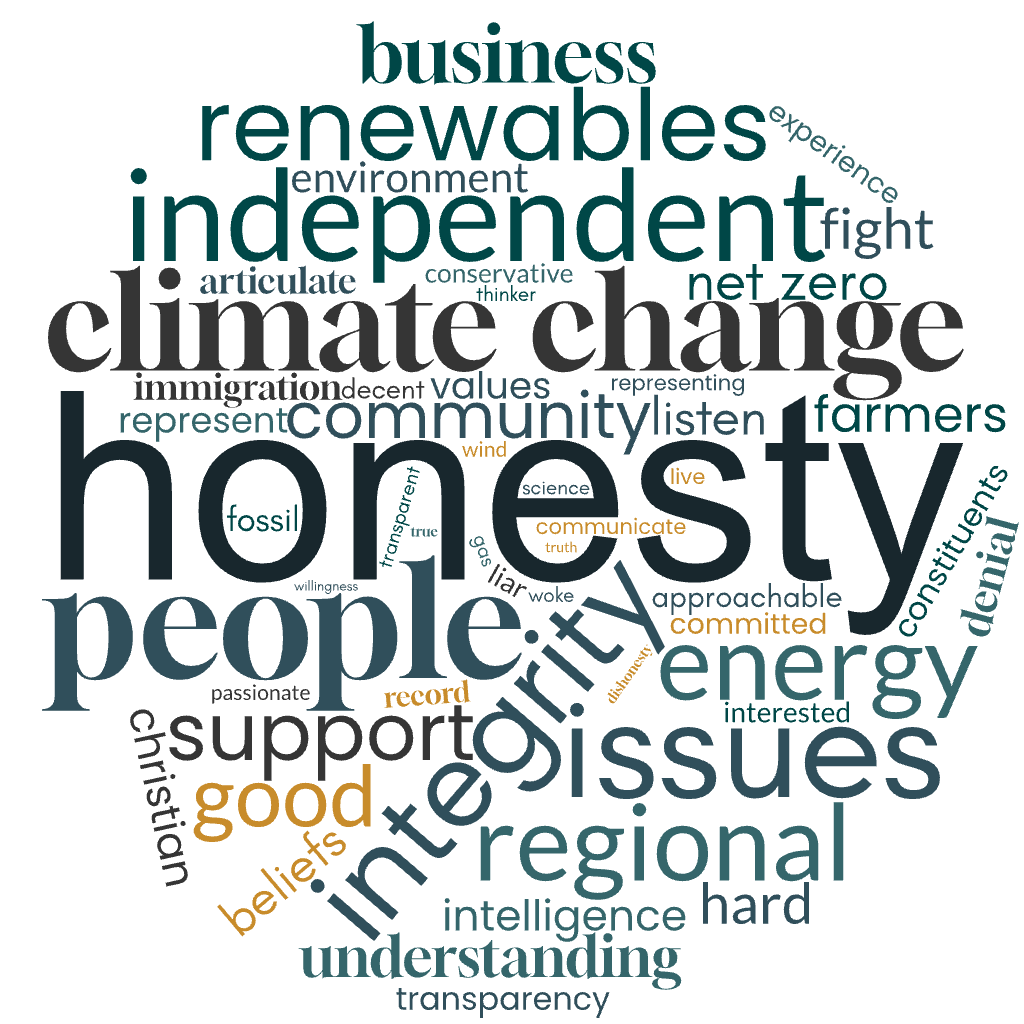
Word cloud of responses to open text questions on personal attribute dealbreaker, New England Times Engage Poll 11.
Independents
Have you voted for an independent candidate at any election in the past?
A high proportion of New Englanders have previously voted independent, because of our history of independent members at state and federal elections.
If you were to vote for an Independent candidate, what would be the most likely reason?
Aligning with the historically high support for independents and most desired values being honesty and integrity, a solid majority of New Englanders would vote independent if they were genuinely the best candidate. There has been significant movement in these figures since the last election, with strategic voting to remove the incumbent dropping markedly.
Would you be more or less likely to vote for an independent candidate if you knew they had received money from Climate 200?
Climate 200 is a private organisation that raises money to direct to “climate focused community independents” and are linked with ‘teal’ independent candidates. We have been tracking the impact on voting intention for Climate 200 backed candidates for some time, and this result continue the trend of Climate 200 support being a net negative influence on voters in the New England. It is important to note, however, that this is predominantly due to fear of money influencing elected representatives – some of those who would never support a Climate 200 supported candidate under any circumstances also commented heavily against the influence of Gina Rinehardt’s money on Barnaby Joyce.
Directly Elected Mayors
Are you happy with how your local council is going at the moment?
While the attitude towards council performance was fairly flat overall, there was significant variance between councils. Most areas are too small for the sample to be confidently relied upon, but use the drop down to see figures for Tamworth Regional Council, where 65% of respondents were unhappy; Armidale Regional Council, which is almost perfectly split between happy and unhappy; and Inverell Shire Council, where just 2.5% of respondents were unhappy.
What do you think is the best way to decide who the Mayor is in your council area?
The issue of whether to have a directly elected mayor was being discussed in TRC, who voted against doing the research on it, so we asked the whole region their views. The views were not as clear cut as some on Tamworth Regional Council argued during their debate on the issue, with less than a majority wanting directly elected mayors in Tamworth, Armidale and Inverell. At the moment the only council in the region that has a directly elected mayor is Uralla, so we have included them in the chart – 64% support for directly electing the mayor – but note the small sample (n=53). Support for the councillor with the most votes getting the mayor – despite the widespread online chatter from people that thought that’s how it should be after last year’s elections – had the lowest support of all three options.
Do you think a Council with a Directly Elected Mayor is better, no different, or worse off, as a Council elected Mayor in any of the following areas?
It’s not clear to what extent people really understand what a directly elected mayor would mean, but a majority of respondents think it might be the same or better than a council elected mayor in key performance areas.
Got something on your mind? Go on then, engage. Submit your opinion piece, letter to the editor, or Quick Word now.