
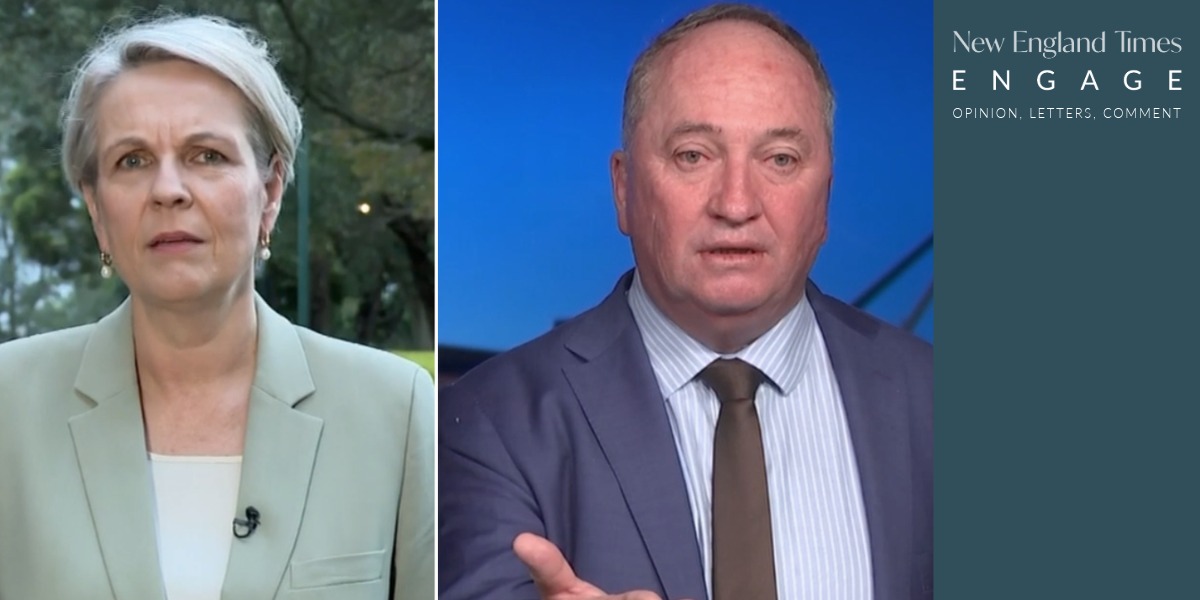
Watching the exchange between Barnaby Joyce and Tanya Plibersek on Sunrise last week illustrated something troubling about modern political debate. It wasn’t simply a disagreement about fuel security or energy policy. It was a case study in how misinformation becomes normalised when it is repeatedly given a national platform.
Democracy depends on robust disagreement. But disagreement only works when arguments are grounded in evidence and when political actors are held accountable for their own records.
During the segment, Barnaby Joyce argued that government climate policies had left Australia vulnerable to fuel shortages. It is a striking claim — and one that collapses almost immediately when subjected to even basic scrutiny.
Australia’s vulnerability to fuel supply disruptions has very little to do with climate policy. It is primarily the result of our heavy reliance on imported crude oil and refined petroleum products. Petrol and diesel used in vehicles, freight transport and agricultural machinery are overwhelmingly sourced through international markets. When geopolitical tensions disrupt oil supply routes or global prices spike, every oil-importing country feels the consequences.
Wind turbines and solar panels do not determine the flow of crude oil through the Strait of Hormuz.
Yet the claim that renewable energy policy somehow caused Australia’s fuel security vulnerability continues to be repeated in parts of the political debate, particularly by Joyce. The logic behind it is difficult to follow. Renewable energy primarily generates electricity for the power grid. Petrol and diesel come from refined crude oil used in transport and industry. These are fundamentally different energy systems.
Suggesting that renewable electricity generation caused fuel shortages is therefore not just wrong — it reveals either a fundamental misunderstanding of how the energy system works or a willingness to blur the facts for political effect. I think the answer in Joyce’s case is a little of both.
More striking still is the political amnesia embedded in the argument.
Australia’s domestic refining capacity did not suddenly collapse in the past year or two. It declined gradually over more than a decade as global refining markets consolidated and older facilities became commercially unviable. Several refineries closed during the years when the Coalition held government — including the period when Barnaby Joyce served as Deputy Prime Minister.
If Australia’s fuel security arrangements were inadequate, those were precisely the years when the politicians now expressing alarm had the authority to address the issue.
This is where the hypocrisy becomes impossible to ignore.
Joyce has spent years at the centre of national government, helping to shape the very policy landscape he now condemns from the sidelines. To appear on national television railing against vulnerabilities that developed during his own time in office is not just political opportunism — it is the behaviour of a consummate political hypocrite.
Yet the television segment itself focused on the theatre rather than the contradiction.
Claims were made, voices were raised and viewers were left with the impression that two competing opinions were simply part of the usual political contest. But not all claims carry equal evidentiary weight.
Communication research describes what happens next as the illusory truth effect: when statements are repeated often enough, people begin to perceive them as credible regardless of their factual accuracy. Familiarity begins to substitute for evidence.
This dynamic helps explain a strange paradox in modern Australian politics.
Despite the constant narrative that Australia is somehow in economic or social collapse, the evidence suggests the opposite. By almost every international measure — life expectancy, income levels, democratic stability, educational attainment and overall quality of life — Australia remains one of the most prosperous and stable countries in the world. Our standard of living continues to rank among the highest globally.
That does not mean Australians are not facing real pressures. Housing affordability, energy costs and access to services in regional communities are genuine challenges that deserve serious policy attention. But acknowledging those issues is very different from insisting that the country itself is in systemic decline.
Yet the language of crisis is repeated constantly in parts of the media ecosystem. Over time repetition transforms rhetoric into perceived reality for some audiences.
This is where media responsibility becomes important.
When highly misleading claims are repeatedly given airtime — particularly by prominent political figures like Barnaby Joyce — those platforms risk legitimising narratives that erode public trust in democratic institutions and in the political process itself.
Ironically, many of the same political figures who promote these narratives also lament declining public confidence in democracy.
But trust in democratic institutions is not strengthened by continually telling citizens that their country is broken — particularly when those delivering the message helped shape the very policies they now condemn.
Australia’s political debate would benefit from more disagreement grounded in evidence and far less tolerance for arguments that collapse the moment the facts are examined.
Because democracy works best when public debate is shaped by reality — not by repetition, theatre and selective memory.

Denise McHugh is an experienced educator in Tamworth. She is Chair of the NSW ALP Education and Skills Committee and Deputy President of the Independent Education Union (IEU).
Got something on your mind? Go on then, engage. Submit your opinion piece, letter to the editor, or Quick Word now.