
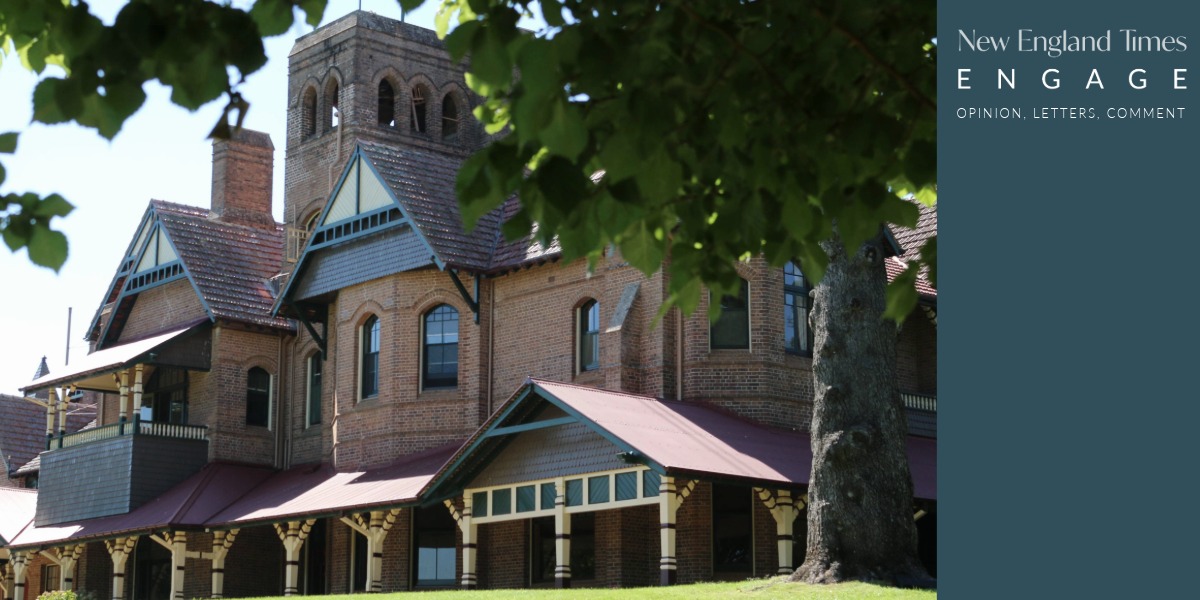
I’m one of hundreds of people coming to Armidale during the autumn 2026 graduation season, in my case to celebrate receiving my master’s degree from the University of New England. It’s a time to celebrate but also to reflect on what we’ve learned and will take forward from our experiences. In my case I’ll be forever grateful to the University and its people for facilitating the intellectual learning, personal growth, and vocational growth that flowed from my degree, particularly given such things were supported through the middle of some extremely trying times.
But to the side of such wonderful direct personal experiences, I’ve been reflecting on some of the more troubling institutional issues that got exposed during my studies, particularly across the period of 2020 to 2022. This period started with the closing in of global pandemic, progressed through some of the deepest university staffing cuts in the country, and peaked with the forced resignation of the former Vice Chancellor, Professor Brigid Heywood, in August of 2022 after she was charged with assaulting a school student at an International Women’s Day event earlier in the same year.
As we would all know, Professor Heywood much later and reluctantly admitted inappropriate conduct.
As I get ready for my graduation ceremony, I’ve been thinking about all these things but particularly the resignation of the former Vice Chancellor. This is because I thought and continue to think that there are further institutional lessons to be learned from what happened.
I’m able to make such comments from an uncommon perspective as well. My point of view is informed by having been elected to the University’s Academic Board for a two-year term, commencing in March 2020 whilst early pandemic lockdown consequences were starting to bite. By the time the former Vice Chancellor resigned I had not long finished an unusually demanding term of service, during which I had periodic and significant engagement with Professor Heywood.
I wish I could say I was shocked by the incident that ultimately prompted her resignation, allied with a Sydney Morning Herald investigation which uncovered substantial evidence of further unusual, inappropriate, or unreasonable conduct. But despite having respect and admiration for the better characteristics of the former Vice Chancellor, I had seen enough to be saddened rather than entirely surprised at learning more about her flaws and the impact they had on people.
At the appropriate moment I reported what I had personally seen and experienced to the Chancellor of the time. I also called for a full and proper investigation into what had occurred. I was not remotely the only one saying similar things back then. An institutional investigation probably would have been forced if the former Vice Chancellor had tried to remain in place for longer, but it never came about owing to her relatively prompt departure.
What we missed out on as a result, was not just the proper and more fulsome testing of all kinds of allegations, but also the adequate probing of deeper questions about how all of this seemed to have been allowed to escalate and deteriorate in plain sight, across years of crisis when the former Vice Chancellor should have been focussed on supporting and leading communities. She certainly should not have been roaming through Armidale supermarkets accosting unsuspecting citizens for not wearing face masks, particularly when the person in question turned out to have a medical condition exemption.
Given what happened, a group of questions that should have been interrogated more closely included whether governing council structural composition, size, and accountability base were adequate for the task of supervising its former most senior executive officer.
Recent wider developments give some clues as to what such an inquiry earlier might have found. At the Federal level, in a final report delivered 11 December 2025, a Senate Committee Inquiry into the quality of governance at Australian higher education providers recommended that state and territory governments “review the establishing acts of universities to ensure the primacy of public research and education in their objects and functions, and consider the composition of members on governing bodies that ensure this can be achieved.” This was partly in response to submissions complaining of the corporatisation of public universities and calling for the re-democratisation of undemocratic governing councils.
The University of New England is typical in this regard with only three members direct-elected on a governing council of thirteen. Since then, a New South Wales Legislative Council Inquiry into the State’s universities handed down an 8 April 2026 interim report, expressing concern about corporatisation and saying “it is deeply troubled by the substantiated pattern of underrepresentation of elected academic staff, professional staff and students.” That inquiry has been focussed on more recent university sector troubles and foreshadows the possibility of broader changes that will require more elected governing body representation. But such comments could easily have applied to the old situation at the University of New England too.
We surely all hope that the particularly sharp crisis moments of 2020 to 2022 will never be repeated. But new and potentially more pressing challenges can always arise, as the University reminds us with its promise to make students ‘future fit’ in the sense of providing the education that will allow us to adapt and thrive in a fast-changing unpredictable world.
I genuinely feel that my education has helped me in such ways. But as an institution, the University can also learn from its past to make its own governance future fit for whatever might come, not just to guard against future problems but to also more fully access and unleash the capacities of its communities.
This autumn is a moment when us graduating communities are starting to implement and extend what we have learned in our various spheres. But with winter coming there’s also an opening for the University itself to incorporate lessons from the past and start to re-democratise of its own accord, precisely to help make itself future fit for whatever might come.
Adrian Cardinali was the Head of Advocacy Services at the Sydney University Postgraduate Representative Association between 2009 and 2020, before commencing and now completing a Master of Arts in Italian Studies at the University of New England. He also served a term as an elected member of UNE’s Academic Board from March 2020 to February 2022.
Got something on your mind? Go on then, engage. Submit your opinion piece, letter to the editor, or Quick Word now.
As a supplementary note to my own article, the Vice Chancellor and the NTEU gave evidence to the above-linked NSW Inquiry the day after my piece was published. Anyone interested in deeper engagement with the issues I’ve raised should read the transcripts of both sets of evidence when they become available. I don’t agree with the Vice Chancellor on all of his solutions to a series of sharp governance issues raised therein. I certainly more than stand by my call for a greater degree of democratisation of the governing council. Yet I can say such things and still recognise that he articulates genuine challenges and his own approach to them with admirable clarity. Meanwhile the contrasting NTEU Branch evidence reflects the maturity and quality of their leadership, born out of navigating through very tough times. Both should be read as part of mature conversations about University direction from here.
Thank you Adrian for recounting your time at UNE during this very sordid period in the university’s history. Your commitment to ensuring students have a voice in the institution is really admirable. I hope the NSW inquiry etc result in some governance reforms that allow staff and students to interact more directly with governance as a routine part of working/studying here.
I concur with your assessment of Prof Moran and his approach — I think he should be commended for some aspects of what he’s done in his time but the reality is that structural problems aren’t addressed by nice words or more amiable managers.
As a retired academic polymath with a clutch of UNE degrees across several faculties, achieved over a 40 year period, I offer my two penny worth.
UNE administration (Boolacrats) have spent a life-time failing to promote UNE as an entity where academic excellence is expected and practiced. Naturally, there are too few exceptions to this observation, but they are/were outstanding examples of academic scholarship, and the ability to inspire students to achieve beyond their wildest dreams.
The 1990s attempt to get a Law Faculty was aborted by then the Vice Chancellor, the hard working initiator was passed over for academic promotion when finally the Law faculty was later established. This has been the UNE corporate practice in several faculties to my knowledge. Drama was one of the worst examples. Education Administration another heartless example.
The failure or refusal to establish a UNE Teaching Hospital simply because a commercial hospital supplier reported that ”the local market was too small for a third hospital in Armidale” was another debilitating cost to the Armidale community. For the record, the opportunity was in ”tourist medicine” for metropolitan persons wanting elective surgery ”immediately” and only a one hour flight away, with the protection of Australian consumer law.
Indeed, with far too few exceptions who were too widely spaced in time, a sceptical observer could readily conclude that generations of Boolacrats spent their days shuffling papers and contemplating their navels rather than working to make UNE a better, or the best place to be. So an unchallenging work place was created for their personal comfort. Was this the desired result of the so-called ”Dawkins Reforms”?