
As Chair of the NSW ALP Education and Skills Committee, I read a lot of polling. But I rarely stop and reread a result because it genuinely surprises me.
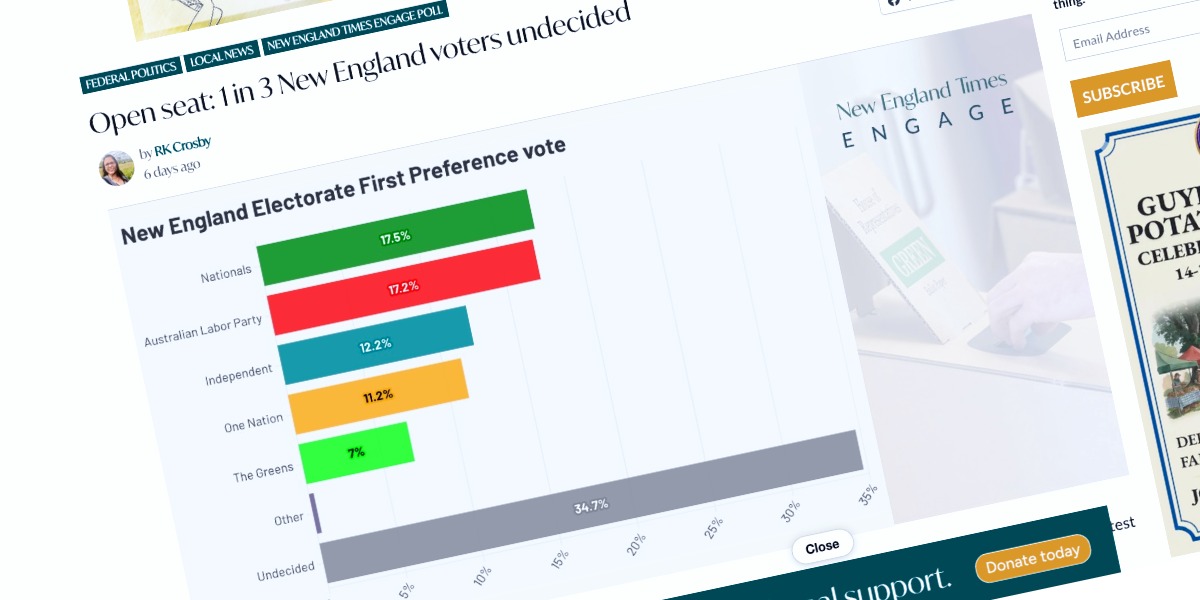
The latest New England Times poll did exactly that.
According to the poll, more than one in three voters in our region say they are undecided about who they will support at the next federal election. In a seat that has been considered safely conservative for generations, that is not a small movement. It is a profound one.
What this indicates to me is that this is not a protest vote. It is not a fleeting mood. It is a signal that something deeper is shifting.
For a long time, New England politics has been defined by certainty. Not necessarily enthusiasm — but expectation. An understanding of how things “normally” go. A sense that outcomes are largely predetermined. This poll tells us that certainty is fading.
And while some will see that as instability, I see something else: possibility. From where I sit, that undecided vote is not confusion. It is discernment.
People are thinking. Weighing. Reconsidering. Asking questions that perhaps have not been asked out loud before. Not because they are angry, even though some would be, but because they are thoughtful. Not because they are disengaged, but because they are engaged enough to pause.
That is a healthy thing in a democracy. It suggests a community that is no longer voting on habit, but on expectation. No longer loyal to labels, but attentive to outcomes.
And that creates opportunity — not just for political parties or independents, but for the electorate itself. Because being “in play” is not simply a tactical advantage for campaigns. It is leverage for communities. It is the difference between being taken for granted and being taken seriously. When a seat is safe, it is easy to be overlooked. When a seat is competitive, it is listened to.
That is the quiet power in this poll result.
From my perspective, working in education and skills, this shift invites a very practical question: what could become possible for New England if it is no longer taken for granted?
Because education is where political leverage becomes real. It is where being “in play” translates into outcomes.
Early childhood education is a case in point. For too long, childcare in regional communities has been treated as an afterthought — something families are expected to solve privately, even though its consequences are public. Anyone who has tried to find a place in a regional town knows this is not just about convenience. It is about whether parents can work. Whether businesses can find staff. Whether communities can function.
When a seat is considered “safe,” these structural issues are easy to ignore. When a seat becomes competitive, they are much harder to sideline. That is the opportunity this poll creates.
Because early childhood is not a niche issue here. It is an economic one. It determines workforce participation, business viability and population stability. And it is exactly the kind of issue that benefits when governments are paying attention — when regions have a voice rather than an assumption attached to them.
Being in play changes the conversation. It moves childcare from the margins to the centre.
The same is true of TAFE — perhaps even more so.
TAFE is both a state and federal responsibility. Funding, policy settings and priorities are shared. And when regional seats are treated as foregone conclusions, vocational education is often the first thing to be thinned out, centralised or quietly deprioritised.
We saw that here. The Coalition didn’t just underfund TAFE — the State Coalition government sold off Scone TAFE. A public asset, built to serve this community, gone. Not repurposed. Not upgraded. Gone.
That was not just a property transaction. It was a statement. It said regional training was expendable. That communities like ours could make do with less. That opportunity could be relocated.
And we have been living with the consequences. Because when TAFE disappears, young people leave. When courses vanish, skills vanish with them. When training is centralised, opportunity is too.
Local businesses struggle to find workers. Apprenticeships become harder to access. Career change becomes more difficult without relocation. Families watch their children move away — not for adventure, but for necessity.
That is not progress. That is slow erosion. That is what being taken for granted looks like. Which is why this poll matters. Because when a seat is no longer “safe,” those kinds of decisions become harder to justify. When an electorate is in play, its needs carry weight. When communities are noticed, their losses are harder to ignore – they have electoral consequences.
Strong TAFE is not nostalgia. It is infrastructure. It is economic plumbing. It is how regions renew themselves. And early childhood is the same. It is not a social add-on. It is how families stay. How towns grow. How work becomes possible.
This is the quiet power in uncertainty. When certainty fades, space opens. When space opens, influence grows. And when influence grows, opportunity follows.
That is what this poll is really telling us. Not that New England is confused — but that it is positioned. Positioned to be heard. Positioned to ask more. Positioned to expect better.
And this is where the broader opportunity sits.
At both state and federal level, Labor is in government. That is not a slogan — it is a structural reality. It means that, right now, there is alignment between Canberra and Macquarie Street. That alignment creates potential. But only if regions choose to engage with it.
And I say this as someone who has contributed to Labor campaigns in a very conservative seat for over twenty years. I have seen the doors close. I have heard the “not here” and the “not now.” I have watched effort go unrewarded.
That is why this moment and the poll matters. This seat is no longer “safe.” It is in play. And that is a good thing. Because democracy works best when no one is taken for granted and evall contenders have to earn support.
For Labor, this is a moment — not to lecture, not to posture, but to listen, to engage and to show that we are serious about governing for New England too.
One in three undecided voters is not a problem. It is a message. And it is an opportunity. But it is not an opportunity only for political parties. It is an opportunity for the electorate. An opportunity to be heard. An opportunity to be noticed. An opportunity to insist on outcomes.
This is not about turning New England into something it is not. It is about making sure New England is not overlooked. It is not about abandoning tradition. It is about expecting delivery.
The undecided voters in this poll are not rejecting politics. They are inviting it to do better. They are saying: show us. Listen to us. Take us seriously.
And that is something worth reflecting on — calmly, thoughtfully and without fear. Because when certainty fades, possibility begins. And right now, New England has both.

Denise McHugh is an experienced educator in Tamworth. She is Chair of the NSW ALP Education and Skills Committee and Deputy President of the Independent Education Union (IEU).
All opinion and comment on New England Times Engage is the opinion of the writer and not New England Times.
Got something on your mind? Go on then, engage. Submit your opinion piece, letter to the editor, or Quick Word now.
the sad state of the new england highway and inland rail is barney’s legacy
Phillip Granger The N E highway has been terrible for a very long time, Don’t blame Barnaby for the state it is in
Julie Virtue Barnaby’s been there for a very long time…..hmmm linkage?
Julie Virtue so Barney did nothing for new England but looked after Gina’s interests
Phillip Granger the Inland Rail deviation passed his property, maybe!
The report confirms that the myth of Coalition competence is just that – a myth. People want competence and a work ethic, something sadly lacking under Joyce’s representation.
Until the candidates for each party have been announced no one can make a firm statement who they will be voting for
Julie Virtue yes they can…
Julie Virtue They can in the New England,they are stitched on to the Nationals believing they still support country people.
Denise you have nailed it! I will be down to help election day.