
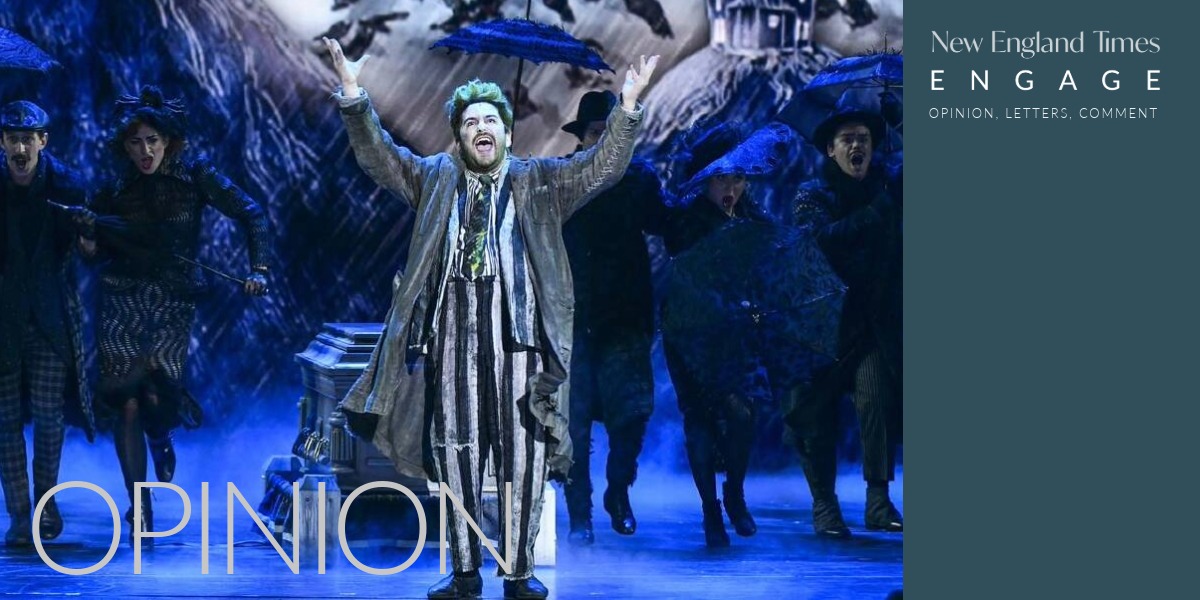
In the Brisbane production of Beetlejuice, even the house seemed to breathe. Projections moved across its walls, the choreography was razor-sharp, illusions arrived before I could work out how they had happened and the puppetry was completely unhinged. At one point, I found myself watching a dancing pig and thinking, quite sincerely, “Yes, this is art.” For a musical obsessed with “the whole being dead thing”, it was, somehow, one of the most alive things I had ever seen.
I should have been watching it in Sydney, but planned seasons in Perth, Adelaide and Sydney had been cancelled as rising touring costs made continuing the Australian production unsustainable. Three weeks after surgery, not yet medically cleared to fly, I used Qantas points for the flight and hotel and made a last-minute theatre pilgrimage to Brisbane because I was not prepared to miss the ovation. The cast deserved it; the writers, musicians, dancers, designers, technicians and creative team bloody deserved it.
The whole being alive thing
I thought I knew what had carried me all that way to sit in a dark theatre: one song. I had built much of the pilgrimage around hearing my favourite rock ballad from the original Broadway cast recording, Dead Mom, live. My mum died before she saw me become engaged, marry, complete my PhD or raise my boys and I thought Dead Mom would be the song that undid me. Instead, Home found the bruise I had not expected. Lydia has searched for her mother in the Netherworld and discovered she cannot bring her back; where Dead Mom reaches for the person who is gone, Home turns towards the life that remains. I went for Dead Mom and came Home thinking about how fiercely I wanted to live and love the life I still had.
The production kept making absent things present, giving grief music, story, movement and shape. We ask the arts to do this constantly: at weddings and funerals, in worship and celebration, through story, song, image, movement and ceremony. Across Aboriginal and Torres Strait Islander cultures, song, dance, story and visual practice are living traditions through which knowledge, Country, kinship and memory continue across generations. We have woven the arts so thoroughly through the rituals of being human that we barely notice they are there; and somehow, when we construct a school timetable, they can still become peripheral.
What arts makes possible for students
As I watched, the stage began filling with people who were not actually there. I mentally cast former students: the one with perfect comic timing, those who found their people in an ensemble, and the backstage crews who learned trust and collaboration. Later that night, a student I had not taught for nine years contacted me after seeing someone overseas who reminded him of me and thanked me for giving him time when he had struggled. I had spent the evening remembering what the arts had made possible for students; his message reminded me how far some of those experiences can travel.
What travels from an arts classroom is rarely the finished work alone. My doctoral research found that drama gave young people space to explore identity, relationships and choices. Australian music research connects sustained participation with belonging, social connection and wellbeing, while Visual Arts research shows how artmaking can help adolescents give form to personal experience and work through emotions and beliefs that may be difficult to articulate. Across dance, drama, music and visual arts, a two-year Australian longitudinal study of 643 students found arts participation was associated with stronger motivation and engagement, alongside self-esteem and life satisfaction. Arts education is not about turning every child into a professional artist; what young people take from it can remain in how they understand themselves, connect with others and make meaning long after the finished work is gone.
Before the ovation
Every person I applauded in Brisbane had started somewhere else: a first arts class, a teacher, a chance to create. Across Australia, those opportunities are narrowing. Gattenhof and Saunders‘ national analysis shows how much is being lost before the curtain ever rises: between 2015 and 2023, senior secondary arts participation fell 21 per cent nationally, while 48 creative arts degrees were discontinued between 2018 and 2025. From my seat in Brisbane, those figures made me trace the production backwards, towards the classrooms, teachers and courses that had made that night possible.
Australia keeps expecting the curtain to rise while weakening what makes the performance possible. We still call on the arts to hold memory, express grief, celebrate, worship, imagine and belong; yet we are becoming less willing to sustain the subjects, teachers and courses behind them. Arts subjects still have to prove they deserve room in the timetable.
In Beetlejuice, visibility depends on a name. The joke at the centre of Say My Name is that Beetlejuice can become visible to the living only when his name is spoken. By the end of that night, Say My Name sounded less like a joke and more like an instruction. Say the actors’ names; then say the musicians, dancers, writers, designers, makers and technicians whose collective work made a house breathe. Keep tracing the production backwards and there are more names still: the teachers, schools and communities that first gave each of them somewhere to discover what they could feel, express, create or become.
Getting to the ovation
An ovation comes at the end, but what makes it possible begins much earlier: in the first rehearsal, the first artwork, the first song, and the moment somebody recognises possibility and gives it somewhere to grow. The arts have always shown up for us at weddings and funerals, in ceremony and celebration, in classrooms and theatres, for grief, memory, possibility and hope. Showing up for them now means protecting the teachers, subjects and pathways through which another generation can find what they do not yet know they need.
I was not prepared to miss the ovation in Brisbane; Australia must not wait until the final bows to decide the arts were worth standing up for.
Cathryn Horvat is a researcher, drama educator and curriculum leader specialising in digital citizenship, ethics and responsibility in digitally mediated environments. She holds a PhD from the University of Sydney, Human-Centred Blended Citizens: A Study of Digital Citizenship through Drama Pedagogy, and leads the Teaching and Learning Secondary Curriculum team within the NSW Department of Education.
This article was originally published on EduResearch Matters. Read the original article.
All opinion and comment on New England Times Engage is the opinion of the writer and not New England Times.
Got something on your mind? Go on then, engage. Submit your opinion piece, letter to the editor, or Quick Word now.