
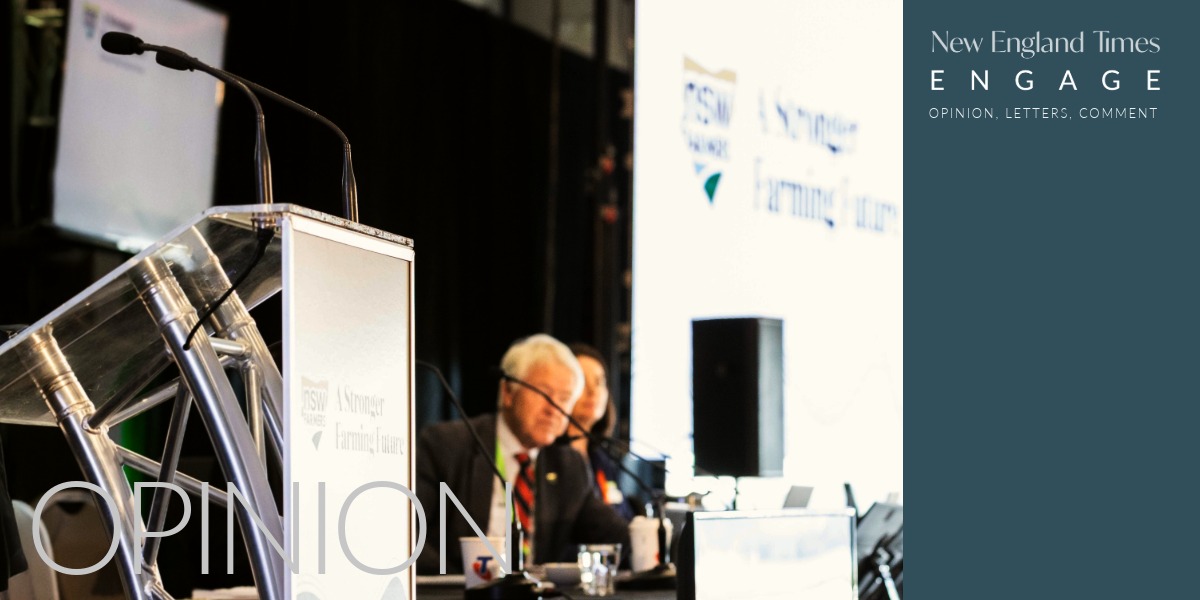
In her speech at this week’s NSW Farmers Annual General Conference, incoming president Bec Reardon rightly called out that farmers today are fighting for their livelihoods against misinformation:
“Advocacy today is more complex and challenging than ever before. We’re really fighting for our livelihoods against misinformation, against ideologies, and against a lot of politicians and decision makers who really do not understand what it is we actually do.”
But what about misinformation from farmers themselves?
In recent years, a very high level of misinformation has been allowed into NSW Farmers conference debate. To be clear from the outset, this is not a problem unique to NSW Farmers, but it’s what prompted this rant and generally a good example of how pervasive misinformation is these days.
I’m not talking about mixing up transmission and generation capacity, although those kinds of factual errors should have been fixed and the issue explained to the movers before they got printed in the compendium.
I’m talking about blatantly absurd claims.
Okay, sure, if you know that (former President of NSW Farmers) James Jackson of Guyra is partial to a little colourful rhetoric, you can probably dismiss this clanger with a chuckle:
“The New England REZ, I think it’s forecast to be eight gigawatts, huge amount, and Sam Copeland up there is hanging out for some better water infrastructure to actually fund construction to supply the water for construction. Because, unfortunately, Armidale is going to have to go without water for about three years while they put it up. And and to be fair, Armidale stinks enough as it is. You know, we definitely want them to shower.”
But what if you don’t know him?
What if that oh-so-funny line about Armidale not having water for three years, and Armidale people not being able to shower, makes its way into a Facebook post?
Or a Barnaby Joyce video?
There is no stopping it.
As the saying goes, “a lie is half way around the world before the truth can get its boots on.”
In a social media-fuelled post-truth world, where it is harder and harder to tell fact from fiction, it’s really much faster than that. The lie has already won in the time it took to press “post”.
When political leaders such as Trump and Hanson and Joyce, alongside a plethora of populist victim-posturing local councillors, undermine sources of truth and facts as part of their tactics to get cheap votes, it often does not matter how fast you get the truth out there. The lies win, and there’s no effective way I know of to combat it.
The same misinformation incubator that has people actually believing that the New England Highway would be closed for 6 days out of 7 can absolutely have people believing that Armidale would have no water for three years. People respond to this stuff with emotion, the rational brain is literally not engaged, there is no thought process that goes “hrm, that doesn’t sound right”.
That is why factual errors at a conference cannot simply be brushed aside as harmless debate.
A motion carried on the floor also carries the authority of the organisation. What is said in moving that motion and printed in the conference compendium may be repeated at a branch meeting, cited in a submission, shared online, or reported by media – as fact. It may used to shape a farmer’s understanding of an issue that directly affects their business, or by a politician to shape policy that affects everyone.
Even if someone checks the claim, corrects it, and publishes the correction, the original assertion is likely already be accepted as fact and shared widely.
I’m not going to embarrass good people by going through the many mistaken beliefs or incorrect assertions aired at conference over the last couple of days. Farmers, like anyone else, are subjected to an overwhelming amount of information, some of which is poor. They’re bombarded by the same misinformation machines and social media algorithms. There is no equivalent of a combine harvester to collect and winnow information efficiently.
Nor do I profess to know everything. I defer to many good people in that room as experts in their fields.
But as someone whose job is to collect, sort, and check information, I know how important it is that organisations with influence – like NSW Farmers – take responsibility for the quality of the information they put before their members and the community.
Once upon a time – and I’ll try not to make this a “when my Dad was senior vice president of NSW Farmers/NFF” lecture – NSW Farmers was very good at filtering the nonsense. The organisation itself blocked motions asking for things that were unreasonable or had already happened, explained where members had got things wrong, and ensured the information sent out by NSW Farmers – including in the motion wording and the supporting statements for the motions – was solid.
Accurate, fair, direct. Never hyperbolic or ideological.
It was a trusted source of information. Farmers could rely on what their organisation said as the hard, accurate facts of the matter.
That did not mean members were always told what they wanted to hear. It meant they could be confident that the position adopted by their organisation had been tested, understood, and grounded in reality. That the information they had been given to consider before asking to vote on it at conference was accurate.
This year’s conference was not as bad as last year, but there were still motions that should not have been on the board: motions calling for culture-war or ideological positions rather than any kind of fact- and science-based rationale; motions asking for things that already existed; motions that just should not have been there.
The number of procedural motions this year – that motions should not be put, deferred to committee, and so on – is itself fair evidence that the way conference motions are assessed and assembled is not what it used to be.
NSW Farmers has seen both a change of president and a number of staff changes lately. Peter Comensoli, himself a former CEO of NSW Farmers in a time when that level of filtering and control of what made it to conference was in place, has also been elected to the Board and will bring with him that institutional knowledge.
Here’s hoping that this is an opportunity for a turning point, to return this critically important organisation to being a source of truth that can be trusted in an increasingly noisy world, and to do more to help its members get the information they need.
That ‘A Stronger Farming Future’ means a stronger grip on the facts.
Because ultimately the only way to stop misinformation is at the source.
And that’s really, really hard when the source is the organisations we should be able to trust.
End rant.

Dr RK (Kath) Crosby is the CEO of research and strategy company KORE CSR, former strategist for the Australian Democrats, and holds a PhD in political behaviour. She is also a well known migraine and health advocate, and the Publisher of New England Times and North Coast Times.
Got something on your mind? Go on then, engage. Submit your opinion piece, letter to the editor, or Quick Word now.