
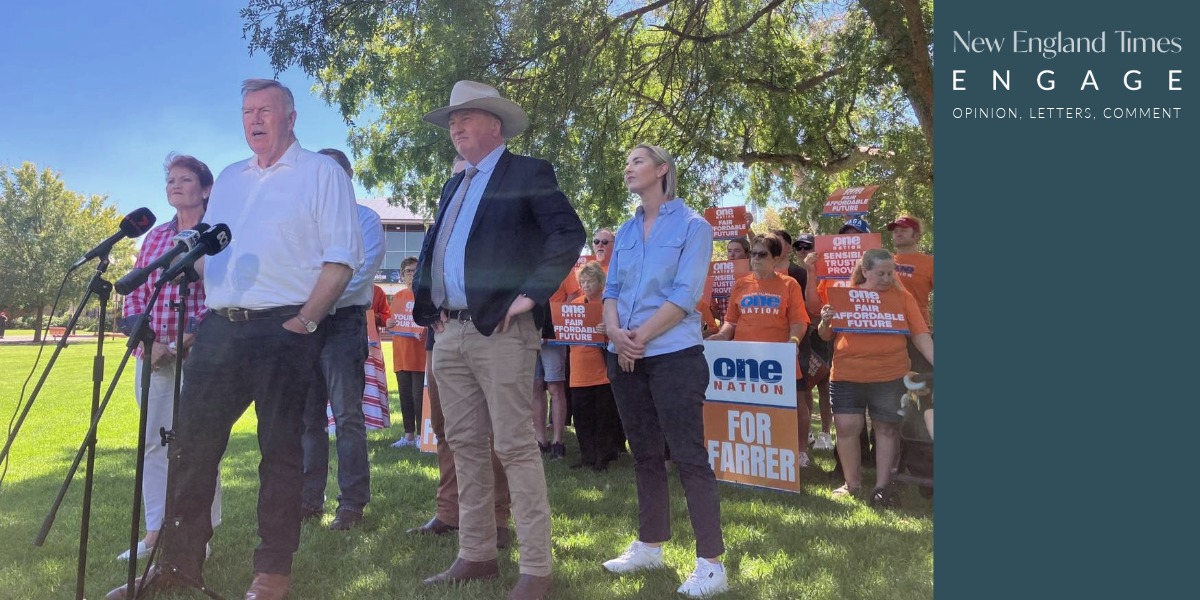
The coming Farrer by-election in southern NSW might seem a long way from New England, but the political warning signs it is sending should concern regional communities everywhere.
Commentator Nikki Savva recently highlighted the real possibility that the contest could come down to a community independent and One Nation. That alone tells us something important: the collapse in trust in the major parties is creating space for protest politics.
Closer to home, New England has already seen how quickly the political landscape can shift. With Barnaby Joyce’s decision to defect to One Nation, our region has suddenly found itself at the centre of the party’s national strategy. That alone should give voters pause. When a protest party begins targeting regional electorates like ours, it is not because it has practical solutions for country communities — it is because it sees an opportunity to harvest frustration.
But protest votes have consequences.
Even Helen Haines, the independent MP for neighbouring Indi, has said the idea that One Nation could seriously contend in Farrer is deeply troubling. And she’s right. Not because regional voters are naïve — quite the opposite. Regional communities understand better than most how fragile local economies can be.
Take immigration. One Nation’s recently announced 2026 immigration policy calls for net migration to be slashed to 130,000 people a year — a dramatic reduction on current levels. The party also proposes an eight-year wait for citizenship, restricting migration from what it calls “culturally incompatible” nations, and withdrawing Australia from the UN Refugee Convention.
It may sound tough, but economists across the political spectrum warn that policies like this would come at a significant economic cost. Australia’s population growth has long been one of the key drivers of economic expansion. Migrants fill critical labour shortages, start businesses, pay taxes and support industries that regional communities rely on.
For country Australia, the impact would be even more immediate. Agriculture, healthcare, aged care, construction and hospitality all rely heavily on migrant labour. Regional hospitals recruit overseas-trained doctors and nurses. My own doctor is from the Philippines. Farms depend on seasonal workers, and many of the major abattoirs across our region would struggle to operate without migrant workers on the processing lines. Small towns rely on skilled migrants to keep local businesses operating. In many regional communities, migration is one of the few things keeping populations stable and services viable.
Economists repeatedly warn that sharply cutting migration would slow economic growth, worsen labour shortages and make it harder — not easier — to keep regional services running.
That’s why the rise of One Nation is not just a political curiosity. It is a real risk to the long-term interests of regional Australia.
In truth, One Nation’s growth says more about disillusionment than ideology. Polling shows many of its voters simply feel ignored by the major parties. When people believe politics isn’t listening, they start looking for someone who promises to “blow the system up.
But anger is not a governing philosophy.
For communities like ours in New England, the danger is obvious. We already struggle for attention in national debates. The answer to that problem is not electing representatives whose politics is built on grievance and division. That only sidelines regional voices further — especially when the real decisions about funding, infrastructure and services are being made in Canberra.
Real influence comes from being part of the national decision-making process — shaping policy and arguing for practical solutions such as better regional healthcare, reliable energy, water security for our farmers and the skilled workers regional communities need to grow.
One Nation offers none of that.
What it offers instead is outrage politics — loud, simple answers to complex problems. That might feel satisfying in the moment, but it rarely delivers results for regional communities that need practical outcomes, not political theatre.
And perhaps this is the real question for New England. If voters are clearly looking for something different, maybe it is time to start thinking outside the box.
For decades this region has largely voted the same way and hoped for different results. Meanwhile, the current federal government holds a thumping majority in parliament — which means the real decisions about national policy and investment are being made on that side of the chamber.
If people genuinely want change, thinking outside the box might mean doing something this region rarely does: voting strategically and being prepared to vote Labor.
Not as a protest vote — but as a serious choice about who is best placed to deliver investment in regional healthcare, schools, infrastructure and jobs.
Because protest votes might feel satisfying for a moment — but they rarely build hospitals, staff schools or keep regional economies strong.

Denise McHugh is an experienced educator in Tamworth. She is Chair of the NSW ALP Education and Skills Committee and Deputy President of the Independent Education Union (IEU).
Got something on your mind? Go on then, engage. Submit your opinion piece, letter to the editor, or Quick Word now.