
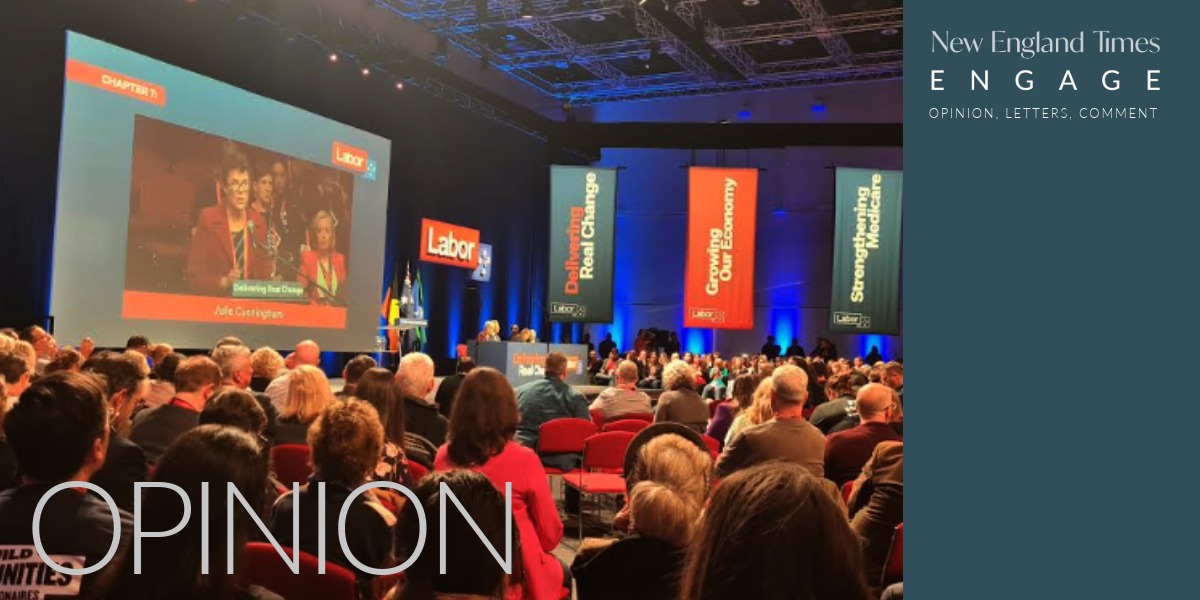
Reflections from my Third Australian Labor Party National Conference
As I looked around the National Conference hall in Adelaide, I saw hundreds of delegates from every corner of Australia.
There were teachers, nurses, tradespeople, students, councillors, parliamentarians, union members, retirees and branch activists. Some had travelled from our largest cities, others from regional towns and remote communities. Young delegates attending their very first National Conference sat alongside members who had spent decades helping shape Labor policy.
They represented different communities, different professions and different generations, yet they shared a common purpose: helping shape policies they believed would improve the lives of Australians.
It was my third Australian Labor Party National Conference, and while the novelty has long worn off, my admiration for the process has only grown.
Politics is often portrayed as little more than Question Time theatrics, social media outrage and thirty-second television grabs. If that’s all people ever see, it’s little wonder many Australians become cynical about politics.
The reality is that the most important work in politics rarely makes the evening news. It happens in branch meetings, policy committees, state conferences, conference debates and countless conversations between members committed to getting the policy right rather than simply getting the headline.
National Conference reminded me of that—and why it matters. Whether you’re a Labor supporter or not, ideas debated here can eventually become national policy.
For three days, hundreds of delegates from every state and territory considered issues that affect every Australian. Housing affordability, education, healthcare, workplace rights, local government, regional development, economic reform, climate policy, artificial intelligence and international affairs were all discussed in detail. These weren’t superficial conversations designed to generate tomorrow’s headline. They were thoughtful discussions about how to improve people’s lives.
What impressed me most wasn’t simply the breadth of policy. It was the process.
Delegates scrutinised policy, amendments were moved, speakers addressed motions, lived experience informed debate and, where persuasive, proposals were strengthened. Ministers listened. Rank-and-file members spoke. Union delegates contributed their expertise. Good ideas weren’t judged by who proposed them but by whether they improved the final policy.
That is exactly how a democratic political party should operate.
Some commentators criticised this year’s conference because not every discussion took place on the conference floor. To me, that criticism misses the point.
Good government doesn’t begin on election day. It begins years earlier, when ordinary members are prepared to put forward ideas, test them, improve them and ultimately help shape public policy.
National Conference is not where Labor policy begins—it is where years of work come together. Policy starts in local branches, where members debate motions, challenge ideas and vote on proposals. Those ideas then move through state conferences, policy committees and consultations before finally reaching the National Conference floor, often after months—or even years—of refinement.
That doesn’t mean debate has been avoided. It means that much of the debate has already happened. That was the process playing out before me in Adelaide.
Of course, discussions continue throughout conference as delegates negotiate amendments, test ideas and work towards consensus. Good policy isn’t produced by the loudest voice in the room. It is produced by listening, compromise and the willingness to improve an idea when a better argument is presented.
Watching that process unfold, I wasn’t seeing politics at its worst. I was seeing democracy at work—a disciplined, organised and professional political party doing the difficult work of governing.
I saw complex issues discussed respectfully. I saw delegates who didn’t always agree, but who listened to one another. I saw policy strengthened because people were prepared to work together rather than simply win an argument.
Watching that process, I found myself thinking: this is exactly the sort of serious, professional political party I want governing Australia.
One of the greatest privileges of attending National Conference wasn’t simply listening to the debates—it was meeting the people behind them.
During the conference I spoke with delegates from every corner of Australia, each bringing a unique perspective shaped by their community and life experience.
I enjoyed wonderful conversations with Fatima Burgruga, a Labor councillor from Cessnock. Originally from Sierra Leone, Fatima has made regional New South Wales her home and now serves her community through local government. Her story reminded me that the Labor movement has always been strengthened by people from diverse backgrounds united by a commitment to public service.
I also met Eamon, a passionate Young Labor member attending his very first National Conference. His enthusiasm was infectious and reminded me that Labor continues to attract a new generation determined to help shape Australia’s future.
Then there was Pam from Sydney’s Northern Beaches, Marcus from Albury, Josh from Broken Hill, Michelle from Toowoomba, Charles from Perth, Ya’qub from Melbourne, and so many others. Looking around the hall, I realised Labor truly is a national movement. Delegates had travelled from every state and territory, representing communities as diverse as the people who live in them. While our local priorities sometimes differed, we were united by a belief that politics should leave Australia better than we found it.
Conference adopted and strengthened a number of practical policies that demonstrated both Labor’s values and its willingness to tackle the challenges of the future.
Delegates supported greater funding certainty for local government, recognising the vital role councils play in maintaining the roads, libraries, sporting facilities and community services that Australians rely upon every day. For regional communities in particular, strong local government is essential to delivering the infrastructure and services that keep communities thriving.
Conference also backed expanding paid practical placements so more students studying teaching, nursing, midwifery, social work and allied health can complete compulsory placements without facing crippling financial hardship. It is a simple principle: no student should have to choose between finishing their qualification and paying the rent.
Delegates supported extending compulsory superannuation to every young worker. If young Australians are old enough to work and earn a wage, they are old enough to begin building their retirement savings.
One of the most forward-looking decisions was endorsing the establishment of a National Fair AI Taskforce to ensure workers have a genuine voice as artificial intelligence transforms our workplaces while developing safeguards and accountability around emerging technologies such as deepfakes. It demonstrated that Labor is preparing not only for today’s challenges, but for tomorrow’s as well.
Among the most significant long-term commitments, however, was Conference’s decision to strengthen Labor’s platform towards including dental care within Medicare through a staged, evidence-based roadmap.
For too long Australians have accepted the absurdity that we treat our mouths differently from the rest of our bodies. Every day people delay seeing a dentist because they simply cannot afford it, often allowing relatively minor problems to become serious health issues. Good oral health is not a luxury—it is fundamental healthcare.
What impressed me about this commitment was that it wasn’t simply a slogan or an unfunded promise. Delegates supported a practical pathway towards achieving universal dental care—recognising both the importance of the goal and the responsibility to implement reform properly. It was another example of Labor setting ambitious long-term objectives while doing the hard work necessary to make them achievable.
One debate that particularly stood out was voluntary assisted dying. Delegates approached one of society’s most difficult ethical questions with sincerity, compassion and respect. There were deeply held views on all sides, yet the discussion never descended into hostility or point scoring.
Conference supported removing outdated Commonwealth restrictions that prevent telehealth consultations relating to voluntary assisted dying—an important reform for people living in regional and remote Australia—while also enshrining in the Party’s Constitution that voluntary assisted dying will remain a conscience vote.
To me, that demonstrated something important. Labor is capable of debating issues of profound moral significance while respecting that good people can, in good faith, reach different conclusions. In today’s political climate, that is something to be valued.
Delegates also supported establishing a Fair Work Court to provide workers and small businesses with a quicker, simpler and more affordable avenue for resolving workplace disputes and recovering unpaid wages. Rights only have real meaning if ordinary Australians have practical access to justice.
What struck me throughout the conference wasn’t that delegates were asking, “Will this make tomorrow’s front page?” Instead, they were asking, “Will this make Australia better?”
None of these policies emerged from a slogan or a media stunt. They were the product of years of discussion in local branches, affiliated unions, policy committees and conferences before finally arriving on the conference floor. That is what serious policy development looks like.
Then came the moment that, for me, captured everything National Conference should be.
Josh Burns, a Jewish Australian, and Basem Abdo, a Palestinian Australian, walked onto the stage together.
Given the pain, grief and division that has accompanied the conflict in the Middle East, it would have been easy for each to speak only of the suffering experienced by their own community.
Both acknowledged the profound pain their communities have endured. Neither sought to diminish the suffering of the other. Instead, they spoke with honesty, compassion and courage about our shared humanity and our shared responsibility to reject hatred, antisemitism and Islamophobia.
The conference hall fell silent.
For a few moments politics wasn’t about winning an argument or scoring points. It was about empathy. It was about leadership. It was about recognising that even on the most difficult and deeply personal issues, respect and compassion must never be lost.
In that moment, the entire conference hall seemed united—not because everyone shared exactly the same views, but because everyone recognised the humanity in what was being said.
It was one of the most moving moments I have experienced at any political conference.
Watching the conference also reinforced something else.
Too often politics today is portrayed as a contest of personalities, slogans and outrage. We are encouraged to believe that strength lies in never changing your mind, that compromise is weakness and that disagreement inevitably leads to division.
What I witnessed in Adelaide was the opposite.
I saw delegates challenge each other’s ideas, move amendments and argue passionately for the communities they represented. But I also saw them listen. I saw them accept better arguments. I saw people who disagreed on particular issues come together once a democratic decision had been made.
That is not weakness. That is democracy.
Unity should never be mistaken for the absence of debate. Quite the opposite. Labor’s unity is the product of democratic debate. Ideas are contested, arguments are heard and decisions are made. Once that democratic decision is reached, the Party unites behind it and gets on with the job.
That is the hallmark of a mature political movement—and, I would argue, of a party ready to govern.
As I boarded the plane home to Tamworth, I wasn’t thinking about who had won or lost a debate. I was thinking about the hundreds of delegates who had travelled from every corner of Australia because they genuinely believe politics can improve people’s lives.
Over three days I watched an organised, disciplined and professional political party at work. I watched serious issues discussed by serious people. Policy was strengthened through evidence, lived experience and compromise. Delegates disagreed, listened, amended and ultimately united behind democratically made decisions.
As a delegate from regional New South Wales, I left Adelaide reassured that the voices of communities like Tamworth were not simply heard—they helped shape the policies that will guide our Party into the future.
Good government doesn’t happen by accident. It comes from listening. It comes from evidence. It comes from ordinary Australians putting forward ideas in their local branches, refining them through policy committees and conferences, and ultimately helping shape the direction of the nation.
I left Adelaide more convinced than ever that I had chosen the right political home—not because Labor is perfect, but because I saw an organised, professional political party doing the serious work of developing serious policy for Australia’s future.
In an era increasingly dominated by personality politics, outrage and social media slogans, that matters.
Because when Australians choose a government, they deserve more than performance.
They deserve a serious party for serious times.

Denise McHugh is an experienced educator in Tamworth. She is Chair of the NSW ALP Education and Skills Committee and Deputy President of the Independent Education Union (IEU).
Got something on your mind? Go on then, engage. Submit your opinion piece, letter to the editor, or Quick Word now.