
There are two things we have done in recent times that generate more reader response than almost anything else we publish. One of them surprises people. The other surprises us.
The one that surprises people is that we push back in the comments.
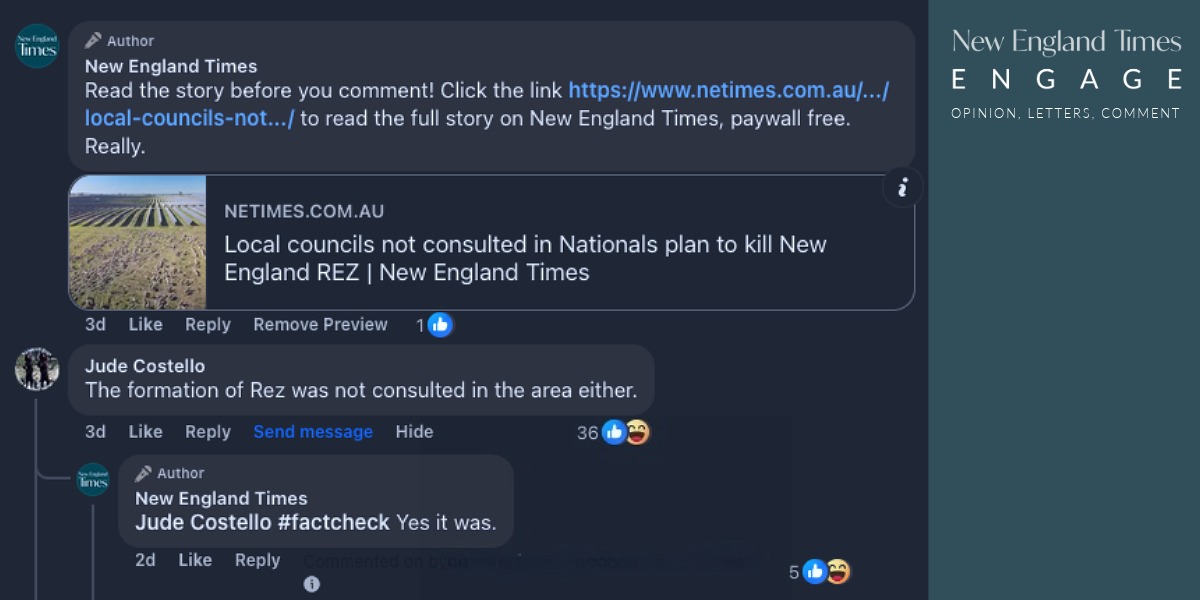
About 18 months ago, on the advice of a social media misinformation expert, the New England Times began actively engaging in the comments on our Facebook page. Not just thanking people for their kind words or apologising for errors, but genuinely pushing back: fact-checking claims, calling out misinformation, and moderating behaviour that turns a public conversation into a shouting match.
The logic is simple, if a little confronting. People are far less likely to post nonsense in a space when they know there is a reasonable chance that nonsense will get called out.
More recently we have become more forthright in telling people to read first, comment second. This has dramatically reduced the number of shouting matches between people who have not read the story and are just reacting emotionally to the headline (although is likely to always be an issue on any story or opinion piece related to One Nation). It seems a number of you have been enjoying that, as we now see plenty of other people telling fellow commenters to read the story first.
And we absolutely love that you’re taking ownership of the space and pushing back on the misinformation with us.
What we have seen since we started this active engagement strategy is a marked improvement in both the volume and the quality of engagement. More people are now willing to make a substantive contribution to a discussion, because they know they will not be harassed or bullied for doing so, and that if they are, we will usually deal with it quickly.
That is not an accident. It takes time and it takes consistency.
It’s also very resource intensive, which is why we don’t hesitate in using the block button for those who are taking a lot of our time and energy.
There are two things that will get you blocked from our page without much deliberation: abusing other commenters personally, and posting racist or otherwise bigoted content. That doesn’t require much explanation.
We have also become less tolerant of two other things: people who post misinformation, are fact-checked, and respond by doubling down with more misinformation; and people who attack the publication itself (other than legitimate critique – for example, claiming we fabricate stories, that we are a front for a political party or interest group, that we always get things wrong, bullying advertisers to not support our business, attacking our staff personally, etc.).
We have been fairly heavy on the block button recently, with a series of unusually emotive debates, particularly about Hanson, trans rights, and the REZ, leading to some heavier moderation demands. Heavy enough that we lost track of the difference between people who were given a temporary time-out for being a bit intense (again, a management technique to make the comments easier to manage – usually people have forgotten what they were so worked up about 24 hours later), and those blocked permanently for something more serious.
Today, we are clearing the decks and unblocking most people, in part because we want to start fresh, and in part because we do not think local businesses should miss out on votes in Best in the New England – which starts today – because a few weeks ago their customer said something dumb on the internet.
That said, this is not a general amnesty, and should not be taken as a change of policy. We will continue to engage, push back, fact-check, and moderate. If you were blocked for a reason, and you repeat that behaviour, you will be blocked again.
You can read our full Terms of Engagement, which covers both the Engage comments and our social media spaces, here.
The other thing that surprises us is how fast AI is becoming a core tool of our business.
Not that long ago I was a purist who thought AI had no business in the journalism business. Now we use it every day.
Recently we published our AI policy, a plain-language explanation of how and when we use AI tools in our newsroom. We have been using a combination of ChatGPT, Claude, and Otter in our editorial processes, finding that each has different strengths. In our operations, we use ClickUp’s AI tool Brain to help manage workflows, Metricool for social media management which also has AI capability, and the built-in AI features in Canva and Adobe to clean up images and produce graphics.
We are approaching all of it with open eyes. Like everyone in this industry, and really every industry, we are still finding our way. But we are genuinely optimistic that, used well, these tools give us a real chance to deliver more local coverage at the standard this region deserves, while freeing our journalists to spend more time out in the community getting good stories and less time at their desks.
On disclosure, we have drawn a deliberate line. When AI helps present information, such as editing a press release or freelancer story into our house style, we do not consider that warrants a disclosure notice. AI has not contributed to the creation of that story; it has only assisted in the presentation of it, like a fancy version of spell check.
But where AI has played a meaningful role in generating the substance of the story, such as producing a localised version of a story or helping us sort through a large amount of data, you will see a note at the bottom of the page. Here’s an example of a story where we had Claude analyse the submissions to a renewable project so we could easily find the genuine submissions and quote from them. For another example, we had Chat GPT do the ‘crib notes’ summary of Pauline Hanson’s Press Club speech, and then had Claude review it and suggest corrections, before a human review to make sure it was accurate.
We will never have AI completely generate content. We see it as a tool to help us be more efficient, journalism is a human judgement profession that requires a lot of soft skills, that no clever machine can ever replicate. A human will always do the final check of a story before posting.
The Australian Press Council, of which we are a member, has not yet issued specific guidelines for publishers on AI use, other than a long standing requirement to disclose when an image has been digitally altered or created. They’re still figuring it out too, including currently testing using it in their complaint management. We will update our policy as standards develop.
In the meantime, both of these things come down to the same principle. Whether we are moderating a Facebook thread or explaining how a story was produced, we will always be direct and transparent with you, with the goal of being a reliable source of news you know you can trust.
Really.

Dr RK (Kath) Crosby is the CEO of research and strategy company KORE CSR, former strategist for the Australian Democrats, and holds a PhD in political behaviour. She is also a well known migraine and health advocate, and the Publisher of New England Times and North Coast Times.