
Right now, Armidale residents have an important opportunity to shape the future direction of the region.
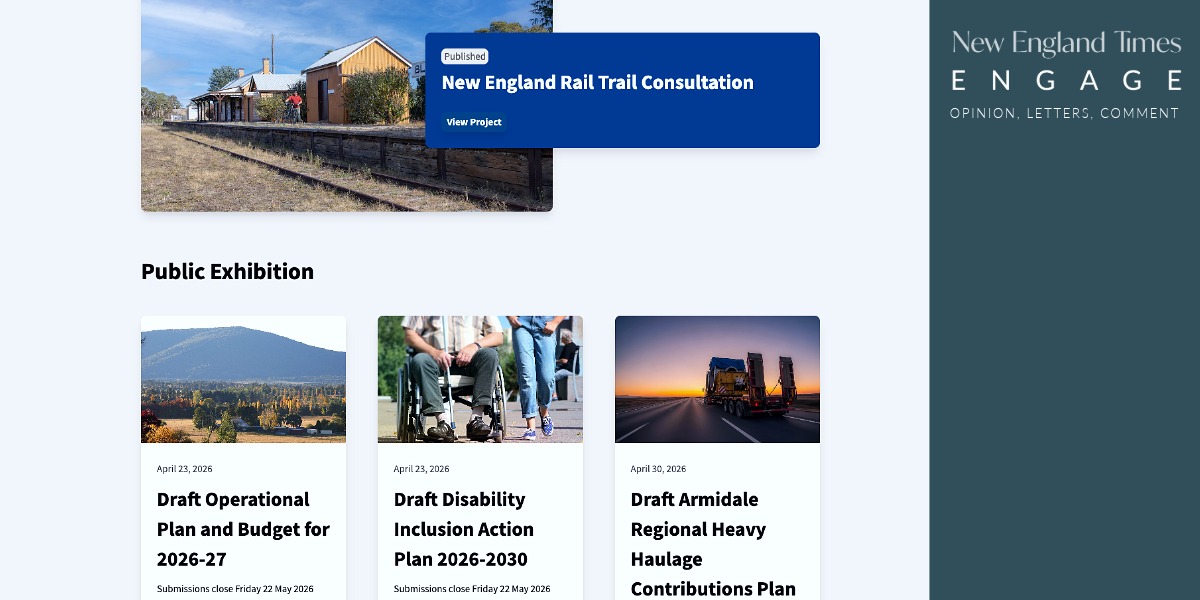
Three major Armidale Regional Council consultation processes are currently open for public submissions, including the proposed New England Rail Trail, the Draft Operational Plan and Budget 2026/27, and the Draft Disability Inclusion Action Plan.
Submissions on the proposed New England Rail Trail are open now and close on 1 June. Meanwhile, submissions on both the Draft Operational Plan and Budget 2026/27 and the Draft Disability Inclusion Action Plan close on 22 May.
Whether residents support or oppose the rail trail proposal, it is critical people actually participate in the consultation process. Too often, major decisions that will shape the future of the region are driven by a relatively small number of highly organised voices while much of the broader community stays silent.
The proposed rail trail development between Armidale and Ben Lomond has become one of the most divisive issues facing the region. This debate should never be framed as being “anti-bike” or “anti-recreation”. Most residents support walking and cycling infrastructure. The real issue is whether we should permanently remove strategic railway infrastructure when practical alternatives exist.
At a time when communities across the Armidale Regional Council area are struggling with deteriorating roads, water quality concerns, housing pressure, inadequate public transport, weed management, and economic uncertainty, council is proposing to commit approximately $2.6 million toward preliminary rail trail activities alone.
Residents should pay close attention to the allocation contained within the Draft Operational Plan and Budget under Regional Activation – Rail Trail, which includes a further $1.5 million for completion of rail trail preliminary works.
This follows the October 2025 council decision to allocate:
• $500,000 from council funds
• a further $600,000 from an undisclosed external source
to engage NSW Public Works to undertake preliminary works in preparation for an application to convert the rail corridor between Armidale and Ben Lomond into a bike and walking trail under the NSW Rail Trail Framework 2022.
Altogether, around $2.6 million has now been directed toward business cases, environmental studies, consultation processes, and other preliminary rail trail work. Federal and state grants for the project have all been lost.
That is a significant amount of ratepayers money for a non-essential recreational project.
Meanwhile, many residents continue to struggle with the condition of local roads, unreliable water infrastructure, inadequate public transport, poor air quality, and a lack of accessible infrastructure within the city itself.
This is where the rail trail debate intersects directly with the Draft Disability Inclusion Action Plan.
Council is proposing to spend millions on a recreational cycling trail outside town while many existing walking and cycling paths within Armidale remain poorly connected, inaccessible, or in need of repair.
For many residents living with disability, older residents, or those reliant on mobility scooters, accessible paths within town are not simply recreational infrastructure. They are essential infrastructure that allows people to safely access shops, services, medical appointments, workplaces, and community life.
Yet those practical access needs often appear secondary to large-scale recreational projects designed primarily to attract tourism.
If council is serious about inclusion and accessibility, then improving connected, accessible pathways within Armidale itself should arguably come before spending millions removing railway infrastructure for a tourism-focused recreational trail.
Armidale Regional Council already has multiple walking and cycling trails throughout the local government area. Existing trails could be upgraded and expanded without dismantling railway infrastructure. Standalone recreational trails could also be developed to destinations such as the Dumaresq Picnic Area, while the Blue Hole trail proposal deserves genuine support and investment.
If the objective is recreation, there are numerous ways to achieve it without destroying an existing rail corridor.
Supporters of the rail trail continue to claim the project will attract thousands of visitors and deliver enormous economic benefits. But residents are entitled to ask a reasonable question: if New England already possesses multiple bike and walking trails, where are these visitors now?
There are also legitimate concerns about economic modelling suggesting the proposed New England Rail Trail would generate almost double the annual benefits of the highly successful Tweed Shire Rail Trail. Those projections deserve close public scrutiny before millions more dollars are committed.
The railway corridor north of Armidale is not simply vacant land waiting to be repurposed. It is strategic transport infrastructure.
Once removed, it will almost certainly never return.
That matters because future freight, passenger rail, heritage tourism, and regional transport opportunities may all depend upon preserving the corridor.
The recent Federal Government decision to terminate Inland Rail at Parkes has fundamentally changed the national transport discussion. Governments are increasingly talking about improving and maximising existing rail infrastructure, not dismantling it.
Council should be advocating to the NSW and Federal Governments that this rail line is a valuable public asset capable of supporting future freight, passenger, tourism, and heritage rail opportunities.
The broader draft budget also raises questions about council priorities.
While the rail trail receives millions in preliminary funding and events such as the Big Chill Festival receive substantial support, many essential services and amenities continue to compete for comparatively limited funding.
Residents may reasonably ask whether council is placing too much emphasis on tourism, entertainment, and aspirational projects while core infrastructure and essential accessibility needs continue to fall behind.
Whatever residents think about the rail trail proposal, now is the time to say so. And even if you don’t care about the rail trail either way, now is the time to say what you want your Council to be focused on.
Because these consultation processes will shape not only how the region spends money, but what kind of region Armidale becomes in the future.
Dr Siri Gamage is a former academic at UNE, Former Vice president of Trains North, Executive Committee member, ARRA. He has been working on the New England Railway project for the past 5 years.
All opinion and comment on New England Times Engage is the opinion of the writer and not New England Times.
Got something on your mind? Go on then, engage. Submit your opinion piece, letter to the editor, or Quick Word now.