
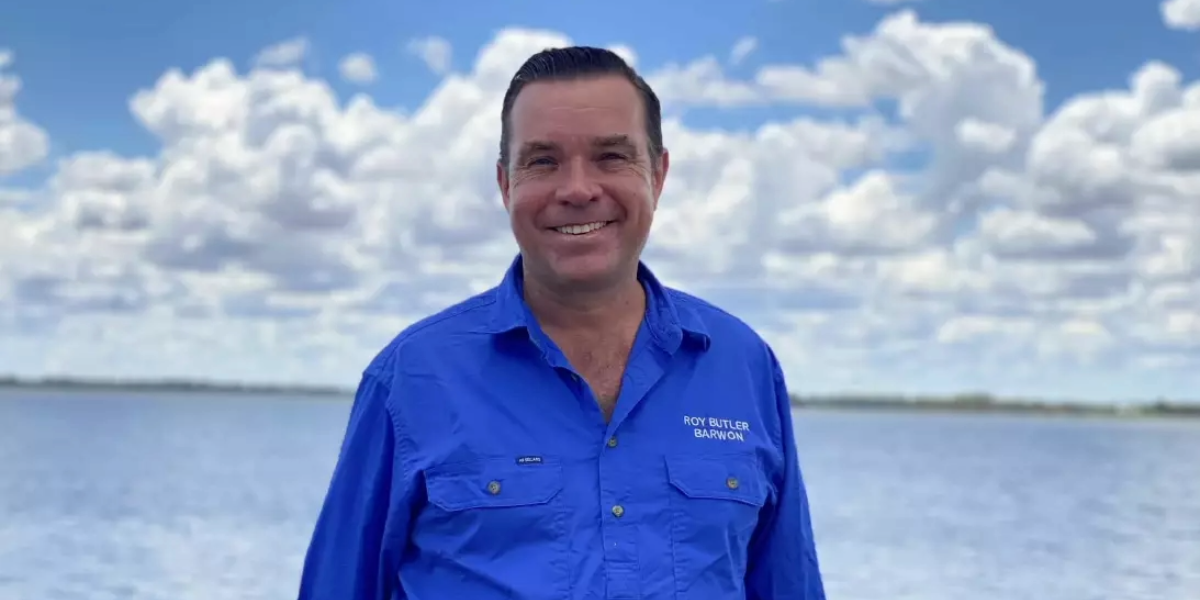
G’day folks,
Last weekend I was in the Grawin and then Coonamble for Anzac Day.
Anzac day at the Grawin is an extraordinary experience, held in a space known as The Sheepyard, the site of the local war memorial, which has plaques commemorating Grawin residents who served in wars since World War I, as well as featuring a pine tree that traces its origins back to Lone Pine in Gallipoli.
From the Grawin, I quickly headed to Coonamble, which was also a moving ceremony, well attended by a broad cross section of the community from children to well-aged community members. I want to thank the Coonamble CWA for the great food and drink they provided after the service. The turnout for the service and the hospitality they showed are a sign of the strength of this community.
From Coonamble I made my way the next day to Gilgandra for the Gilgandra Show. There was a huge crowd, and I got to take a spin on one of their racing lawnmowers. I’m not destined for Formula One racing but it was a lot of fun.
This week I am heading out across Barwon on a very special journey.
RFDS Torch Relay
Before I headed out to the Grawin, I spent much of last week preparing for something a bit out of the ordinary.
This week, from April 29 to May 1, I am making a 1300km journey, flying the flag, as it were, for the Royal Flying Doctor Service, carrying a torch – actually, a flare like the ones they use to guide their planes, but decorated with special indigenous artwork.
I will be making the trip riding on a motorbike that has been marked up to look like an RFDS aircraft, and travelling in convoy with a car that will be towing the fuselage of an RFDS aircraft, the kind used to educate the public about their aeromedical service. People will be able to have a look to see what it is like aboard an RFDS aircraft.
I will be stopping in several places across Barwon including Bourke, Cobar, Wilcannia and Broken Hill.
I hope to see you on the road showing your support for this great Australian institution.
To donate you can go to https://se.doyourthing.org.au/fundraisers/roysroadtrip/roy–s-road-trip
Wagga Wagga Trap Shooting Championships
Earlier in April I travelled to Wagga Wagga for the Australian Clay Target Association’s (ACTA) National Trap Shooting Championships.
This was a fantastic event held over several days in April at the ACTA’s impressive facility in Wagga Wagga. It attracted competitors from right across the country.
I was invited to say a few words at the opening ceremony and to present the award to the winning veteran shooting team, which was Victoria.
In my remarks I spoke briefly about how events like this are safe, fun and draw people of all ages to compete alongside each other, socialise and generally come together over their shared passion for the sport.
Some of the best experiences in my life, and some of the best people I have met, were at gun clubs, I said that I don’t want future generations to miss out on all of that, which is unfortunately a risk at the moment with the changes to firearms laws. We have been working hard to bring commonsense back into the discussion about firearms.
There were a lot of familiar faces at the championships, and a lot of people approached me with concerns and questions about the firearms laws.
I got to have a bit of a shoot on the practice range, thanks to some help from David White, President of the NSW Clay Target Association, and my good friend Anna Shedrina from Bronze Wing.
It was heartening to see so many good people enjoying their chosen sport. It is just unfortunate that these are the law-abiding people who will be most affected by the new firearms laws, and not the terrorists and criminals that the laws should target.
To keep up to date with the latest on the campaign go to https://www.roybutler.com.au/new_firearms_legislation_faqs
Lightning Ridge Bowls Tournament
From Wagga Wagga I made an eight hour journey across about two thirds of the state to be in Lightning Ridge for a bowls tournament.
Not just any bowls tournament, it was the inaugural 2026 SUPER 4s Tournament at the Lightning Ridge District Bowling Club, which carried the biggest first prize of any bowls tournament in the world. Out of a total prize pool of $130,000 teams were competing for a first prize of $80,000.
Money like that brought some talent from around the world, with players from as far away as Scotland and Bulgaria, along with world champions Jake McShane and Nathan Black (who hail from Team Merrylands) as well as Matthew Lucas (from the Helensvale Hawks).
On the day I was there the club was packed with competitors and spectators. I briefly joined the commentary team of Boyd “Happy” Dumbrell and Jayson Pinnock but, being no expert on the game, I left the actual commentary on the sport to them. They were streaming the event live to a global audience.
Congratulations to the winning team from Broadbeach and the runners up Musgrave Hill and congratulation also to the manager of the Lightning Ridge District Bowling Club, Scott Bailey for putting on such a world class event.
I wish Scott and the competition every future success and hope that it will continue for many years to come, as one of the many gems in Barwon’s sporting crown.
Some fascinating Barwon species
Some people used to think that there was very little living in the arid areas of the Far West of NSW, but that perception is changing, especially with recent news about species being studied out west.
Recently a newly recognised species of the endangered Kungaka Skink was confirmed as inhabiting the Broken Hill Complex Bioregion at Mutawintji National Park (MNP).
It is known to be one of the rarest reptiles in Australia.
Congratulations need to go to the Mutawintji Board of Management, which is made up of a majority of Aboriginal people, supported by the NSW National Parks and Wildlife Service and their stewardship of the area.
Subpopulations of the skink were identified in three sheltered rocky gorges within MNP, these are critical refuges that protect these skinks from predators.
A taxonomic study by the Australian Museum, published recently in Zootaxa, has now confirmed this population as a distinct new species. Named ‘Kungaka’ by the Wiimpatja, the Traditional Owners of Mutawintji National Park, this recognition is a major step forward for conservation.
Now formally recognised as its own species, the ‘Kungaka’ is eligible for independent conservation listing and is expected to be nominated as Critically Endangered under both NSW and Commonwealth legislation.
I have also heard that recently researchers from Latrobe University have been at the Imperial Lake Nature Park undertaking studies on the turtles that inhabit both lakes. The population is being recorded and follow up studies will probably occur yearly.
Three species of turtles have been recorded including the long-neck, short-neck and the broad- shelled turtle in significant numbers.
Fun fact: turtles contribute to freshwater health, since they are one of the most effective scavengers.
Imperial Lakes can only benefit from their presence and Mutawintji is certainly a richer place for its skinks.
If you are interested in conserving turtle populations check out https://1millionturtles.com/
To find out more about the Kungaka go to https://www.environment.nsw.gov.au/news/protecting-australias-rarest-reptile-extinction
Ross River Fever virus warning
The Far West Local Health District has confirmed that Ross River Virus has been detected in Central Darling Shire as part of ongoing mosquito monitoring.
Ross River Virus is spread through the bite of infected mosquitoes. Symptoms can last for several months, so preventing mosquito bites is the best protection.
I urge people in the communities of the Central Daring Shire to take extra precautions.
• Apply mosquito repellent
• Cover up exposed skin
• Take care when spending time outdoors, especially at dawn and dusk
Staying mosquito safe helps protect you and your community.
For more information on the disease go to https://www.cdc.gov.au/diseases/ross-river-virus-infection
Civics – The Title ‘Honourable’
You might often hear people refer to MPs as ‘the Honourable’, I have even had people refer to me as ‘the Honourable’, but, while it is nice that these people afford me such respect, I am not officially ‘the Honourable Roy Butler, MP.’
In NSW Parliament, not everybody has that title. While the members of Parliament are sometimes referred to as ‘Honourable Members’, by the speaker when he or she is talking to them during a sitting, the term “Honourable” is a specific title only for certain members of Parliament.
It is given to members of the “Executive council”, which comprises the Governor (although the Governor is also known as “Her/His Excellency”) the Premier and members of the cabinet – that is all those serving as Ministers (which is also an official title, although I have heard people call me a ‘Minister’, which I also am not).
It is also given to the Speaker of the Legislative Assembly, the President of the Legislative Council and all other members of the Legislative Council.
After they retire from Parliament, former Premiers, Ministers and Legislative Council members can use the ‘Honourable’ title. Federal Ministers and Prime Ministers retain the title ‘Honourable’ for life.
All other members of Parliament, are known only as Ms/Mrs/Mr and their name, or more formally their electorate as in “the Member for …..” But there are also rules governing how they must be addressed and how they must address others.
On the floor of Parliament members must refer to other members by the name of their electorate, and must always refer to the Speaker as “Mr/Ms/Madame Speaker”.
The titles may sound a bit pompous, but they are part of a long tradition of parliamentary democracy going back centuries. They help identify the roles that members of parliament play, and they introduce an element of respect and dignity, which can tend to deteriorate during Question Time, but which needs to be upheld to keep proceedings orderly.
Facts:
When a former parliamentarian who has gained the title ‘the Honourable’ acts dishonourably they can be formally stripped of the title. Legislative Council Member Eddie Obeid, who served in the Council from 1991 to 2011, and who was also a Minister for a time, was found guilty, along with other former Ministers Joe Tripodi and Tony Kelly, of misconduct and corruption while in a public office. In 2014 Obeid and Tripodi were stripped of their ‘Honourable’ title by the Governor, Sir David Martin, on a recommendation by Premier Mike Baird.
In England Parliamentarians who are part of the Privy Council, a formal body of advisors to the King or Queen, are known as ‘Right Honourable’, to distinguish the higher status of that office. The Council itself is referred to as “The Most Honourable”.
Got something on your mind? Go on then, engage. Submit your opinion piece, letter to the editor, or Quick Word now.