
Roy’s Roundup 23 November 2026
G’day folks,
The final, scheduled, sitting week of the year is over, things will probably go a bit quiet towards Christmas, but it won’t be long until people go into full election mode.
The final sitting weeks before an election year are a strange time. A dozen members of the Legislative Assembly have already announced they are not standing at the next election; most gave valedictory speeches and there was a general sense that change might be in the air.
The disruption to the normal run of business meant that I was unable to have my bills debated, one of which was returning the appeals for Firearms Registry decisions to the NSW Civil and Administrative Tribunal (NCAT).
The government itself was racing against time to pass some of its final pieces of legislation before parliament rose for the year.
With the growing influence of another party, many are predicting the next parliament will look very different.
Community Preschools
Recently the government recently revealed a new Universal Preschool Funding Model, which drew flak from community preschools, because it could potentially mean cuts to funding in some community preschools.
Barwon has quite a few community preschools, so it was important to talk to the government about their funding model and to see if there was some way of providing transitional funding to ensure that community preschools are not disadvantaged while the government refines its funding model.
I gave a Private Members Statement on November 10, talking about the importance of community preschools in my electorate, also about the potential negative impacts of the new funding model and asking for transitional funding. I also had discussions with the Education Minister Prue Car.
Fortunately, the government announced a few days later that there would be two years of transitional funding for community preschools affected by the new Universal Preschool Funding model.
Effectively that means that no affected preschool will receive less funding than it did in 2026, while the Government undertakes a review of the funding model and improves it.
This is a sensible outcome that protects services, supports families, and gives everyone time to fix the flaws.
I want to thank all the preschool leaders and educators who spoke up and shared their concerns. Your advocacy had a significant impact.
Country Mayors in Parliament
In the first November sitting week the Country Mayors Association of NSW held a leadership forum at NSW Parliament.
It was good to catch up with some mayors, councillors, General Managers and other council movers and shakers who had made the trip to Sydney for the meetings.
This was just an informal meeting during one of their morning tea breaks, not time enough to go into deep discussion of some of the issues affecting councils at the moment – that will come later at one-on-one meetings. This was more of a social chat over a cuppa.
One hot topic of discussion was the upcoming election and what that might hold in store for the State Government and for councils around NSW.
By all accounts the forum was great success.
Timber Industry Drop-In
During any given sitting week there will various different industrial groups holding events, where they showcase their products but also where they can sound parliamentarians out about the issues affecting their industry.
One of these in the November sitting weeks was a drop-in session held by representatives from the Timber, Furnishing and Textiles Union.
Fiercely proud of what they do and the major part they play in other industries, not least the housing industry, they showed me some samples of innovative Australian wood products, that are sustainable, ethically sourced and high quality.
But it was also the launch of their report “Part of the Puzzle: Timber’s critical role in securing more NSW homes”.
The report looks at the timber industry’s significant contributions to the economy, but specifically to housing supply.
It seems obvious that we need to be producing more timber to solve supply chain problems with building houses in NSW, which would lower costs and provide jobs.
We need to preserve what’s left of the timber industry and make a more concerted effort to grow it, or we could end up dependent on imports of foreign timber, which is not subject to the same stringent controls on sustainable sources and quality as home-grown timber.
I would love to see a revival of the timber industry, especially across Barwon, and I will be doing all I can in parliament to make that happen.
To read the report go to https://tftunion.aflip.in/857b706538.html
Collarenebri students in Parliament
Of all the good things that happened in the November sitting weeks, one of the highlights had to be a visit by students from Collarenebri Central School.
If often say that one of my favourite parts of being a state member is when I get to meet with students who come to Parliament of NSW for education programmes and tours.
We met in the NSW Parliament Education centre, and we were fortunate to be joined by Mayor Jasen Ramien, and GM Andrew Brown from Walgett Shire Council, who were there for the Country Mayors Leadership Forum.
The students were naturally curious about what I do, and also about Jasen’s job, so we told them some of the things that working as a state member or country mayor entails. We also both talked about how we got into public service.
That led to a more general discussion about the things that can be done at all levels of government to serve your local community, as well as the wide variety of opportunities for community leadership.
The students were already well versed in community actions; they gave a presentation of some brainstorming they have been doing about solving some problems in their town including waste management.
It proved to be a unique opportunity for them to engage directly with the Mayor and GM and to see how they can take action at a local level and how they can implement some of their ideas.
It was an interesting chat. I want to thank the students for their attention and interest, and I thank them also for the gifts of a hat and fridge magnet (which I am wondering whether I can turn into belt buckle).
I wish all of the students at Collarenebri Central all the best and I look forward to seeing whether our chat and their visit to parliament has inspired them to go out and work for their community, or even to stand for public office sometime in the future.
Alternative Suspension Program
Children who are suspended from school often miss out on crucial learning, are often left to themselves and the suspension does little to set them on the right path. But an Alternative Suspension program being run by the Y (formerly the YMCA) is showing some great results, with students who take part returning to school less violent, more engaged and ready to continue with their education.
Instead of being left to their own devices during a suspension, students who are enrolled in the Y’s program are supervised, complete their schoolwork, participate in group behavioural sessions and speak with social workers to address wider issues in their lives. It is a much more sensible approach than simply taking them out of the classroom mix.
The program is running in Broken Hill, and I attended an event recently at Parliament to show my support for the program.
To find out more go to https://www.ymcansw.org.au/alternative-suspension/
Fixing Regional Water Infrastructure
Recently there were reports of a backlog of as much as $5 billion worth of projects needed to fix problems with regional water and sewage infrastructure.
During the sitting weeks I worked to draw attention to this problem. With a Question Without Notice and a Notice of Motion.
The question asked whether the government would conduct and urgent audit and “prioritise the most urgent works to avoid the increasing number of failures and avoid unexpected failure of water assets.”
To which the Premier responded that:
” We need to make sure it is safe and secure. He is right that the Audit Office has highlighted repairs worth $5 billion that need to be made across the regional water network to keep water security for regional communities. The member asks us to prioritise urgent repairs and the needs of regional towns and communities, and I give him that commitment. We have already committed $230 million for Broken Hill water and wastewater services, $530 million for the Belmont desalination plant and $63 million for the modernisation of infrastructure at Leeton—just to name a few—but there will be more to come.” (To see video of the question and the answer go to https://www.roybutler.com.au/video_clips)
In my Notice of Motion I backed in the question by urging the government to ” to conduct an urgent, comprehensive audit of water and sewerage infrastructure across regional New South Wales; to prioritise funding for the necessary repairs and upgrades identified by the audit; and to establish and publish a clear timeframe for the completion of both the audit and the required infrastructure works.” (To see video of the Notice of Motion go to https://www.roybutler.com.au/video_clips).
It is something I will continue to work on up until the election, and beyond, if the electorate wants to elect me to continue for a third term.
IIRD Committee Report into Service Delivery Standards in Regional NSW
As chair of the NSW Parliament’s Investment, Industry, and Regional Development Committee, I had the honour of delivering the committee’s final report into Service Delivery Standards in Regional NSW in the last sitting week of the year.
The report looked into issues such as:
- current performance measurements, accountability mechanisms, monitoring metrics, and reporting frameworks for services in regional NSW outsourced to third-party providers
- differences in government service delivery standards between metropolitan and regional areas
- options to improve monitoring, evaluation and reporting of the delivery of government funded services in regional NSW, with reference to the social justice and community sector
- the need to reform and develop legislative frameworks to improve government service delivery standards in regional NSW
It found that communities outside major cities experience fragmented services and severe shortages across healthcare, transport, housing, and aged care. Programs considered universal across NSW are often unreliable or unavailable in regional areas.
It also found that the comparison of regional and metropolitan standards is hindered by inconsistent statewide data. The Committee recommended mandating region-specific data collection on metrics such as wait times, referral rates, and unmet service needs across both government and outsourced providers.
The Committee recommended that third-party service contracts be adjusted to reflect the actual higher costs of operating in regional NSW, including vast travel distances and workforce recruitment challenges.
To prevent duplication and improve accountability on the ground, the Committee recommended that the Department of Communities and Justice provide secretariat support and consistent record-keeping for regional interagency meetings, alongside funding for local providers and councils to attend.
To read the full report go to https://www.parliament.nsw.gov.au/parliamentary-business/committees/inquiry-details?committeeInquiryId=3153
Public Interest Debate on Firearms Laws
In the final sitting my colleague Phil Donato, the member for Orange, brought on a Public Interest Debate condemning the government’s ill-considered firearms laws.
It was the last opportunity to debate the reforms on the floor of Parliament before the election.
This time I focused my arguments on the government’s claim that less firearms owned by law-abiding firearms owners will mean less that are likely to fall into the hands of criminals and terrorists who will use them for nefarious purposes.
I dismantled that argument by pointing out that the government has zero evidence to back that up. There is no data on the correlation between the number of legal firearms owned and levels of crime involving stolen registered firearms. The only evidence there is suggests that if there are more licenced firearms owners with the legally registered firearms that the crime rate drops.
The number of firearms stolen every year is also miniscule compared to the number of illegal firearms out there in circulation, some people estimate the number to be in the hundreds of thousands. Criminals and terrorists don’t need to steal firearms to commit a crime, they have thousands they can access on the black market.
To see my contribution to the debate go to https://www.roybutler.com.au/video_clips
Second Term wrap-up
For my final Private Members Statement of the year, I looked back over the last four years at some of the achievements of my team and I.
One of the biggest achievements has been getting the electorate noticed again and not taken for granted by a major party.
The number of ministers visiting the electorate increased in my second term, with many finding it an eye-opening experience to see how things are in the bush.
Among our other achievements (too many to list in the Private Members Statement, which only goes for five minutes and too many to list here) were raising the electorate specific funding for Barwon to the record level of a billion dollars, securing $30 million for the Royal Flying Doctor Service to continue doing their vital work. There were road projects we helped get through, grants funding for arts, sports and vital infrastructure. We got the funding for Western Air Services in Cobar, Bourke, Walgett and Lightning Ridge extened, we secured $37.3 million for legacy lead remediation in Broken Hill and we introduced legislation to protect Police Memorials and to set standards for consultation on government projects in regional NSW.
There is still a lot more to do, particularly winding back the government’s firearms reforms, but I am determined to work for the good of Barwon if my constituents see fit to elect me for a third term in March next year.
To see the entire speech go to https://www.roybutler.com.au/video_clips
Civics: Proroguing Parliament – what happens in the lead-up to an election in NSW
Every parliament must come to an end, and we have just seen the last scheduled sitting weeks of the 58th NSW Parliament. We now enter a period where the government winds down and changes into election mode.
Since a referendum was held in 1995, NSW Parliament has had fixed four-year terms. Which means that the entire Legislative Assembly must be dissolved and every seat is contested at the election, while in the Legislative Council only 21 of the 42 seats are up for grabs.
After Parliament rises, that is the final sitting week ends, at the end of four years the Governor proclaims that both houses of parliament are prorogued (temporarily suspended) and the Legislative Assembly is dissolved (the Legislative Council is only half dissolved but since it is prorogued it cannot sit until the Government reconvenes Parliament).
This happens sometime in February. Once the proclamation has been made any bills, notices of motion and orders of the day lapse.
When parliament is prorogued writs are issued for an election to be held. Polling day is normally held on the fourth Saturday in March, but next year it will be held earlier to avoid a clash with the Easter holiday.
The government is then in a “caretaker period”, because although they are still the government they cannot make any new policies, initiatives, enter into major contracts or make decision on tenders, or make any legislative commitments that would lock a future government into a given course of action (although the government may still make election promises). The government is also unable to make any statutory, board or senior executive appointments until after the election.
All of the routine government business and government services continue as usual, but public servants stop providing advice to ministers during the caretake period.
If any urgent major decisions need to be made, as the result of an emergency, the government needs to consult the opposition.
Once the election is held and the results are confirmed, a government is formed, the cabinet and the business of government can continue again before the prorogation of parliament ends when the Governor sets a date summoning the new parliament to meet (usually in May after the election).
Quick Facts:
In medieval England the parliament was summoned by the monarch and typically only met for brief periods, dissolving it once the royal business was concluded (usually raising money for things like wars, works, or the functioning of the royal court).
Magna Carta established the principle that the needed to seek the “common counsel” of the kingdom for levying taxes, which led to more regular sessions of parliament.
In 1629 King Charles I dissolved parliament and it did not sit again until 1640, the longest an English monarch ruled without parliament. He finally broke that streak in 1640 when he convened parliament twice, the first was only brief, from April to May, but the second which first sat in November, ran for twenty years.
That was because parliament passed the Parliament Act of 1640 stipulating that it could only be dissolved by the members of that parliament. It was suspended in 1653, but still not technically dissolved until the it was temporarily allowed to sit again at the end of the Civil War in 1660 when it was finally formally dissolved.
The first NSW Parliament, which first met on May 22 in 1856, was allowed a maximum term of five years, however, political instability led to the parliament being dissolved in December 1857.
In practice none of the first seven NSW parliaments went the full five-year term. The closest was the fifth parliament, which sat for four years and nine months from January 1865 to November 1869 (the longest term in NSW history).
In 1874 the term was changed to a maximum of three years. In 1981 it was changed to a maximum of four years until a referendum in 1995 set the length at four years.
The Legislative Council’s members originally were nominated by the Governor and sat for life, never having to face an election. That changed to 12-year terms in 1934, with members of both houses voting to elect the councillors. In 1978 the council became elected by ordinary voters, with members sitting for three terms of the Legislative Assembly. But reforms in 1991 reduced the length of terms to two terms of the Assembly, with half of the seats coming up for election every four years.
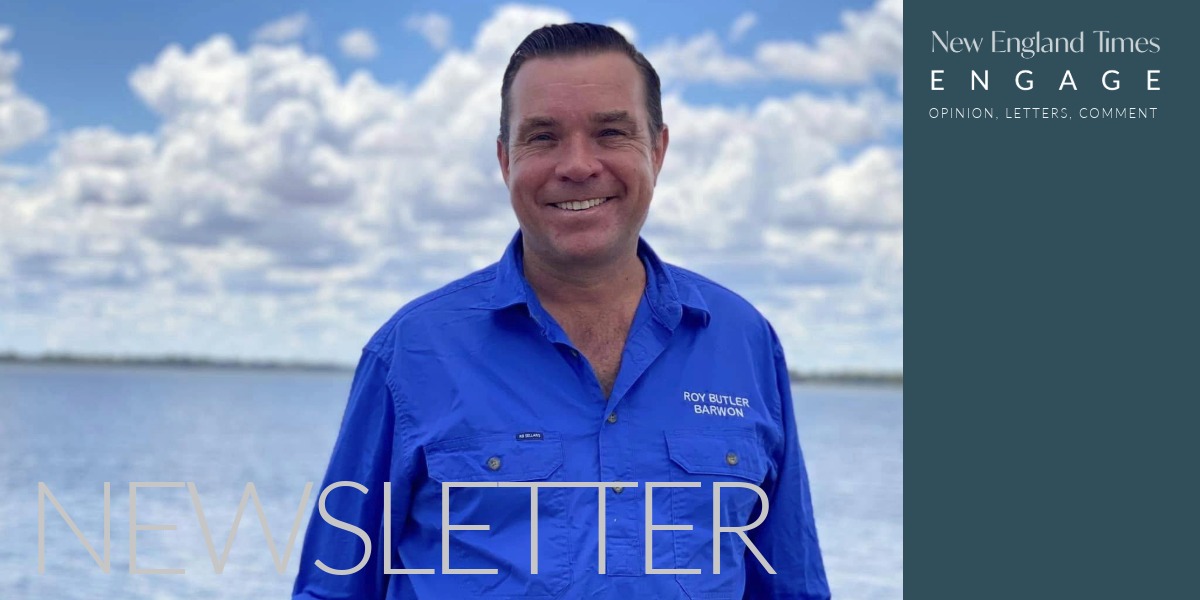
Roy Butler is the state MP for Barwon. This is his regular newsletter.
All opinion and comment on New England Times Engage is the opinion of the writer and not New England Times.
Got something on your mind? Go on then, engage. Submit your opinion piece, letter to the editor, or Quick Word now.