
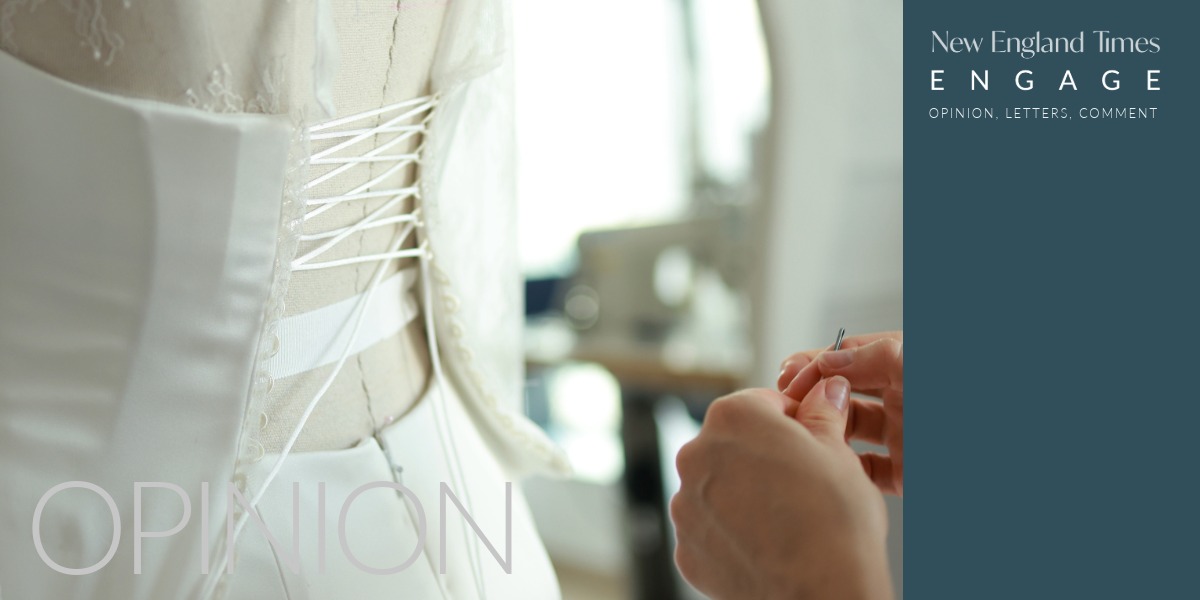
My daughter is getting married in November, so recently she took her wedding dress to a dressmaker for alterations. Now, my daughter being my daughter, didn’t simply hand over the dress, discuss hems and fittings and leave. She got talking.
She asked the dressmaker how she had ended up in the alterations business. The answer turned into one of those conversations that starts out being about one thing and leaves you thinking about something much bigger.
The woman, who is only 35, had studied fashion design at TAFE. Somewhere along the way she found herself doing clothing alterations and discovered there was not only good money to be made, but enormous demand for people with the skills to do the work.
She now employs three seamstresses and pays them very well. But here was the part that really caught my attention: she said she could employ another six tomorrow if she could find them. She can’t. The skills simply aren’t there.
The three seamstresses she employs are all in their 60s and 70s. They have skills that were once relatively commonplace: measuring, cutting, sewing, fitting, altering and understanding how fabric and garments actually work. Skills often passed from one generation to another, learnt at school, at TAFE, on the job or even around the kitchen table. But as that generation leaves the workforce, there aren’t enough younger people coming through behind them.
And when she said it, I realised I see evidence of this all the time. Hardly a week seems to go by without someone on Facebook asking, “Does anyone know someone who does alterations?” or “Can anyone recommend a good dressmaker?” We tend to scroll past these posts without giving them much thought, but perhaps they are telling us something. The people with these skills are becoming harder and harder to find.
We have somehow allowed extraordinarily useful and potentially lucrative occupations such as dressmaking, tailoring and alterations to become dying skills.
My daughter’s wedding dress alterations will cost about $1,200, and that figure itself tells part of the story. This is highly skilled, painstaking work. A wedding dress can be an extraordinarily complicated garment. Altering one properly requires precision, patience, experience and judgement. You are taking an expensive dress designed and constructed in a particular way and making it fit one individual person perfectly, without making it look as though it has been altered at all. And, heaven forbid, you certainly don’t want to make a mistake.
That expertise has value. And when there are plenty of customers wanting it and relatively few people capable of providing it, that skill quite rightly commands a good price. Isn’t that exactly what we keep telling young people we want for them, a skill that is in demand, valued and well paid?
Here is a 35-year-old woman running a successful business who says she could employ another six skilled workers immediately. Not at minimum wages, either. She pays her seamstresses very well because their skills are valuable and increasingly difficult to find. Yet somehow I doubt many careers advisers are sitting down with 16-year-olds and saying: “Have you thought about becoming a dressmaker, tailor or specialising in alterations?”
Perhaps they should be.
For decades we have sent young people a fairly narrow message about what success looks like. Finish school, go to university, get a degree and find a professional career. University is absolutely the right pathway for many young people, but it was never going to be the right pathway for everyone. And in elevating university as the gold standard, I wonder whether we inadvertently diminished the status of practical and vocational skills.
There is nothing second-rate about earning a good living from a skill that other people need and very few people can provide. Nor should a young person be discouraged from becoming a tailor or a dressmaker simply because these occupations don’t fit our fashionable idea of what a “career of the future” is supposed to look like.
That is why this little conversation in a dressmaking shop also made me think about TAFE and the way we plan for the workforce of the future. Governments rightly talk about skills shortages. We hear constantly about the need for more workers in construction, health, aged care and other essential industries. But perhaps we also need to look more closely at the smaller occupations quietly approaching a demographic cliff because so many of the people possessing those skills are nearing retirement. Who replaces them?
And there is another dimension to this that seems particularly relevant right now: artificial intelligence. We spend an enormous amount of time discussing the jobs AI might replace. There are predictions about what it will mean for accountants, lawyers, designers, journalists, teachers, programmers and countless other professions. Perhaps we should devote a little more attention to the jobs AI can’t do.
AI can generate a picture of a wedding dress in seconds. It can probably produce the pattern. It can write the advertising copy, design the website, organise the appointments and send the invoices. But it can’t stand behind a bride wearing that dress and see precisely where it doesn’t sit properly. It can’t feel how the fabric falls, pin it to her individual shape, carefully unpick intricate stitching, alter the garment and put it back together so beautifully that nobody looking at the finished dress would ever know what had been changed.
And it is not just wedding dresses. A skilled dressmaker, tailor or alterations specialist works with real people and real bodies, each one different, making judgements and adjustments that require dexterity, experience and an eye developed over years. For that, you need a human being with very particular skills in his or her head and in his or her hands.
There is something wonderfully ironic about the possibility that occupations some might regard as old-fashioned could turn out to be remarkably well suited to the economy of the future. Perhaps the safest career in the age of artificial intelligence isn’t necessarily learning how to compete with the machine. It might be learning to do something the machine cannot.
And perhaps we need to broaden the conversation we are having with young people accordingly. Not every 18-year-old needs to head to university. Not every career of the future will involve sitting behind a computer screen. There are practical skills, trades and crafts sitting right under our noses for which there is genuine demand, good money and, in some cases, employers crying out for people.
Dressmaking, tailoring and alterations are perfect examples of skills we have perhaps undervalued, stopped encouraging young people to pursue, or simply assumed would always be there. Yet when an employer can offer good, well-paid work to six people tomorrow and cannot find anyone with the skills to do it, surely that should tell us something.
My daughter went in to have her wedding dress altered. She will come out with a beautifully fitted dress and a $1,200 alteration bill that reflects the skill, time and expertise required to do the job properly. Meanwhile, the dressmaker would happily come out of the experience with six new employees — if only she could find them.
And I came away wondering whether, amid all our talk about preparing young people for the jobs of the future, we might have overlooked something rather obvious.
Some of those jobs have been here all along.

Denise McHugh is an experienced educator in Tamworth. She is Chair of the NSW ALP Education and Skills Committee and Deputy President of the Independent Education Union (IEU).
Got something on your mind? Go on then, engage. Submit your opinion piece, letter to the editor, or Quick Word now.