
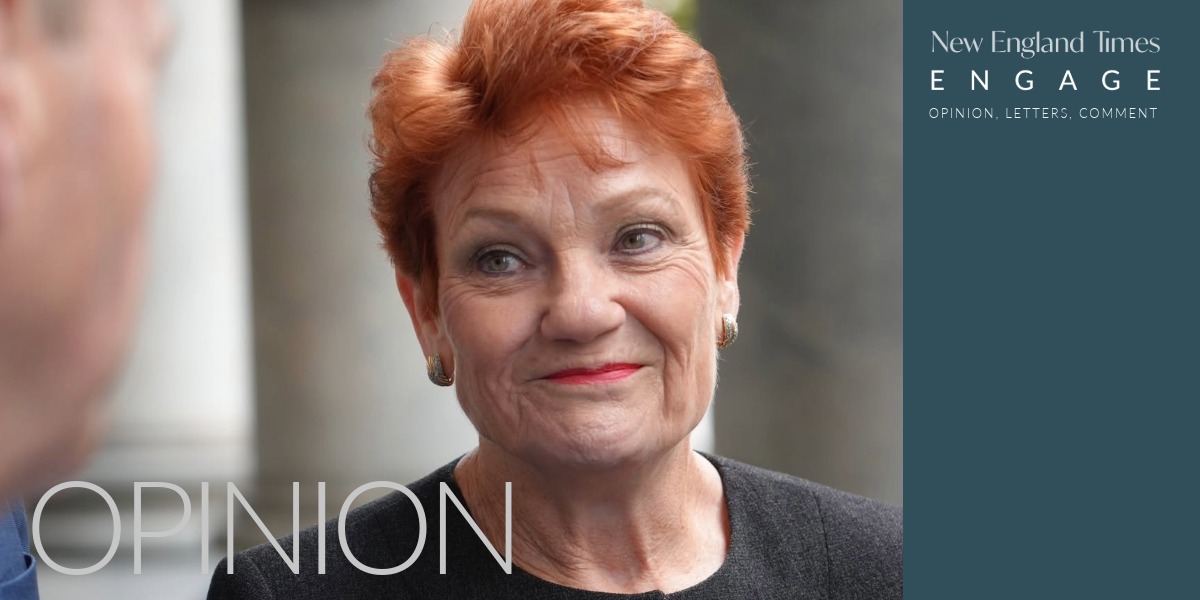
Pauline Hanson and I have more in common than you might think.
She is 72. I am 70. She is a woman who has been around politics for about 30 years. I have dabbled in politics for roughly the same amount of time. We both have strong opinions, neither of us is particularly inclined to keep them to ourselves, and it appears neither of us is remotely concerned about what people think of us. I suspect neither of us has mellowed greatly with age either. I would like to think I express myself a little more clearly, but Pauline may well disagree.
And Pauline likes to say she speaks her mind and tells it like it is. Well, so do I — if you didn’t already know.
So here is me telling it like it is. After watching Australian politics for most of my adult life, I regard the rise of One Nation as one of the most damaging developments in our political culture. There. I said it.
Not because Australians shouldn’t be angry. They have every right to be angry about housing, the cost of living, access to health care and pressure on services. My problem is what One Nation does with that anger. It takes complicated problems and finds somebody to blame. Migrants. International students. Indigenous Australians. The major parties. Economists. Experts. The media. The establishment. Somebody, somewhere, is always responsible for whatever is wrong with Australia.
It is grievance politics. It is outrage and whinging on steroids.
Underneath all that outrage there is often precious little serious policy. One Nation recently proposed slashing immigration by 750,000 over three years. Nationals leader Matt Canavan, hardly some left-wing apologist for high immigration, criticised the proposal for lacking proper costings and questioned the procession of different migration policies coming from One Nation. Immigration affects housing, universities, agriculture, regional communities, the workforce, tax revenue and economic growth. You cannot govern a country by announcing a big number and waiting for the applause.
Then there was One Nation’s proposal to allow eligible Australians struggling with rent or mortgages to divert some superannuation contributions into their wages. When Barnaby Joyce, One Nation’s treasury spokesman, was pressed by Sarah Ferguson on 7.30 about the economic modelling and consequences of the policy, he responded: “I’m the Treasury spokesman, not Jesus Christ.”
Well, nobody expected a miracle, Barnaby. Some modelling would have been nice.
That exchange sums up much of what bothers me about One Nation. Governing is hard. Outrage is easy. It is easy to tell people somebody has ripped them off or promise to tear something down. It is much harder to explain what you will put in its place, what it will cost, who will pay and what the consequences might be.
There is also a nastiness, a meanness, in One Nation’s politics that I find increasingly disturbing. A One Nation cartoon repeatedly described Andrew Hastie as a “traitor” over evidence he gave after being subpoenaed in the Ben Roberts-Smith defamation proceedings. Hanson refused to remove it even after the RSL and politicians from across the political spectrum objected. I disagree with Hastie on plenty politically, but what exactly was he supposed to do, ignore a subpoena or lie under oath? Calling a former SAS officer a traitor for fulfilling his legal obligation isn’t courageous plain speaking. It is an extraordinary way to treat someone who served his country.
Then we had Hanson’s description of Indigenous Australians as “the most primitive race on Earth”, followed, when criticism arrived, by a qualified apology to those offended by her terminology.
And this week we were reminded of her comments about Anthony Albanese’s late mother, Maryanne, who lived for decades in public housing while suffering severe rheumatoid arthritis. Hanson had described Albanese repeatedly referring to his public-housing upbringing as “pathetic” and questioned why his mother remained in the same housing commission home for so long. When those comments resurfaced, another qualified apology followed.
That is the sort of politics I find particularly ugly. People struggling in public housing don’t need lectures from politicians about how long they are entitled to need help. Indigenous Australians don’t need to be told they have “achieved nothing”. And someone who answers a subpoena and gives evidence under oath doesn’t deserve to be called a traitor.
This is where “telling it like it is” becomes a very convenient shield. Say something offensive, inflammatory or poorly informed and, when challenged, claim you are simply brave enough to say what everyone else is thinking. Criticism becomes proof of your courage. Expertise becomes elitism and ignorance somehow becomes authenticity.
I reject that completely. Ignorance is not a virtue. Knowing less than the experts does not make you more in touch with ordinary Australians. Refusing to listen does not make you strong. Turning a complicated national problem into a three-word slogan does not make you a political visionary.
There is hypocrisy too. One Nation demands accountability from everybody else but bristles when its own policies are scrutinised. It demands respect for its supporters while showing remarkably little respect for those it chooses to target. It complains about division while using anger and grievance as political fuel.
And then there is the anti-establishment routine. After three decades in politics, Pauline Hanson is not some political outsider banging on the doors of Canberra. She has been a federal MP, a senator and party leader, and is one of the most recognisable politicians in the country. At some point, surely, you lose the right to pretend you have nothing to do with the political establishment you have spent 30 years being part of.
Australia has real problems. Housing affordability and cost-of-living pressures are real. Australians are perfectly entitled to debate immigration levels. Governments should be challenged, bureaucracies questioned and politicians held accountable. But serious problems deserve serious answers, not another scapegoat, another cartoon or another group of Australians to blame.
That is ultimately what worries me about One Nation. Constantly telling Australians who they should be angry with doesn’t bring this country together. Cruelty doesn’t become acceptable because you call it plain speaking, and promoting suspicion of knowledge, evidence and expertise doesn’t make Australia stronger.
At 70, perhaps I have learned something from my own years dabbling around the edges of politics. I am more prepared than ever to say what I think, but I am also more aware that words matter. Political leaders can use words to explain, persuade and bring people together, or they can use them to frighten, blame and divide.
So yes, Pauline and I have a few things in common. Two women in our seventies. Thirty-odd years hanging around politics. Strong opinions. Neither particularly frightened of expressing them. Neither, apparently, losing much sleep over what other people think of us. And we both like telling it like it is.
So here is me telling it like it is.
Australia deserves better than politics built on anger, grievance and blame. We deserve leaders with serious policies and evidence to support them, and the courage to tell people that complicated problems don’t have easy answers. We deserve better than scapegoating migrants, sneering at experts, insulting Indigenous Australians and branding decorated soldiers traitors. We deserve leaders who make this country stronger by bringing Australians together, not politicians who build their support by finding someone else for us to fear, resent or blame.
And that is not One Nation.

Denise McHugh is an experienced educator in Tamworth. She is Chair of the NSW ALP Education and Skills Committee and Deputy President of the Independent Education Union (IEU).
All opinion and comment on New England Times Engage is the opinion of the writer and not New England Times.
Got something on your mind? Go on then, engage. Submit your opinion piece, letter to the editor, or Quick Word now.