
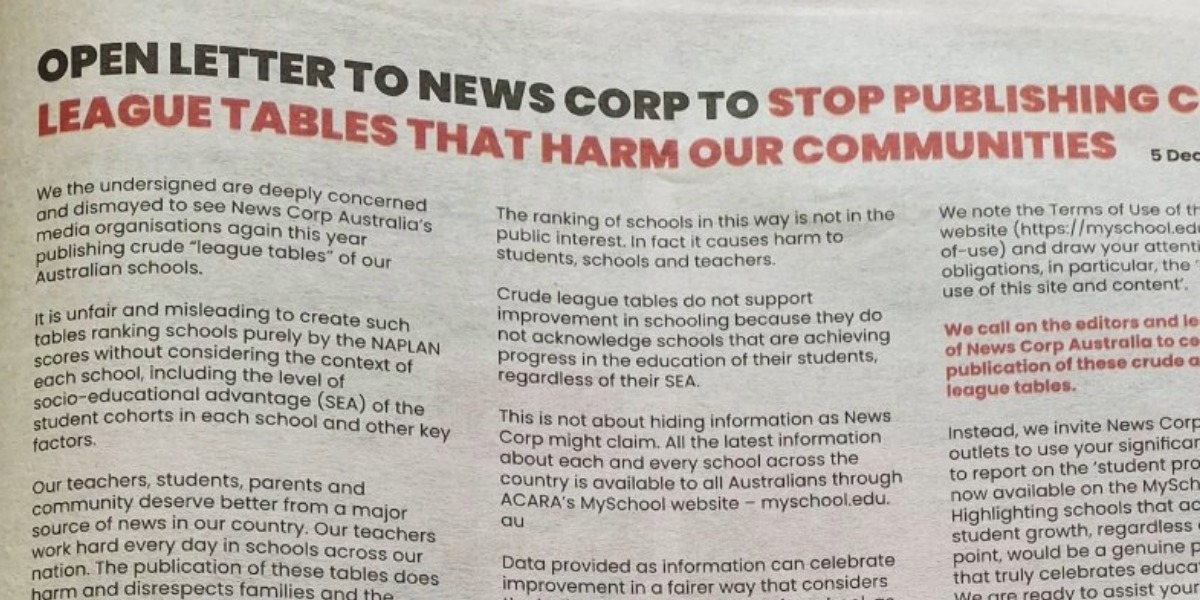
Last week, News Corp Australia republished its controversial school league tables, ranking schools by NAPLAN results. Almost immediately, 41 education leaders — including teacher unions, principals’ associations, and parent groups — signed an open letter calling the rankings “misleading, crude and harmful”. The renewed publication is a stark reminder that reducing schools and students to a single number has real consequences for equity, morale, and public trust.
One of Australia’s most respected education experts, Professor Pasi Sahlberg, has been clear about why these rankings are fundamentally flawed. NAPLAN was never designed to measure school quality, he argues — using it for league tables is “like measuring your body temperature with a teaspoon.” The tool is wrong, the method is wrong, and inevitably, the conclusions drawn are wrong.
League tables are often presented as objective measures of school quality, but they oversimplify complex realities. Raw test scores fail to account for the broader context of each school — the challenges students face, the support they receive, and the resources available to teachers. Schools in affluent areas almost inevitably top the rankings, while those serving disadvantaged communities fall behind, not because of poor teaching, but because of circumstances outside their control.
The human cost of this approach is real. Past tabloid coverage — such as front-page stories that “name and shame” students from disadvantaged communities like Mount Druitt based on their HSC or NAPLAN results — has left lasting scars on students, families, and school staff. These stories create stigma, reduce morale, and reinforce negative stereotypes about entire communities.
League tables ignore context
Raw test scores tell us little about the extraordinary work happening in classrooms every day. Socioeconomic background, community support, and student needs play a huge role in outcomes. Publishing crude league tables risks blaming schools for factors outside their control, rather than celebrating their achievements or providing meaningful support.
Narrowing education to tests
League tables create pressure to “teach to the test,” narrowing the curriculum and prioritising what is measured over what truly matters. Creativity, critical thinking, arts, physical education, and wellbeing programs — all vital to a holistic education — are sidelined. Students with diverse learning needs may be excluded or overlooked, while teachers are forced to focus on metrics rather than the children in their classrooms.
Stigma, competition, and demoralisation
Public rankings foster competition rather than collaboration. Schools may attempt to boost scores by “cream skimming” or discouraging students who are unlikely to perform well, while teachers and principals in lower-ranked schools face stigma and reduced morale. Instead of building strong, supportive communities, league tables drive wedges between schools, parents, and students.
What real accountability should look like
Instead of simplistic rankings, we need richer, contextualised information about schools. Data should include student progress over time, support for diverse learners, extracurricular opportunities, and community engagement. This would provide parents with a fuller picture while promoting collaboration rather than unhealthy competition.
More than a spreadsheet
Our schools are far more than numbers on a spreadsheet. League tables distort education’s purpose, deepen inequality, and misrepresent the dedication of teachers and school communities. When media outlets publish crude rankings, the human cost is clear: students and communities are stigmatised, teachers are demoralised, and the public-school sector is unfairly judged.
If we care about fairness, opportunity, and the wellbeing of every student, we must reject these crude rankings and demand meaningful measures that reflect what schools truly do. Australian education deserves better than league tables — and so do our children.

Denise McHugh is an experienced educator in Tamworth. She is Chair of the NSW ALP Education and Skills Committee and Deputy President of the Independent Education Union (IEU).
Got something on your mind? Go on then, engage. Submit your opinion piece, letter to the editor, or Quick Word now.
And yet you publish NE top ranking school as an article? NAPLAN was never meant to be used for promotion of schools. If you compare the top ranking NE school with equivalent socioeconomic background I am sure it comes out looking not so bright, only average. Dare you to be brave – publish and respond to my comment!