
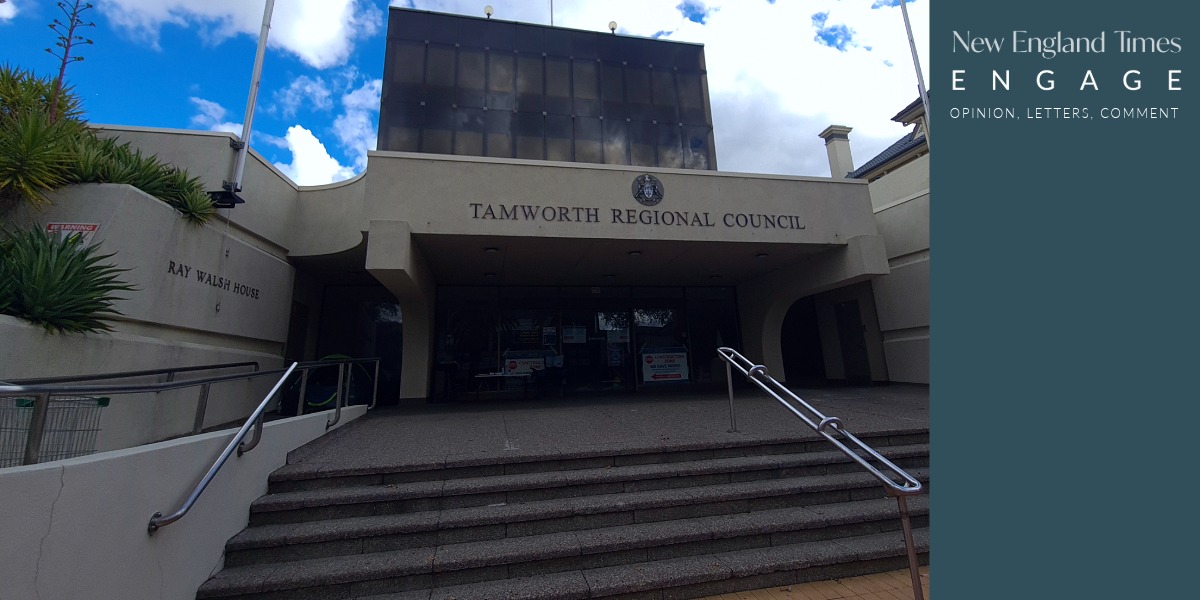
For decades, Ray Walsh House stood at the centre of civic life in Tamworth.
Opened by Queen Elizabeth II in 1977, the Peel Street building served as the headquarters of local government in the region for generations. Today, however, the building remains vacant as questions continue over its future, remediation costs, and long-term accommodation plans for Tamworth Regional Council (Council) staff.
What began as an asbestos-related workplace issue has gradually evolved into a much broader public discussion about transparency, public assets and the future direction of civic infrastructure in Tamworth.
According to publicly available Council information, Ray Walsh House was vacated in late 2021 after the failure of air-conditioning systems servicing several floors led to investigations into asbestos-related risks.
An internal all-staff email dated 8 December 2021 advised staff that environmental hygienists had detected no asbestos fibres on Levels 1 or 3 and that detection on Level 2 was confined to a fall zone directly under ventilation.
Council later stated that friable asbestos had been identified within vermiculite fire protection sprayed onto structural steel members in ceiling spaces and that the air-conditioning system could not be replaced without asbestos remediation works being undertaken first.
Attention intensified in 2024 following the release of remediation reports and asbestos documentation under freedom of information legislation.
One of the key documents was the EnviroScience Solutions “Asbestos Register and Management Plan”, which categorised asbestos-related materials under a five-level management system ranging from A1 (“Restrict Access & Remove”) to A5 (“No Action Required”).
Some public commentary has described Ray Walsh House as “asbestos riddled”. However, the publicly released asbestos documentation presents a more detailed picture, with most identified materials classified for monitoring or managed removal rather than immediate removal.
According to excerpts from the report, most identified materials within the building were categorised A3, A4 or A5. Only two identified A2 classifications related to ceiling-space vermiculite structural coating on the first and third floors.
The report also stated that asbestos-containing materials in good condition and left undisturbed posed minimal risk if left in situ, while materials likely to be disturbed during renovation or demolition should be removed under controlled conditions before works commenced.
Despite this, extensive internal stripping works were later carried out throughout the building, including removal of fittings, partitions, floor coverings and workspaces as part of remediation and demolition preparation works.
The extent of those works has since become a major focus of public debate.
Residents, councillors and community groups have questioned why extensive below-ceiling stripping occurred when much of the identified asbestos material appeared to be located in ceiling spaces and structural coatings. Questions have also been raised about whether targeted remediation of roof cavity asbestos was fully explored, how remediation costs compared with proposed long-term leasing arrangements for alternative accommodation, and how decisions regarding internal demolition works were ultimately reached.
Others point out that asbestos remediation in ageing public buildings can quickly become complex once workplace standards, air-conditioning replacement and future redevelopment plans are taken into account.
Council’s position regarding the building has also evolved over time.
In May 2024, Council resolved not to remediate Ray Walsh House for reoccupation by staff and instead investigate alternative accommodation options.
Debate over the building’s future nevertheless continued throughout 2024. In November, councillors unanimously supported a Notice of Motion moved by Cr Stephen Mears calling for review of all options for the building, including remediation, repurposing or possible future reoccupation “if and/or when it is safe to do so”.
The motion also called for additional community consultation and workshops involving industry professionals with expertise in remediation, building compliance and renovation.
At the same time, Council continued investigating long-term accommodation arrangements for staff, with public discussion later focusing on proposed leasing arrangements for the former Workers Club building.
Whatever decision is ultimately made, Ray Walsh House has become far more than a building issue. It is now a broader conversation about transparency, long-term planning and the future of public assets in Tamworth.

Robyn Lang is the Secretary of the Tamworth Regional Residents and Ratepayers Association Inc.
(TRRRA). She is actively involved in community advocacy and local issues across the Tamworth region, with a focus on community participation, clearer access to information, and helping local voices be heard on issues affecting the region.
All opinion and comment on New England Times Engage is the opinion of the writer and not New England Times.
Got something on your mind? Go on then, engage. Submit your opinion piece, letter to the editor, or Quick Word now.
The air conditioning does not require replacement. It was switched off by an employee.
The building was originally the office of the Peel Cunningham COUNTY COUNCIL — the Electrical Supply Co.
Yes, this has become a major concern, as it has highlighted what a lot of ratepayers discern to be mismanagement!