
G’day folks,
For most people the summer break is over, kids will soon all be back at school and the new year is well underway. We have had some hot days in recent weeks, but hopefully the worst of the heat is over.
We have also had a tragic start to the year, with the murder of three people and an unborn baby in Lake Cargelligo in January.
Though shocked, the local community is very tight knit and resilient, people came together to support each other through the ordeal.
At the time of writing this the alleged murderer was still on the run, but police are following every lead, and I am confident that he will soon be brought to justice.
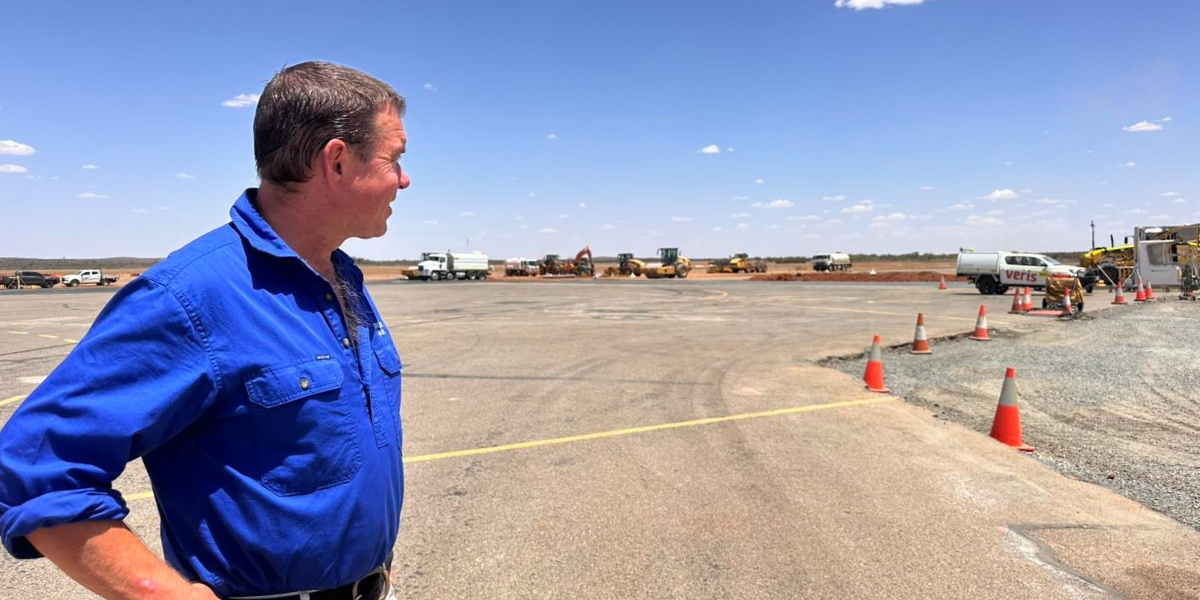
Over the last two weeks I have been travelling the electorate – visiting Narrabri, before heading out to Lake Cargelligo, and Broken Hill.
This week will be the first sitting week of the year, the first of two consecutive weeks. I will be continuing my efforts to try to wind back some of the legislation hastily passed before Christmas. I will keep you up to date with my progress.
Lake Cargelligo
The recent tragic events in Lake Cargelligo have rocked that community and raised many questions.
It is a difficult time for all those directly affected, especially given the investigation is still underway, and the alleged perpetrator has yet to be brought to justice.
At heart of this crime is the question of what more can be done with regards to domestic violence and how we can avert further tragedies. In recent years, significant investment has been directed toward strengthening support for victim-survivors of domestic, family, and sexual violence (DFSV) and expanding programs aimed at reducing violence against women and children. Yet, despite these efforts, events like this show that serious gaps remain.
It is crucial we continue to examine how current programs operate, where they make a difference and where they fall short. Only by clearly understanding this can we ensure that future investments are targeted effectively and drive meaningful, lasting change.
My heart goes out to the people of Lake Cargelligo, and anyone else affected by domestic violence.
Firearms legislation
As I said I am working with a team on doing something about the firearms legislation rammed through parliament in the days before Christmas last year. I am constantly being asked questions and my offices have been inundated with queries from constituents and firearms owners from inside and outside my electorate.
Things are still in motion, the regulations that will go with the legislation have yet to be determined and it will take time to find money in the budget and to set up the infrastructure for the compensated confiscation of firearms.
In the meantime, my team has compiled a list of frequently asked questions and answers that you can access on my website at roybutler.com.au/new_firearms_legislation_faqs
If you can’t find the answer, get in touch with one of my offices.
Assistance for Warren Residents
Recovering from a natural disaster can be difficult. The people of Warren are still getting over the storm that ripped through the area late last year. But assistance and support is now available for residents, primary producers and small business impacted by the Severe Weather Event that hit the Warren Shire on November 26, 2026.
This includes:
- Primary producers: Concessional loan up to $130,000 raa.nsw.gov.au/disaster-assistance/ndrl/producers | Transport subsidy up to $15,000 raa.nsw.gov.au/disaster-assistance/natural-disaster-transport-subsidy
- Small business: Concessional loan up to $130,000 raa.nsw.gov.au/disaster-assistance/ndrl/small-business
- Sporting and recreation clubs: Concessional loan up to $10,000 raa.nsw.gov.au/disaster-assistance/ndrl/sporting-and-recreation-clubs
- Not-for-profit/community organisation: Concessional loan up to $25,000 raa.nsw.gov.au/disaster-assistance/ndrl/natural-disaster-relief-loans-for-non-profit-organisations | Transport subsidy for donated fodder raa.nsw.gov.au/disaster-assistance/donated-fodder
For more details see: raa.nsw.gov.au/disaster-assistance/declarations
Big Shout
Alcoholism can be a real problem in country areas. This week saw the launch of “The Big Shout” a national appeal by grassroots bush charity Sober In the Country (SITC) to raise awareness of the issue.
SITC was founded by Narrabri local Shanna Whan AM, winner of the 2022 Australian of the Year Local Hero award. The Big Shout flips the classic Aussie tradition of shouting a mate a beer and turns it into a ‘virtual shout’ with real and serious impact.
The goal is to help this small organisation that’s created a massive national social impact expand their life-saving work supporting remote and isolated Australians who simply need a hand, and not another drink in their hand.
Shanna has supported countless people from this electorate in the past decade through SITC’s peer support network, and their extremely user-friendly message that when communities simply make it #OK2SAYNO (to booze) and cater for everyone, whether they’re drinkers, non-drinkers, or sometimes drinkers – lives are saved and changed.
Shan and her very small team have always been clear that the charity doesn’t preach prohibition. Instead, they show how mateship, respect, and personal choice can be powerful for those choosing to cut back or quit alcohol for health, mental health, or personal reasons.
Given how much this organisation has done for so many, I want everyone in Barwon to pitch in and show it some support. Let’s help them grow, spread and continue doing the work that’s already making such a profound difference.
For updates, head to soberinthecountry.org/the-big-shout/
Submissions needed for Service Review
One of the things I pushed hard for, as Chair of the Industry, Investment and Regional Development (IIRD) committee, was a review into service delivery standards of government services, including those outsourced by the government, provided to country areas. I am pleased to say that the review is now underway, but to make it successful it needs your input. Submissions are open until February 15.
The Committee will investigate issues such as:
- current performance measurements, accountability mechanisms, monitoring metrics, and reporting frameworks for services in regional NSW outsourced to third-party providers
- differences in government service delivery standards between metropolitan and regional areas
- options to improve monitoring, evaluation and reporting of the delivery of government funded services in regional NSW, with reference to the social justice and community sector
- the need to reform and develop legislative frameworks to improve government service delivery standards in regional NSW
To make a submission, which can be as simple as an email with a few lines about your own experience, go to parliament.nsw.gov.au
Broken Hill
Last week I visited Broken Hill, where I attended several events, including their Australia Day celebrations. I was at a dinner hosted by Broken Hill City Council at which the Australia Day Ambassador, journalist and TV personality Liz Deep-Jones, spoke.
Although the day means different things to different people, my hope is that it makes us think about how we can move towards our future united and striving to make this country a better place for everyone.
One of the best aspects of Australia Day is the chance to give recognition to people who have striven for excellence and done great things in their communities. Congratulations to all those who got a gong in the Australia Day honours list, but also a big congratulations to all those who earnt an award locally.
I was also privileged to be part of a special event, the burying of a time capsule, which has taken place every 25 years since 1975. It was fascinating to hear what was going on a quarter of a century ago as some of the letters in the time capsule were read out.
I hope to be around for the next time in 2050.
Save the Greyhound tracks
The future of greyhound racing in Barwon is under threat. Recently after my trip to Broken Hill, I went to South Australia to meet with the CEO of Greyhound Racing SA, Brenton Scott, to discuss their capacity to take on Broken Hill participants following GRNSW’s announcement that Broken Hill and the Coonamble track will cease operations in June.
There are several reasons why I don’t want Broken Hill participants to go to SA. There are economic benefits and social connections that come from greyhound racing that will be lost from Broken Hill, two aspects that are being overlooked in the decision to close the track.
While the meeting went well, and there is no doubt that SA have great facilities and the ability to take on the participants from Broken Hill, I will still push for a parliamentary inquiry in the context of track closures. I will also seek to amend the objectives of GRNSW and that GRNSW allow the Broken Hill and Coonamble tracks to produce an operating model that meets the requirements of GRNSW and will permit them to keep racing.
Civics – Taxes
Although a lot of people don’t like paying them, and many people also do as much as possible to minimise the amount they pay, taxes are a necessary part of running a state or country.
If you expect to be able to have medical services, roads, schools and be protected by the police and armed forces, then you must accept paying taxes.
At the heart of it all is the fact that humans tend to live together in societies so they can cooperate. Human society operates better for all concerned when it is well organised, with efficient, fair, non-oppressive systems of organisation. Standards of life improve, people have jobs, homes to live in and all the infrastructure necessary to live long and fruitful lives.
Social cooperation on a large scale over the last few millennia has given us steadily rising living standards. What brought us all together originally was that cooperation meant that no one individual had to do all the work, but labour and other tasks could be shared. People could also specialise and offer better skills and services to each other – some people were better at farming, some at building, some at healing – and specialist knowledge could also be shared.
What could also be shared was resources. Pooling resources made it possible to create things that benefitted more than one member of society, such as schools and hospitals. It is impossible for all individual citizens to educate themselves up to tertiary level, build roads, set up their own health system and construct villages, towns and cities. This needs collective effort and pooled resources.
One of the ways of getting people to pool their resources is to get them to pay taxes. While there are flaws to this system, and many would argue that taxes are often not equitably applied or distributed, it is better than some systems that operated in the past (see fun facts below).
The taxation system and the redistribution of taxes in our society is also controlled by democratically elected governments, so we have some say in what happens to the money collected. Governments lay out their distribution of taxpayer money in a yearly budget, which is presented to the public and published. The public judges the government on their ability to collect taxes and to use them well and has the power to vote them out if they don’t do well.
In Australia state and federal government have power over different areas of taxation. About 80 percent of taxes are levied by the federal government with income, good and services and company taxes making up the bulk of it, while states have things like stamp duty, land tax, payroll tax, and gambling and gaming tax.
The key thing about all of this is that governments are answerable to the electorate for what they do in terms of collecting and using taxes. It may not always seem fair or reasonable, but governments can expend a lot of political capital, that is lose voter support, if they get it wrong.
Facts: In medieval times feudal lords generally took a portion of whatever crops or livestock their subject citizens, or “serfs”, produced as a tax, but they could also demand the serf give over time to labour on whatever the lord wanted – building projects, planting and harvesting crops, looking after stock – in exchange for living in the lord’s realm and gaining protection from foreign invaders. Serfs also had to serve in a lord’s army if the lord demanded it.
Lords had to be careful about how much tax they extracted from their serfs because rebellions were often caused by too much tax being levied on people who found it hard to pay.
There were some famous instances of revolts by serfs or peasants against lords and even monarchs, including the 1381 Peasant Revolt in England during which King Richard II’s chancellor and treasurer were killed by a mob of peasants.
England’s King Charles I brought about the English Civil War when he tried to raise money through taxes levied without parliamentary consent. He lost the war and his lost his head as a result. When the monarchy was later restored the monarch’s power to raise taxes was further limited by the Parliament.
Roy Butler, Member for Barwon
All opinion and comment on New England Times Engage is the opinion of the writer and not New England Times.
Got something on your mind? Go on then, engage. Submit your opinion piece, letter to the editor, or Quick Word now.
There is at 28,000 preventable deaths in Australia each year. 35 of these are from firearm homicide. For recorded homicides with known gun status, only about 15 % of offenders held a firearms licence and only about 11 % of the firearms used were registered at the time of the crime. That’s about 5 deaths. If a legal gun was not available these lives would not necessarily be save as another method may be used. Gun numbers are up and gun crime is down but the only number we keep hearing from our leaders is the 4 million guns and this is somehow meant to be something to be scared of. Law abiding gun owners rightly have good reason to be aggrieved that their use of firearms is to be curtailed for no real outcome. But all tax payers need to ask why we are spending billions on saving less than five lives when there is 27,995 deaths that could be a better use of the money. We should be asking what crimes could police be stopping instead on doing extra paperwork and inspections of legal firearms owners. Do we think more gun and safe inspections by Zoom will make the difference. It is hard enough to get a doctor’s appointment and should Medicare and scarce doctors be used to do mental heath reports that will do nothing and probably have a negative effect by deterring gun owners seeking mental health support for fear of loosing their licence . It’s time that some real questions were answered. There is billions for guns but charities still need to rattle the tin to keep families and children fed in a cost of living crisis. Politicians are very quiet all we hear is 4 million guns.
Greg Mills you wouldn’t be surprised to know that the new NSW Police Glock 9mm is included in the new increased numbers
Majority of the population doesn’t really care about your plight over fire arms restrictions get over it.
The Greyhound racing days are also slowly dying out why try to keep something alive that is costing the tax payer money with little to no returns?
Sophia NA so you are against something that costs tax payers money with little to no returns and want to get rid of it? Well then you must be against the firearms registry then! It costs hundreds of millions of dollars a year to run and has not solved nor prevented one single crime. So are you going to start championing for it to be discontinued or are you going to be a hypocrite??
Brett Beesley lmao the fire arms registery provides an actual use and service.
Greyhound racing has provided animal cruelty and gambling both pretty bad things wouldn’t you agree.
Sophia NA what use does the firearms registry do regarding stopping criminals?
Brett Beesley knowing a fairly accurate list of fire arms so when a firearm is used in a crime the data base can be cross checked to identify it’s ownership.
You seem to have this misconception that every firearm incident is illegally acquired.
The register is also used to ensure compliance of fire arms legislation.
Which lets be honest your arguement here is that you don’t like being made sure you’re compliant with the rules because “you follow the rules and so does every law abiding gun owner I know”.
Stop acting as if this is some selfless arguement for everyone’s freedoms, it’s not your just disgruntled you chose an interest and hobby that has strict regulations and if you don’t like it well you can always find other things to do.
The only people who have a valid arguement in any respect about the legislation is people who actually need fire arms for their profession, ie farmers and professional hunters, anyone else is a hobbyist and quite frankly can just stfu and deal with it or find a new hobby.