
Over the decades I have been in a fair few farming paddocks, and many the time have I heard a farmer say to me, “I have the weediest farm in the area and they are hard to kill also.”
I would politely disclaim this thought and say, “I have seen much worse,” which I probably had.
The second part of the “hard to kill” maybe has more truth to it with our more recent revelations and research showing that pollen from a herbicide-resistant plant can travel some distance on the wind. My weed scientist colleagues in WA demonstrated that Resistant Annual Ryegrass (or ARG) genes in the pollen travelled three kilometres on the wind to pollinate a susceptible ARG plant, which then produced viable ryegrass seeds that were resistant to an ALS herbicide mode of action.
The only bit of good news is these susceptible plants produced fewer seeds as that separation distance increased.
Back to the bad news: unfortunately, pollinator insects like bees can also transfer pollen with resistance genes in it to susceptible same-species plants also. Generally, I have always said that bees have a roving radius from the mother hive of around 3 miles; however, as we have learnt from major bee deaths in an Ag area, when they are hungry and thirsty, it can be up to 5 miles.
Pollen grains come in various sizes too, so the heavier they are, the less distance winds may move it, plus pollen viability can be affected by air temps and humidity.
Regarding Barnyard grass, you will be pleased to know that, as it is a highly self-pollinating species, the level of resistance spread by pollen would be much lower than another local outcrossing species like Pigweed.
Oh, by the way, that dratted Feather Top Rhodes (or FTR) is both self-pollinating and cross-pollinating; however, it is predominantly self-pollinating, yet certainly pollen can be transmitted between FTR plants.
So resistance genes can travel a long way in pollen, so critiquing yourself or your neighbours for weed burden or resistance levels could have some credit. However, really it is best to focus on your weeds in your property area and don’t forget those stock routes or roadside table drains, where weeds may grow and seed very freely and prolifically.
In our Weedsmart Big 6 tips and tactics for combatting herbicide resistance, it is a key point to stop any weed setting seed.
I call all these weed control efforts Area Wide Management of Weeds, and don’t forget to bring your neighbours along gently too, for the Weed Free Area award that I will deliver one day.
That’s all folks.
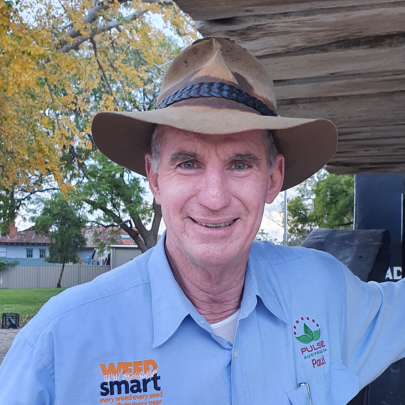
Paul McIntosh has been involved in providing broadacre agronomic support since 1977. Since 2015, Paul has held combined roles with Pulse Australia and Weedsmart, as an industry development and extension agronomist. His regular weeds column is published in a number of places including New England Times Engage.
Got something on your mind? Go on then, engage. Submit your opinion piece, letter to the editor, or Quick Word now.